
Livraison le jour même ou le lendemain

Qualité garantie

Débloquez vos offres de bienvenue: Livraison GRATUITE | Jusqu'à -80 % | 30 jours d'essai gratuits à JoyPlus
Téléchargez l'application
A flat battery can leave a car, van or motorbike stranded at the worst possible moment. A car battery booster lets you restart a 12 V engine without waiting for help from another vehicle. Depending on the model, it can also double as a car power bank, a portable tyre inflator or an emergency LED light.
Before you buy, though, it’s worth looking beyond the numbers printed on the box. An impressive peak current isn’t enough to guarantee compatibility with your vehicle. Here are the criteria to examine so you don’t end up with an ill-suited device.
Manufacturers often highlight a current value, for example 2,000 A, 4,500 A or 7,000 A. This is usually the peak current, delivered for a very short burst. The continuous starting current, the internal battery capacity in Wh or mAh, and the quality of the cables all affect real-world performance.
For a small petrol city car, a compact model may be perfectly adequate. An SUV, a van or a diesel engine often needs more headroom. Always check the maximum engine capacity stated for both petrol and diesel engines.
The phrase “all vehicles” can be misleading. Most of the boosters shown here work on 12 V systems, but their limits are not the same. Some are suitable for a petrol engine up to 5 l, while others accept a diesel up to 14 l. Electric vehicles are not covered by this conventional starting function.
On a hybrid vehicle, also check for the presence of a 12 V auxiliary battery and consult the compatibility information provided by the manufacturer.
A portable car starter shouldn’t be thrown in the boot and forgotten until the next mishap. A lithium battery that is too low on charge may not deliver the energy you need when the time comes. Most manufacturers recommend recharging the device every two to six months, even if it hasn’t been used.
Heat inside the cabin, moisture and damaged cables can also reduce the device’s reliability. A carry case and a dry spot in the boot are therefore far from unnecessary.
Start by noting your vehicle’s engine type and capacity. For a typical petrol car, a model rated between 1,500 A and 3,000 A can suit various uses. A large diesel engine or a van, on the other hand, requires more careful checking.
Owners of motorhomes, pick-ups and SUVs would do well to choose a model whose spec sheet clearly states the limit for diesel engines. A diesel and petrol battery starter should also have cables long enough and clamps that fit your battery terminals.
A car booster with a compressor can get you out of trouble after a slow pressure loss. A maximum pressure of 150 PSI doesn’t mean inflation will be instant, though: the air flow rate, tyre size and compressor temperature all come into play.
Models with a screen, PSI/BAR/kPa units, presets and automatic shut-off are more practical for everyday use. Always stick to the pressure recommended by the manufacturer and use a separate pressure gauge when you need an accurate reading.
Go for smart jump leads equipped with protection against reverse polarity, short circuits, overcharging and overheating. An audible or visual alert reduces the risk of a connection error, but doesn’t replace reading the manual.
An emergency car LED light, a USB port, a USB-C cable and a carry case can also prove particularly useful during a night-time breakdown or a long journey.
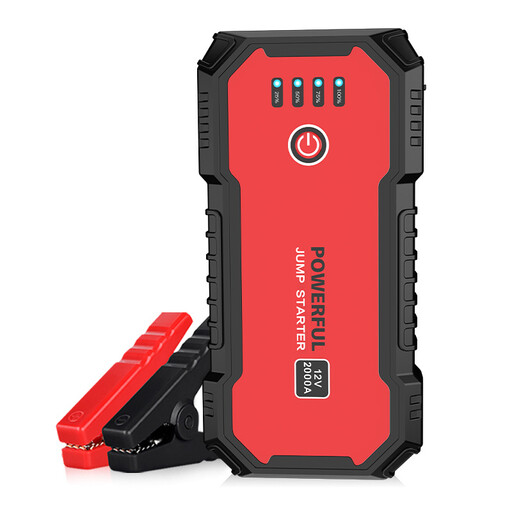
Why this choice suits this profile: At 430 g, this model is ideal for drivers looking for a simple solution for a car, van or motorbike running on 12 V.
The spec sheet clearly states 12 V petrol and diesel compatibility, rather than promising unlimited use.
Peak current of 1,500 A, 14,000 mAh battery, USB ports and three-mode lighting.
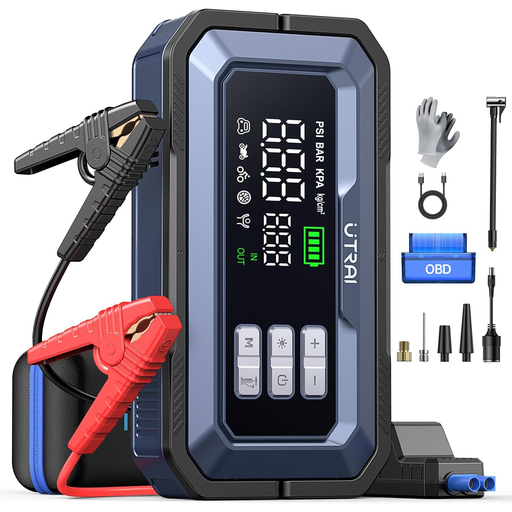
Why this choice suits this profile: This model combines starting, a compressor, a 12 V output, lighting and OBD2 diagnostics for long journeys and a wide variety of vehicles.
The usage limits are detailed: 12 V systems, diesel engines up to 14 l and compressor up to 150 PSI.
12 V output at 160 W, USB-C PD 18 W charging, LED screen and ten stated protections.
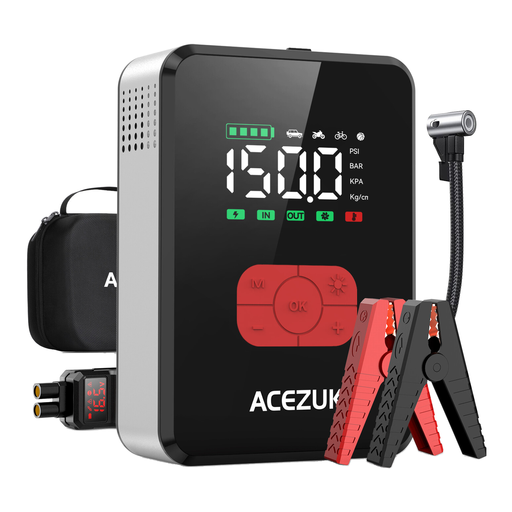
Why this choice suits this profile: Its built-in compressor and stated compatibility with diesel engines up to 12 l make it ideal for SUVs, vans and large vehicles.
The compressor screen, automatic shut-off and clamps with alerts reduce the risk of careless handling.
Stated peak current of 7,000 A, 26,800 mAh capacity, 150 PSI compressor and carry case.
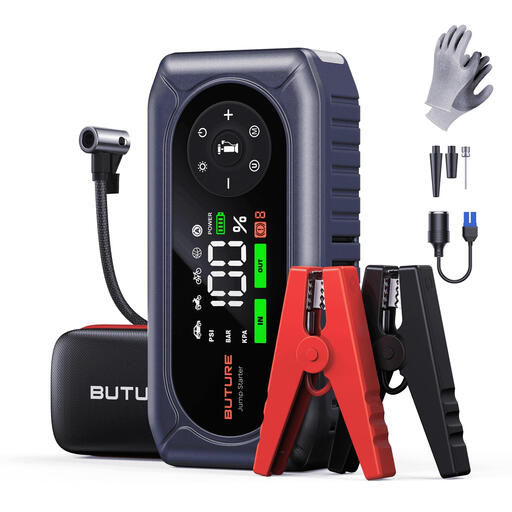
Why this choice suits this profile: This 5-in-1 model combines starting, inflation, lighting and USB charging for holiday departures and daily commutes alike.
The five inflation modes, automatic shut-off and pressure screen make the extra functions easier to use.
4,500 A stated, petrol up to 9 l, diesel up to 8 l, 150 PSI compressor and 500-lumen lighting.
We’ve put together a comprehensive list, updated in real time, of products that meet these demanding selection criteria and European safety standards.
To use the compressor, set the pressure recommended by the manufacturer, let the device cool down between cycles and do not exceed the stated running time.
The standby time depends on the technology used, the temperature and the self-discharge rate. To keep a reserve available, recharge the device every two to three months, or follow the manufacturer’s recommendations. Also avoid leaving it permanently in a car exposed to sunlight.
Yes, provided the model explicitly states its compatibility with diesel engines and the corresponding engine capacity. A 12 V battery booster designed for a small petrol car won’t necessarily be suitable for a large diesel engine. Also check the minimum charge level required before starting.
No. The booster delivers an electrical impulse to try to start the vehicle. A car battery charger gradually recharges the battery over several hours. These two devices therefore meet different needs: one-off breakdown assistance for the former, maintenance charging for the latter.