
Livraison le jour même ou le lendemain

Qualité garantie

Débloquez vos offres de bienvenue: Livraison GRATUITE | Jusqu'à -80 % | 30 jours d'essai gratuits à JoyPlus
Téléchargez l'application
A dead battery is arguably one of a driver's worst nightmares. Finding yourself stranded, late for a crucial appointment, or worse, stuck on the side of the road in the middle of the night... it's a scenario we'd all rather avoid. The portable car battery booster seems like a silver bullet, but be warned: the market is saturated with often misleading marketing promises.
Before you make a decision, it's crucial to understand the common pitfalls that cause many drivers to regret their purchase. Some devices, despite their enticing spec sheets, will let you down the moment you need them most.
To make an informed choice, focus on the technical specifications that truly make a difference in performance and safety.
Rather than being dazzled by peak amps, check the booster's compatibility with your engine's displacement (gasoline or diesel). A booster for a diesel engine requires significantly more power than a model designed for a small gasoline city car.
The reliability of a jump starter depends on its internal battery and safety features.
A good booster can also serve as a power bank to charge your smartphone and tablet via its USB ports. Some models go even further by integrating a booster with a compressor, a very practical 2-in-1 solution for topping up your tires without relying on a service station.
To guide you, here are a few models that meet specific needs, all evaluated against our performance and reliability criteria.
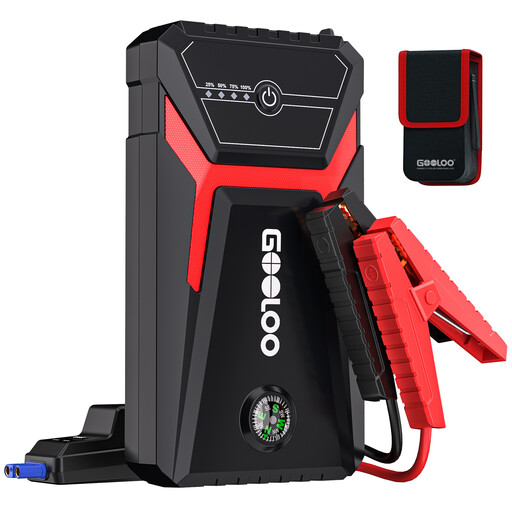
Why it stands out: The perfect backup solution for drivers of city cars, sedans, or small SUVs. It offers an excellent balance of power, safety, and price, without being cluttered with unnecessary features.
This model gets straight to the point: jump-starting. Its 1500 A power is more than enough for the majority of vehicles (up to 6.0L gasoline / 4.0L diesel), avoiding the trap of inflated and useless figures.
It integrates 10 safety protections through its smart clamps, making it ultra-simple and safe to use, even for a complete novice in mechanics.
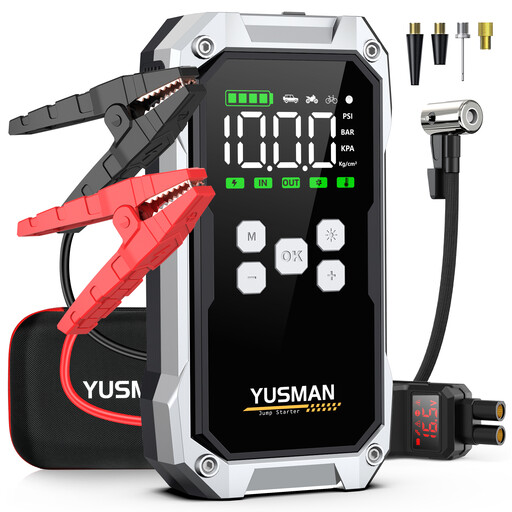
Why it stands out: Designed for owners of large vehicles (SUVs, 4x4s, diesel vans up to 10.0L) and outdoor enthusiasts. A true Swiss Army knife for the road, camping, or boat trips.
Here, versatility isn't a gimmick. The air compressor (150 PSI) is a genuinely useful feature that justifies its size. The high power is well-matched to large engines, making it a coherent choice.
It combines a powerful starter and an efficient compressor in a single unit, with a convenient LCD screen to read the pressure in real time. A smart 2-in-1 that frees up space in your trunk.

Why it stands out: For those who want a device they can forget in their car for months and have it work when needed, without worrying about maintenance or the weather.
It tackles the Achilles' heel of lithium boosters: self-discharge and thermal fragility. Its sodium-ion battery can hold a charge for years and operate in extreme conditions (-40°C to 80°C / -40°F to 176°F).
Sodium-ion battery technology. According to the manufacturer, a single charge can last 5 years on standby. Better yet, the battery can be 'revived' even after a complete discharge, unlike lithium.
Explore our full selection of boosters that meet our demanding specifications for performance and safety.
The required power depends on your vehicle's engine size and fuel type. For a standard gasoline car, a model with 1500 A peak is more than enough. For diesel engines or large displacements, opt for a model with at least 2000 A. In any case, rely on the manufacturer's recommendations, which specify compatible engine sizes.
It all depends on its technology. Conventional lithium-ion boosters do not handle extreme temperatures well. Leaving them in a car in the middle of summer (over 60°C / 140°F) or in deep cold (-20°C / -4°F) can damage their battery and shorten their lifespan. Sodium-ion models, designed for a much wider temperature range, are far more suitable for being left in a vehicle.
For a lithium-ion model, plan to recharge it every 2 to 3 months to compensate for self-discharge and ensure it's ready when you need it. Sodium-ion boosters, with their very low self-discharge, allow for much longer intervals between charges, sometimes several years according to manufacturer data.