
Livraison le jour même ou le lendemain

Qualité garantie

Débloquez vos offres de bienvenue: Livraison GRATUITE | Jusqu'à -80 % | 30 jours d'essai gratuits à JoyPlus
Téléchargez l'application
A dead battery. It's undoubtedly one of the most common and frustrating problems a driver can face. That dreaded silence when you turn the key, the dashboard lights flickering weakly... it's a scene we'd all rather avoid. While traditional jumper cables were long the only solution, they require a second vehicle to be present. Fortunately, today there's a much more self-sufficient and compact solution: the battery booster.
As a product expert for Joybuy, my mission is to help you navigate the jungle of available options. This buying guide is designed to give you clear selection criteria and introduce you to the most relevant models. The goal? To help you make an informed choice, free from unnecessary marketing jargon.
Before comparing models, let's review the essential criteria that define a good portable car jump starter.
Peak amperage, measured in amps (A), is the most critical factor. It determines whether the booster has enough 'juice' to start your engine.
Always check the compatibility stated by the manufacturer (e.g., "up to 6.0L petrol / 3.0L diesel") to ensure it matches your vehicle.
Almost all recent models use a lithium battery. This technology offers decisive advantages: they are lighter, more compact, and hold their charge much longer than older lead-acid batteries.
Many of these devices are true Swiss Army knives. They also function as a power bank to charge your portable devices (smartphones, tablets, etc.) via their USB ports. Some models go even further with 12V fast charging or dedicated outputs to power small equipment, like a portable air compressor.
A good jump starter must include a full suite of protections to prevent any damage to your car's electronics or the device itself. Check for the essential safety features:
An LED screen that clearly displays the charge level and the steps to follow is also a real bonus for simplicity and safety.
We have selected three products that cater to very different user profiles, from the casual driver to the owner of large vehicles.
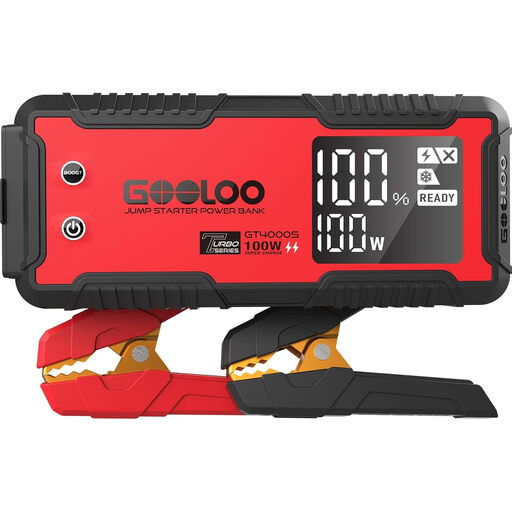
Its standout feature: Its 100W two-way fast charging. In practice, not only does it recharge to 100% in just over an hour, but it can also power up a laptop as fast as its wall charger, via its USB-C port.
Advantages:
Who is it for? Ideal for owners of large vehicles (SUVs, vans, motorhomes, boats) and professionals. It's also a smart choice for those who want an ultra-fast charging solution for their portable devices, especially laptops.
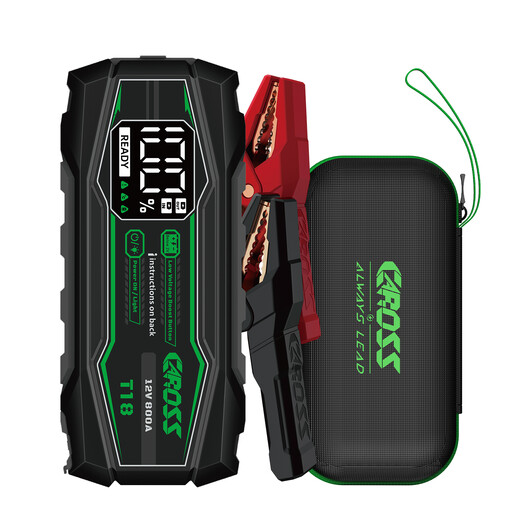
Its standout feature: This model focuses on simplicity and safety for everyday use. Its 'Boost' function allows you to force a start even on almost completely dead batteries, where other boosters would fail.
Advantages:
Who is it for? The everyday driver of a city car, sedan, small SUV, or motorcycle. It's the reliable and simple solution to keep in the glove box so you never have to fear a dead battery again.
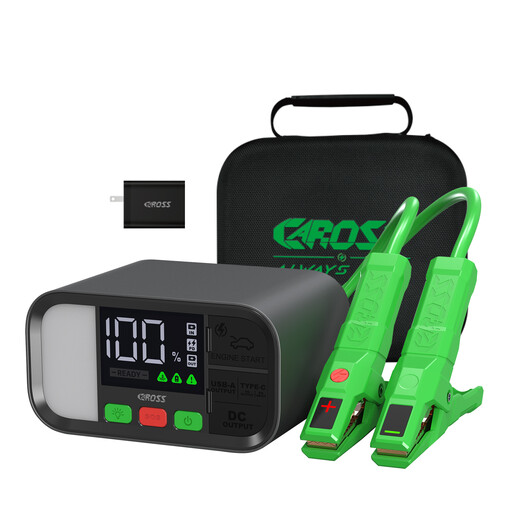
Its standout feature: Its Smart Connect technology and non-polarised clamps, a true innovation in safety. It's impossible to make a connection error: the system automatically detects the correct polarity.
Advantages:
Who is it for? Those who place safety and simplicity at the top of their priorities. It's also an excellent choice for tech enthusiasts who will appreciate its 65W PD fast charging and sleek design.
Our selection focuses on specific needs, but the market for portable jump starters is much broader. If these models don't quite meet your expectations, or if you want to explore other power levels and features, feel free to browse our full catalogue.
? Explore Our Full Range of Lithium-Ion Jump Starters
It all depends on your engine. For a standard petrol car, 800A to 1000A is sufficient. For a diesel engine, an SUV, or a commercial vehicle, it's safer to aim for a model with at least 1500A. The easiest way is to refer to the booster manufacturer's recommendations, which always state the maximum compatible engine sizes (in litres).
No, not if you choose a recent model. Modern boosters, like the ones in our selection, are packed with safety features (reverse polarity protection, short-circuit protection, overvoltage protection, etc.). These systems protect both your car's battery and its onboard electronics. By following the user manual, the risk is virtually zero.
No, it is not designed to be left connected. A lithium battery booster is an emergency device. Once its job is done, it should be disconnected and recharged. To preserve its lifespan, it's recommended to check its charge and top it up if necessary every 3 to 6 months. Store it in a temperate place (glove box, boot), ideally in its protective case.