What sets the machines apart?
If you make several coffees a day, start by thinking about how much effort you’re happy to put into each cup. Then check the drinks you want to make, the maintenance involved and the space available.
Bean grinder
Choose this if: you want to make coffee regularly from whole beans, with the extraction process automated.
Bear in mind: UFC-Que Choisir reports that these machines are noisier and bulkier than capsule machines. Maintenance varies by model.
Portafilter
Choose this if: you want to fill and tamp the coffee yourself for each drink.
Bear in mind: if you want to use freshly ground beans, check whether you have a grinder or whether one is built into the machine.
Soft pods
Choose this if: you want to keep using pre-portioned coffee but move away from rigid capsules.
Bear in mind: the drinks you can make and the pods you can use depend on the system. Check that it makes the style of espresso you’re looking for.
Capsules
Stick with these if: keeping preparation to a minimum matters more to you than switching to a different type of coffee.
Bear in mind: this option won’t help you move away from capsules. Check that the ones you use are compatible.
| Criteria | What to check | Your needs |
|---|
| Daily preparation |
Compare the automated preparation of a grinder with filling and tamping a portafilter, and with inserting a pre-portioned coffee product. |
Several espressos a day: I want to know exactly how much effort each cup will take. |
| Drinks |
Check the recipes available on the exact model, the type of coffee it makes and, for milk-based drinks, the accessories and steps involved. |
I also make milk-based drinks; a machine that only makes coffee wouldn’t suit my needs. |
| Maintenance |
Check the manual for instructions on descaling and cleaning the brew group or parts that come into contact with milk. De’Longhi says that how often you need to descale depends, among other things, on water hardness. |
Before switching machines, I want to make sure I can fit these tasks into my routine. |
| Noise and space |
Measure the space you have and check that you can access the water tank and parts that need cleaning. UFC-Que Choisir reports that a grinder is noisier and takes up more space than a capsule system. |
In a kitchen where space or noise is a concern, these factors can matter just as much as the preparation itself. |
| Coffee products |
Check which beans are suitable or the exact compatibility of capsules and pods. Also consider how to dispose of them after use. |
I want to move away from rigid capsules without accidentally switching to another pre-portioned system that won’t make the drinks I usually enjoy. |
A guide to the brands and their ranges
These examples illustrate different ways to make coffee. Check the features and maintenance requirements of each individual model.
De’Longhi
The brand offers both automatic grinders and manual portafilter machines.
- According to De’Longhi, its grinders make coffee from beans ground by the machine, while its manual models require you to fill and tamp the portafilter.
- For descaling, check the manual for your model: De’Longhi says the frequency depends on water hardness.
Philips
A brand to consider if you’re looking for an automatic grinder and want to know what maintenance the brew group requires.
- Philips provides rinsing and lubrication instructions for certain models covered in its documentation.
- Don’t assume these tasks or their frequency apply to every Philips model. Follow the manual for the machine you choose.
Nespresso
A popular choice for households that want to keep making coffee with capsules from the Original system.
- Original capsules, such as the Livanto product featured by Nespresso France, are designed for this system.
- Check which system your machine accepts, and remember that this option still involves using capsules.
Senseo
An option to consider if you prefer soft pods to rigid capsules.
- Senseo France offers classic pods, as well as formats designed for certain milk-based drinks.
- Check the cup size and recipe offered by the machine and pods: not every option in the range makes a short espresso.
Sage
A portafilter option for anyone who wants to be involved in making their coffee.
- Sage says the Bambino has a 54 mm portafilter that holds 18 g of coffee, as well as a steam wand.
- These details apply to this specific model. Check which accessories are included and what cleaning the version you’re considering requires.
Bean-to-cup machines available on Joybuy
These models are options to consider if you want to switch from capsules to a machine with a grinder. They don’t cover the other ways of making coffee discussed above.
 Image unavailable
Philips EP2230/10 Series 2200 LatteGo, espresso machine with grinder
Switch from capsules to beans with this espresso machine featuring a grinder. If you also make milk-based drinks, check which recipes and LatteGo components are included with this version, and how to clean them.
View on Joybuy
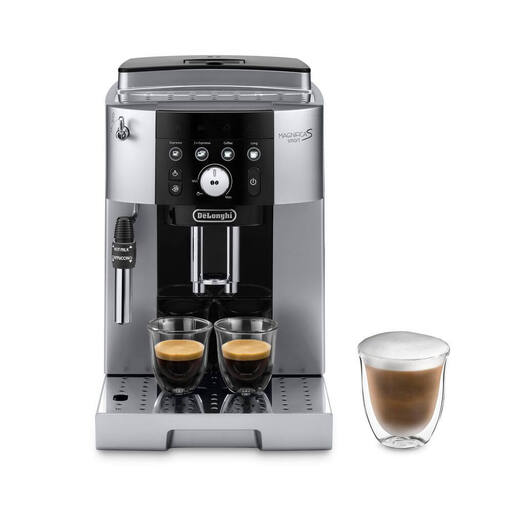 Image unavailable
De’Longhi Magnifica S Smart ECAM250.23.SB, espresso machine with grinder
An automatic grinder machine for making espresso from beans. If milk-based drinks are important to you, check how this specific version prepares milk and what maintenance it requires.
View on Joybuy
 Image unavailable
HiBREW H16, automatic espresso machine with grinder and milk system
This model combines a grinder with a choice of 6 advertised drinks, including cappuccino. Before choosing it for several coffees a day, check the manual for recipes, cleaning requirements and the space it needs.
View on Joybuy
 Image unavailable
De’Longhi Magnifica S ECAM22.140.B, espresso machine with grinder
Another automatic grinder machine for switching from capsules to beans. Before comparing it with other models, check the manual for the drinks it makes, the space it needs and the maintenance involved.
View on Joybuy
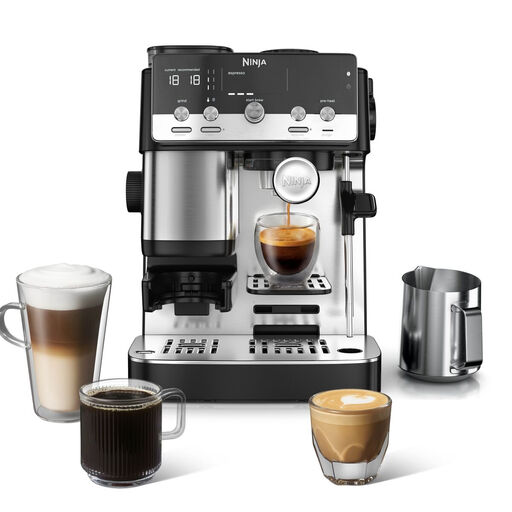 Image unavailable
Ninja Luxe Café Mini 2-in-1 ES301EU, espresso and filter coffee machine with grinder
This espresso and filter coffee combination may appeal to households looking to make different drinks from beans. If milk-based drinks are part of your usual routine, check how the frothing system works on the ES301EU version before choosing.
View on Joybuy
Frequently asked questions
How often should you descale an espresso machine with a grinder?
According to De’Longhi, how often you need to descale depends, among other things, on water hardness. Follow any alerts from your machine and the instructions in the manual for your exact model, rather than following a schedule intended for all grinder machines.
Does a grinder need maintenance other than descaling?
Yes, some models also need their brew group maintained. For the machines covered by its guidance, Philips describes tasks such as rinsing and lubricating the brew group. Check your model’s manual before following these instructions or their recommended frequency.
How should you recycle capsules in France?
ADEME says that aluminium and plastic coffee capsules can go in the recycling bin, bag or container for paper and packaging. Also check your local authority’s guidance for any local requirements.
What protection applies to a machine bought from a professional seller in France?
According to the French Ministry of the Economy, the statutory guarantee of conformity applies to new, second-hand and refurbished goods sold by a professional to a private individual in France. Keep your proof of purchase and the machine’s description in case it doesn’t match the advertised specifications.


