
Livraison le jour même ou le lendemain

Qualité garantie

Débloquez vos offres de bienvenue: Livraison GRATUITE | Jusqu'à -80 % | 30 jours d'essai gratuits à JoyPlus
Téléchargez l'application
As the sun returns, so does the desire to enjoy your garden, patio, or balcony. But prolonged exposure can quickly spoil the fun. The cantilever parasol stands out as the smartest and most elegant shade solution available today. Unlike a classic centre-pole parasol, its offset mast completely frees up the space under the canopy, making it ideal for sheltering a large garden lounge set or a dining table without the obstruction of a central base.
With so many models on the market, how do you navigate the options? This guide is here to help. We've broken down the essential criteria for a purchase that combines durability, design, and everyday comfort.
To make the right choice, focus on three key points: the frame, which ensures stability; the canopy, your shield against UV rays; and ease of use, for hassle-free comfort.
The sturdiness of your parasol depends on its mast, ribs, and base. An aluminium frame is an excellent choice for its light weight and natural resistance to corrosion—a significant advantage for outdoor furniture.
Stability is the name of the game, especially for a large tilting parasol. Ensure the model has a wind vent at the top of the canopy. This opening allows air to circulate, a detail that makes all the difference in reducing wind load and creating a more effective wind-resistant parasol. Finally, never overlook the weighting. A parasol with a cross base must be securely anchored with heavy slabs (concrete or fillable with water/sand). Their weight must be appropriate for the parasol's span.
The quality of the canopy determines both your protection and the parasol's lifespan. The fabric weight, expressed in grams per square metre (g/m?), is an excellent indicator of its density and strength. A fabric of at least 180 g/m? provides sufficient opacity and durability. Models with a 200 g/m? or heavier canopy guarantee much better longevity.
Opt for a water-repellent parasol canopy, treated so that raindrops bead on the surface without immediately soaking in. UV protection is just as crucial, not only for your skin but also to prevent the canopy from fading after one summer.
The great advantage of a cantilever parasol is its versatility. A model with 360° rotation allows you to follow the sun's path throughout the day without moving its heavy base. The tilt function is also a real plus for adjusting the shade when the sun is low on the horizon.
Most models include a crank handle for effortless opening and closing. These systems make operating your garden parasol child's play.
To help you make an informed decision, we've selected three models that stand out for their features and design.
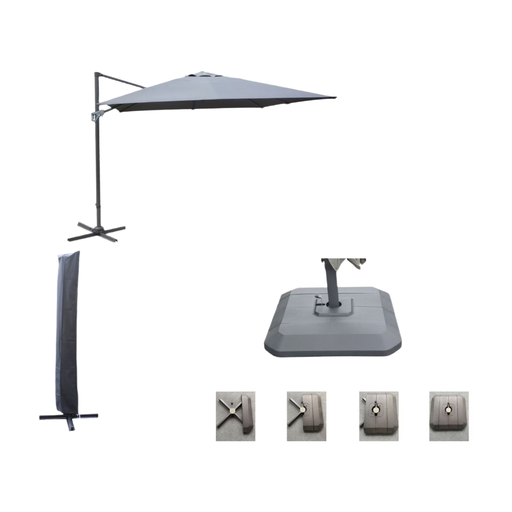
Key Feature: This is the ultimate "ready-to-use" package. No need to hunt for accessories: everything is included, from the fillable base to the protective cover. It guarantees perfect compatibility without any hassle.
The Pros:
Who is it for? For those who want a turnkey, sturdy, and easy-to-install solution. Perfect for a large patio or poolside, without having to worry about accessory compatibility.
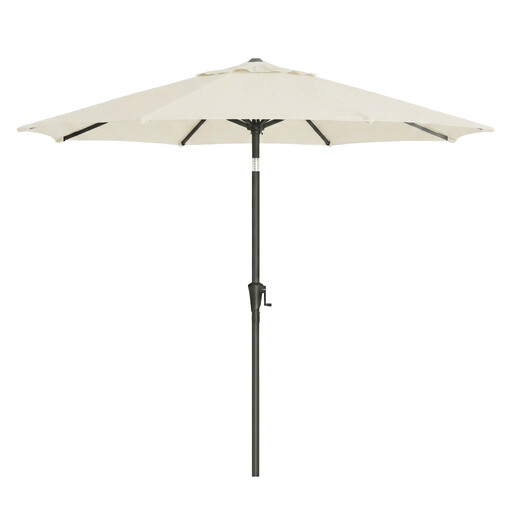
Key Feature: This is a return to the classic centre-pole parasol, but in an XXL version. With its 3.4 m diameter, it offers an impressive amount of shade. An excellent alternative to the cantilever model for certain setups.
The Pros:
Who is it for? For those who have a garden table with a central hole or who prefer the stability of a centre-pole parasol, especially on a balcony. Note that the base is not included, giving you the freedom to choose the weighting that suits your ground surface and budget.
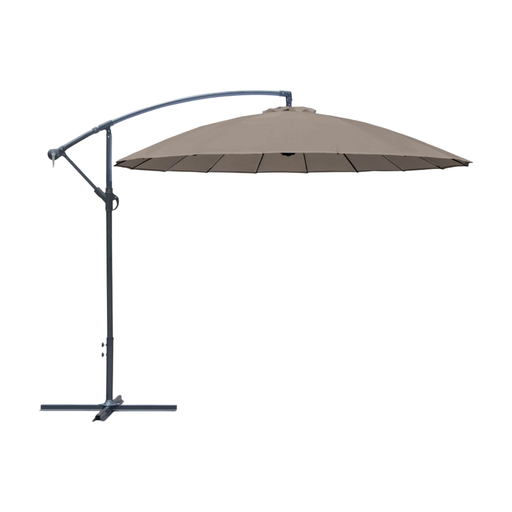
Key Feature: This Proloisirs parasol focuses on flexibility. It combines a rotating mast and a tilting canopy, but its standout feature is its 18 fibreglass ribs, which give it better flexibility in the wind.
The Pros:
Who is it for? For those looking for a high-performance cantilever parasol who want control over the choice of weighting, for instance, to match it with their patio flooring.
If these models don't check all your boxes, don't worry. Shape, size, colour... there are countless other options to create the shady oasis of your dreams. Feel free to explore a wider selection.
Weighting is the key to safety. Never underestimate it! By design, a cantilever parasol has a larger wind profile than a centre-pole model. Strictly adhere to the weight recommended by the manufacturer, which often ranges from 50 kg to over 80 kg for the largest models. Slabs that can be filled with water or sand are a smart solution: you can empty them at the end of the season for much easier winter storage.
Aim for a minimum fabric weight of 180 g/m?. Below that, the canopy will lack opacity and tear resistance. A UV treatment is essential, both for your skin and to prevent the canopy's colour from fading after a few weeks in the sun. A water-repellent canopy will protect you from a surprise light shower, but be aware that it is not waterproof and will not replace a proper shelter in heavy rain.
This is their weak point: cantilever parasols are vulnerable to wind. The wind vent (or chimney) at the top of the canopy helps to release pressure but doesn't work miracles. The golden rule is simple: always close it as soon as the wind picks up and when you are not using it. Keep in mind that damage caused by wind is almost always excluded from the warranty.