One- or two-person household looking to avoid leftovers
You add sweetcorn to a salad or serve it as a side, and want a tin you can easily finish once it’s open.


If you’re shopping for one or two people, start by thinking about how much you’ll use once the tin is open. Small tins are ideal if you only eat sweetcorn occasionally, while a larger one means planning several meals close together. To build up your cupboard stock, check how many tins are in the pack, make sure they’re in good condition and read the details for each product. Bonduelle advises transferring leftovers to an airtight container, refrigerating them and eating them within 24 hours.
You add sweetcorn to a salad or serve it as a side, and want a tin you can easily finish once it’s open.
You keep a few unopened tins for future meals and pay attention to dates as well as the condition of the tins.
You choose a specific product based on its ingredients and the claims that matter to you, rather than assuming the same features apply to an entire brand.
Start with how much you use at each meal, then decide how many unopened tins to keep in stock. Next, check the ingredients and production details for the product you’ve chosen.
| What to consider | What to check | Who is it for? |
|---|---|---|
| Amount once opened | Check the amount in each tin and the drained net weight, then choose a portion that suits your meals. | If I only use sweetcorn occasionally, I’d rather open a small tin than have to store leftovers. Around 33% of consumers prioritise this. |
| Stocking up and tin condition | Check the best-before date and storage instructions, and make sure each tin is intact. | If I want sweetcorn ready in the cupboard, I need to keep track of dates without overlooking the condition of the tins. Around 25% of consumers prioritise this. |
| Number of tins in the pack | Compare the number of tins and the amount in each with how often you use sweetcorn. | If I don’t make many meals with sweetcorn, I’d rather match the number of tins I keep in stock to how much I plan to use. Around 25% of consumers put this first. |
| Ingredients and claims | Read the ingredients and nutritional information. Check for an organic claim or any other statement on the specific product you’re considering. | If a particular claim influences my choice, I want to know exactly which product it applies to and what it means. Around 17% of consumers prioritise this. |
Once opened, a tin can no longer be stored like an unopened one in the cupboard. If you only eat sweetcorn occasionally, it can be tricky to use up the leftovers in your next meals.
Choose an amount you can finish, or plan another meal soon. Bonduelle advises transferring leftovers to an airtight container, refrigerating them and eating them within 24 hours.
A best-before date is different from a use-by date. The DGCCRF also warns that a tin that is bulging, rusty or misshapen may have deteriorated.
Rotate your stock and check each tin before use. If anything about its condition gives you cause for concern, don’t eat the contents.
“No added sugar”, “no added salt”, organic and a claim about pesticide residues don’t mean the same thing. A claim on one product doesn’t apply to the whole brand.
Decide which feature you’re looking for, then check the ingredients, nutritional information and exact wording on the product you choose.
Bonduelle offers a range of products, including organic options, varieties with no added sugar and a range labelled “no pesticide residues”.
Carrefour Classic' and Carrefour Bio ranges include several sizes of canned sweetcorn.
E.Leclerc offers Notre Jardin sweetcorn and Bio Village organic sweetcorn, among other products.
Auchan’s range includes its own-brand products and other brands in a variety of sizes.
Aldi offers crunchy sweetcorn and organic sweetcorn, among other products.
These products include small tins that you can open one at a time, as well as larger sizes to plan for across several meals. To compare the amount you’ll actually get, check the drained net weight on each pack.
 Image unavailable
You can open the two small tins separately if you only use a little sweetcorn at each meal. Check the drained net weight and storage instructions after opening on the packaging.
 Image unavailable
This 285 g tin is a good choice if you’re planning to use its contents across a few meals close together. The pesticide-residue claim appears in the product name. Check the wording on the packaging, and don’t confuse it with organic certification.
 Image unavailable
If you’re shopping for one or two people, plan how you’ll use this 400 g tin once it’s open. Check the drained net weight and how long leftovers can be kept on the packaging.
 Image unavailable
If you don’t eat sweetcorn often, you’ll need to plan several meals for this 570 g tin. Before choosing this size, check the drained net weight and storage instructions for after opening.
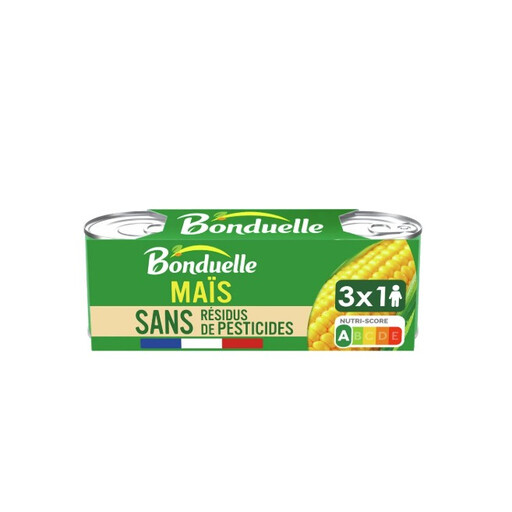 Image unavailable
If you want to keep several tins in the cupboard, check the packaging to confirm what the “1/4 x 3” variant means, how much each tin contains and what to do after opening. “No Residues” is a product claim, not organic certification.
Yes. As explained by the French Ministry of the Economy, a best-before date indicates how long a product will keep its quality; it isn’t a use-by date. However, check the condition of the tin: the DGCCRF warns that dents, rust or bulging may indicate that it has deteriorated. If in doubt, don’t eat the contents.
Follow the instructions on the product you’ve bought. For leftover tinned vegetables, Bonduelle advises transferring them to an airtight container, refrigerating them and eating them within 24 hours.
No. A Bonduelle product listed by Auchan is labelled “no added sugar” but also states that it contains naturally occurring sugars. Check the “of which sugars” line in the nutritional information for the product you’re interested in.
No. “Organic” refers to a certification, while Bonduelle defines its “no pesticide residues” claim for the range concerned as meaning that no chemical pesticide active substance was quantified at its stated threshold of 0.01 mg/kg. Check which claim actually appears on the tin you choose.