Parents looking to avoid added sugars
For a lunchbox, the ‘no added sugars’ claim answers a different question from the total amount of sugars. Compare the ingredients and the ‘of which sugars’ line too.


To avoid added sugar in the sweetcorn for a lunchbox, look for a product labelled ‘no added sugars’, and don’t confuse this with ‘sugar-free’ or ‘reduced sugar’. Then check the ‘of which sugars’ line, choose a pack size to suit the number of portions and plan how to store any leftovers after opening.
For a lunchbox, the ‘no added sugars’ claim answers a different question from the total amount of sugars. Compare the ingredients and the ‘of which sugars’ line too.
The number of tins, drained weight and amount used at each meal can help you choose a pack size without leaving awkward leftovers to deal with.
If you’re also looking for an organic label or a stated growing method, check for this separately from the sugar and salt information on the label.
Start by deciding whether avoiding added sugars is your priority. Then choose a quantity that suits your portions and any leftovers you’ll be able to store.
| Criterion | What to check | Who it matters to |
|---|---|---|
| Added sugars | The claim on the packaging, the ingredients and the ‘of which sugars’ line per 100 g. | I want to avoid added sugar without assuming this means there are no sugars at all; around 33% of consumers would put this criterion first. |
| Pack size | The number of tins and net drained weight, based on the portions you’re planning. | I’m preparing a lunchbox or several meals and would rather open an amount I can use; around 27% of consumers would make pack size their priority. |
| Ingredients and labels | The ingredients, salt per 100 g and the label you’re looking for on the specific product. | Salt or a particular label matters more to me than the sugar claim alone; around 20% of consumers would prioritise the ingredients or this specific criterion. |
| Storage | The condition of the tin and the storage temperature and time after opening. | I prepare meals in advance and need to be able to store leftovers according to the label; around 20% of consumers would make this a priority. |
Sweetcorn can contain naturally occurring sugars even when no sugar has been added. For example, an Auchan product listing for a Bonduelle product gives its sugar content as 5.1 g per 100 g.
Check the ingredients and the ‘of which sugars’ line. When comparing two products, use the same 100 g basis.
Any unused sweetcorn should be stored according to the instructions for that product. For one of its products, Bonduelle advises keeping it at a maximum of 4 °C and consuming it within 48 hours of opening.
Choose a pack size that suits the portions you’re planning, and read the tin’s instructions before preparing the lunchbox.
Organic status, no added sugars and salt content are separate pieces of information; an organic label is no substitute for checking the nutritional values.
Check the specific product for the claims that match your priorities, as well as the ingredients and drained weight.
The DGCCRF warns that a swollen, misshapen or rusty tin may indicate that the product has deteriorated.
Check the tin before opening it, and don’t eat the contents if you have any doubts.
The brand offers sweetcorn with no added sugars in several pack sizes, including one product with a drained weight of 420 g.
The Carrefour range includes sweetcorn with no added sugars, including 285 g tins and packs of 3 × 140 g, as well as an organic option.
E.Leclerc stocks Notre Jardin sweetcorn with no added sugars in 285 g tins, packs of 2 × 140 g and packs of 3 × 140 g, as well as a Bio Village product.
The Auchan range includes Bonduelle sweetcorn with no added sugars and a 230 g jar of Auchan Bio sweetcorn labelled with this claim.
ALDI France lists a 285 g BIO® organic sweetcorn product.
These two Joybuy products are baby corn, which is different from the sweetcorn kernels mentioned above. If you’d like to add it to a lunchbox salad, check the sugar claims and the drained quantity you’ll need on each pack.
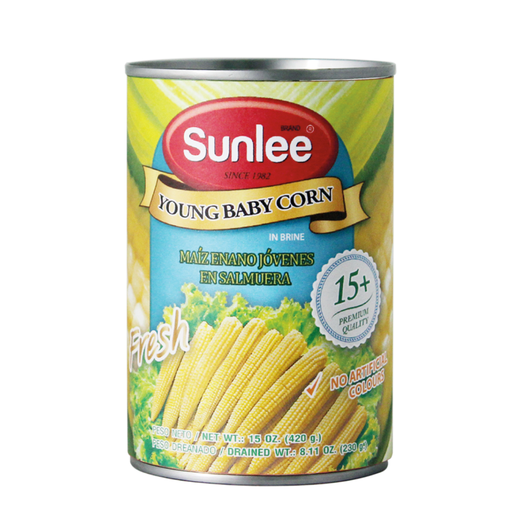 Image unavailable
If you’re making a lunchbox salad with baby corn rather than sweetcorn kernels, check how much you’ll need before opening this 420 g pack.
Check the drained weight, the ‘of which sugars’ line and the storage instructions after opening on the packaging for this product.
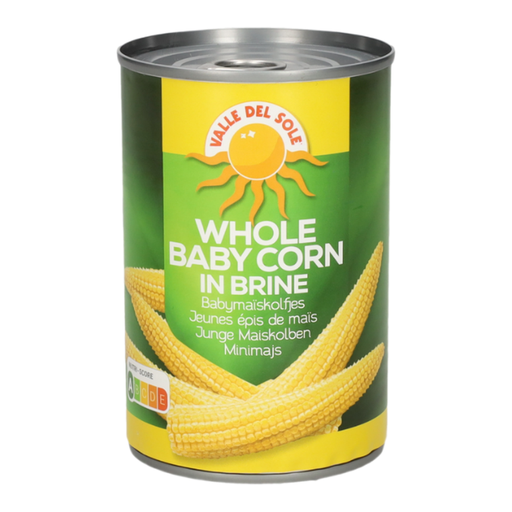 Image unavailable
This 400 g baby corn is another option to consider if you’re planning to use it in a lunchbox salad instead of sweetcorn kernels.
Check the drained weight for your portions, then look at the product’s sugar claims and storage instructions after opening.
Yes, it can contain sugars that occur naturally in sweetcorn. An Auchan listing for a Bonduelle product gives its sugar content as 5.1 g per 100 g, so check the ‘of which sugars’ value for the product you choose.
No. A product having no added sugars doesn’t, by itself, show that it has less sugar than another sweetcorn product. To compare two products, check their exact claims and nutritional values on the same 100 g basis.
Follow the storage time and temperature given for the product you’ve opened. For one of its tinned products, Bonduelle advises keeping it at a maximum of 4 °C and consuming it within 48 hours; don’t assume this guidance applies to every product.
No. Don’t use a tin that is swollen or rusty, or one that is misshapen and gives you cause for concern. The DGCCRF warns that this kind of damage may indicate that the product has deteriorated.