If you avoid added sugars
You’re looking for a recipe with no added sugar, without assuming that sweetcorn contains no sugar at all. The ‘of which sugars’ line lets you compare products on the same per-100 g basis.


For a comforting dinner, choose canned sweetcorn according to what matters most to you: no added sugars, no added salt or a size that suits your meal. The claim ‘no added sugars’ does not rule out naturally occurring sugars, nor does it prove that the total sugar content is lower. Compare the ingredients list and nutrition information per 100 g.
You’re looking for a recipe with no added sugar, without assuming that sweetcorn contains no sugar at all. The ‘of which sugars’ line lets you compare products on the same per-100 g basis.
For a hot side dish, your top priority is a recipe whose ingredients list contains only sweetcorn and water. Carrefour’s product page for Géant Vert Organic Sweetcorn lists these ingredients for the product in question.
For a pan-fried dish or gratin, you’ll want to check the stated texture and country-of-origin details for the specific product, rather than infer them from general wording on the packaging.
Start with the ingredients list and sugar content per 100 g, then compare products by their salt content, drained weight and the amount you plan to serve.
| What to consider | What to check | Who it’s for |
|---|---|---|
| Added sugars | Check the ingredients and the ‘of which sugars’ line per 100 g: Anses reminds consumers that ‘no added sugars’ does not mean sugar-free. | I want to avoid added sugar in the recipe, without confusing this with sweetcorn containing no sugars at all; around 50% of consumers would put this need first. |
| Added salt | If this is your priority, look for an ingredients list containing only sweetcorn and water, then check the salt value. | For my side dish, I’d prefer a recipe with no added salt; around 30% of consumers would have this as their priority. |
| Size and texture | Compare the drained net weight and storage instructions after opening; check the stated texture of the product you’re considering. | If I’m making a pan-fried dish or just a few portions, I want an appropriate amount and a texture that suits the dish; around 20% of consumers would make this their first choice. |
Naturally occurring sugars are still included in the total. For example, Bonduelle states that its ‘no added sugars’ product contains 5.1 g of sugars per 100 g.
Check the ingredients and the ‘of which sugars’ line on the label. To claim that a product has a reduced sugar content, you need an appropriate comparison; this claim alone isn’t enough.
Recipes vary: the Bonduelle and d’aucy product pages list salt, while Carrefour’s page for Géant Vert Organic Sweetcorn lists sweetcorn and water.
If added salt is a deciding factor, check the ingredients list for the exact product you’re buying.
The total weight includes the liquid. You could also be left with leftovers after opening if the amount of sweetcorn isn’t right for your meal.
Compare drained weights, choose a size that suits the portions you’re planning and follow the storage instructions on the packaging.
A no-added-sugars option in a 340 g tin, with 285 g drained weight.
The range covered here includes an organic sweetcorn option with no added salt and another product described as extra crunchy.
A crunchy, no-added-sugars option, which Auchan describes as grown and made in France.
Organic sweetcorn with no added sugars, available in a 2 × 140 g pack according to Auchan’s product page.
Two separate products described as ‘no added sugars’ in E.Leclerc’s listings.
These whole-kernel sweetcorn products could make a good side dish for dinner. Their names alone don’t establish that they have a reduced sugar content, so check the ingredients, values per 100 g and pack size of the product you’re interested in.
 Image unavailable
If you’re serving sweetcorn kernels as a side, you can compare this 285 g pack with the amount you’re planning for your meal. Check the label for sugars per 100 g, salt and storage instructions after opening.
 Image unavailable
The 2 × 140 g pack could suit you if you’re planning to divide the sweetcorn between two meals. To choose based on sugar or salt content, compare the information for this specific product rather than relying on details from another Bonduelle tin.
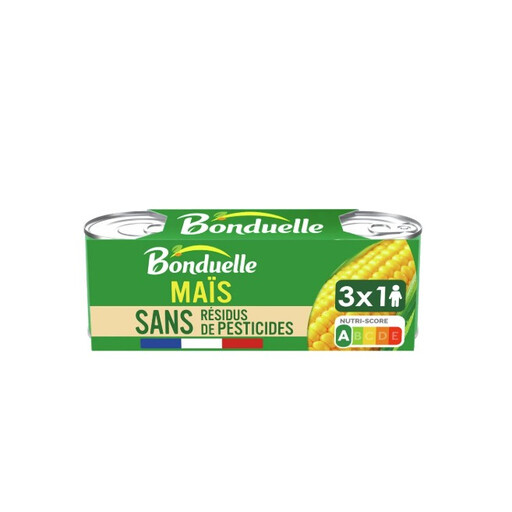 Image unavailable
This whole-kernel sweetcorn could make a good side dish. If the pack size matters for your meal, check the number of tins and the total quantity before choosing: the product title alone doesn’t tell you.
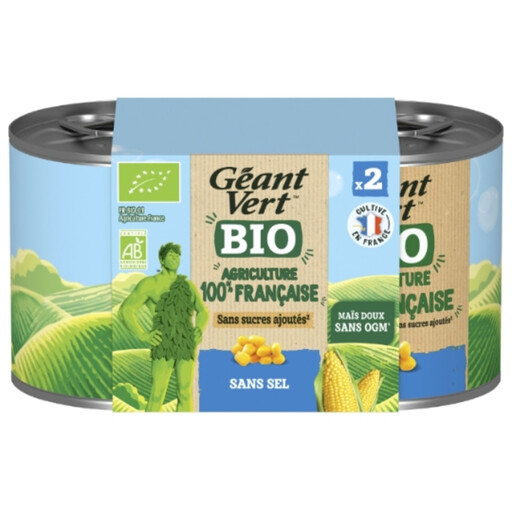 Image unavailable
If you’re looking for sweetcorn kernels for a dish, check the exact product details before adding it to your basket. The salt and pack information associated with this product don’t match, so check the ingredients, nutrition table and pack contents on the label.
No. As Anses points out, this claim doesn’t rule out sugars naturally present in sweetcorn. For example, Bonduelle states that its no-added-sugars product contains 5.1 g of sugars per 100 g.
No, not on this basis alone: ‘no added sugars’ describes the recipe, while a reduced sugar content requires an appropriate comparison. To compare two tins, check the ‘of which sugars’ line on each, using the same per-100 g basis, without turning that comparison into a product claim.
Follow the instructions on the tin you’ve bought. The Bonduelle and Auchan product pages for the products in question advise refrigerating the contents and using them within two days of opening. Auchan also says to transfer the contents to a suitable airtight container.
No. These claims relate to different characteristics. If a product is described as having ‘no pesticide residues’, check its ingredients list and nutrition information separately if sugar or salt is important to your choice.