Bulk buyers keeping an eye on sugars
You want to check the declared sugar content without confusing “no added sugars” with lower total sugars.


When buying canned sweetcorn in multipacks, start by choosing according to what matters to you: “no added sugars” does not mean “sugar-free” or “reduced sugar”. Compare the “of which sugars” figure per 100 g, then choose a pack size you can use within the stated time after opening each tin.
You want to check the declared sugar content without confusing “no added sugars” with lower total sugars.
You’re choosing between several small tins and a larger size for salads or hot dishes. How much you’ll use after opening matters just as much as how much you keep in the cupboard.
You check these details on the specific product you’re interested in, while comparing its ingredients and nutritional information separately.
When stocking up, first check what the label says about sugars, then compare the drained weight and tin size with how often you use sweetcorn.
| What to consider | What to check | Who it matters to |
|---|---|---|
| Sugar claims | Check the “of which sugars” figure per 100 g and the ingredients list. If you’re looking for “reduced sugar”, make sure that claim appears on the product. According to the French National Consumer Institute, it requires at least 30% less sugar than a similar product. | I want to know whether the sweetcorn meets my goal for total sugars, rather than relying on the front of the pack alone. Around 37% of consumers would put this distinction first. |
| Usable quantity | Compare the drained weight per tin and the number of tins in the multipack. | For regular meals, I want a drained quantity of sweetcorn that suits what I actually serve. Around 27% of consumers would put this need first. |
| Organic, origin and ingredients | Check any organic or origin claims on the product you choose, along with its ingredients and nutritional information. | I prioritise organic status, a stated origin or a particular ingredient list, without assuming this tells me anything about the sugar content. Around 18% of consumers would make this their priority. |
| Storage after opening | Choose a tin size that suits how you’ll use it, and follow the refrigeration instructions and timescale on the label. | If I only use part of a tin at a time, I’d rather be able to finish the rest within the stated time. Storage would be the first consideration for around 18% of consumers. |
Sweetcorn can contain naturally occurring sugars even when no sugar has been added. A reduced sugar claim is different: it is based on a comparison with a similar product.
Check the “of which sugars” figure per 100 g. Don’t assume a reduction is claimed unless it appears on the packaging.
Two multipacks containing several tins won’t necessarily provide the same amount of sweetcorn once drained.
Check the drained weight of each product before deciding how much to stock up on.
A larger size may not be the best choice if you can’t use the opened contents within the stated time. The Bonduelle and Auchan Bio product pages cited for their products advise refrigerating them and using them within two days of opening.
Choose a size that suits your planned meals and follow the instructions on the tin you buy.
Organic status and sugar content describe different characteristics; one doesn’t tell you the value of the other.
Check the nutritional information for the specific product, even if organic is your main priority.
Bonduelle offers a 285 g drained-weight sweetcorn product with no added sugars. There’s also an organic option in the range.
Carrefour Bio offers a no added sugars option in a pack of three tins, each with a drained weight of 140 g.
Auchan Bio offers organic sweetcorn kernels with no added sugars in a 2 x 140 g pack.
The products featured include a 285 g tin of sweetcorn with no added sugars and a 3 x 140 g multipack.
ALDI offers organic BIO® sweetcorn and FLEURS DES CHAMPS® crunchy sweetcorn in a 420 g tin.
These Bonduelle sweetcorn products come in different pack sizes for stocking up. Before choosing, consider whether the size suits how much you’ll use after opening, and check the sugar claims on each product.
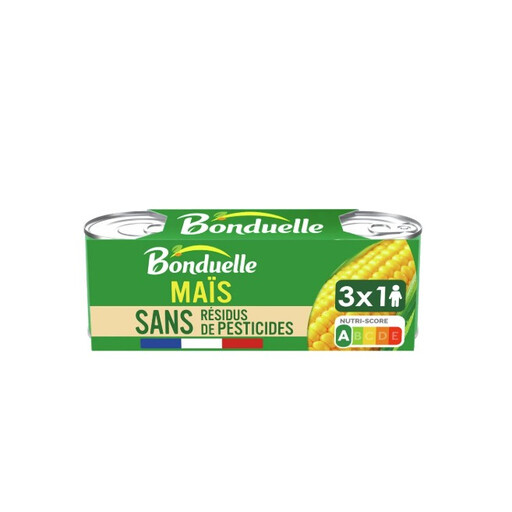 Image unavailable
The “1/4 x 3” pack may suit shoppers who prefer to open smaller portions at a time. Check the pack details and drained weight per tin before planning your portions.
 Image unavailable
The two 140 g tins are a good fit if you’d rather open a smaller tin at a time. To compare how much sweetcorn you can use, check the drained weight too.
 Image unavailable
The 570 g size is worth considering if you expect to use a large tin after opening. Check its drained weight and follow the storage instructions on the product.
 Image unavailable
This 285 g tin lets you stock up one tin at a time. If drained weight or sugar content will guide your choice, compare the details on this product with those of the other tins you’re considering.
No: it may contain naturally occurring sugars. When comparing products to stock up on, check the “of which sugars” figure per 100 g rather than relying on the claim on the front of the pack.
According to the French National Consumer Institute, this claim requires at least 30% less sugar than a similar product. “No added sugars” on its own doesn’t prove that sugar has been reduced, so check which claim the product actually makes.
Choose according to how much you use each time you open a tin. Small tins let you open one at a time; a larger size works if you can use or store the remainder as directed on the label. The Bonduelle, Auchan Bio and Géant Vert product pages cited for their products advise refrigerating them and using them within two days of opening.
No: organic status and sugar content are two separate considerations. Compare the “of which sugars” figures per 100 g for the specific products you’re interested in, even if they both carry a “no added sugars” claim.