People cooking for a small group
For an Easter salad or side dish, the drained weight helps you choose a tin whose contents you’ll mostly use, so you’re less likely to have leftovers once it’s open.


For a salad or Easter side dish you’re making in one go, choose a single tin if you expect to use most of its drained weight. A multipack of smaller tins is better for preparing several dishes at different times, but it isn’t the same as buying one individual tin. Then compare the ingredients and claims on the exact product you’re considering, and follow its storage instructions after opening.
For an Easter salad or side dish, the drained weight helps you choose a tin whose contents you’ll mostly use, so you’re less likely to have leftovers once it’s open.
If you use sweetcorn in several dishes made at different times, compare a single tin with a multipack of smaller tins, checking the quantity in each tin.
If you’re looking for an organic product, one with no added salt or another specific claim, check the tin you’ve chosen. These features don’t automatically apply to every product from a brand.
First work out how many dishes you’ll be making, then compare the drained weight and the number of tins. The ingredients, product claims and shape of the sweetcorn can then help you find the right option for your recipe.
| What to consider | What to check | Who it matters to |
|---|---|---|
| Quantity for one meal | Compare the drained weight with the amount of sweetcorn you need for the dish. | For a small group, I want to use nearly all the tin in one side dish rather than keep leftovers once it’s open. About 33% of consumers prioritise a quantity that suits the meal. |
| Portioning | Check whether it’s a single tin or a multipack, and how much each tin contains. | If I’m making several salads at different times, I’d rather open just one small tin at a time. This is the main priority for around 27% of consumers. |
| Ingredients and claims | Read the ingredients list and check the exact claim on the product: organic, no added sugar and no pesticide residue refer to different characteristics. | When a particular feature matters to me, I want to see it on the tin I’m buying, rather than assume it applies to the whole brand. Around 20% of consumers put this first. |
| Shape and recipe | Check whether the product contains kernels or baby corn; if it’s described as “crunchy”, check the specific product concerned. | For a particular Easter recipe, I choose the shape of the sweetcorn before deciding on the pack size. Around 20% of consumers put how well it suits the dish first. |
A description such as “3 × 140 g” means there are several tins. It doesn’t refer to one tin, even if each one is small.
If you’re making one dish, check the number of tins and the drained weight. Choose a multipack if you’re genuinely planning to open several tins.
“Organic”, “non-GMO” and “no pesticide residue” aren’t interchangeable claims; each applies to the specific product carrying it.
Choose the feature you’re looking for, then check the wording on the label of the product you’ve selected.
Instructions for storing an unopened tin don’t explain how to store its contents once it’s open.
Transfer leftovers to a suitable container, refrigerate them and follow the storage time given for the product you bought. An Auchan product page recommends using its product within two days.
Bonduelle offers several canned sweetcorn products, including 285 g drained tins, with an organic option and another carrying the “no pesticide residue” claim.
d’aucy offers 285 g crunchy sweetcorn carrying the “no pesticide residue” claim, as well as a 285 g organic option.
Carrefour France’s range includes Carrefour Classic' sweetcorn with no added sugar, in a single 285 g tin and a multipack of 3 × 140 g.
The Auchan range checked includes a product carrying the “no pesticide residue” claim, in a multipack of 3 × 285 g.
ALDI France offers 285 g of BIO® organic sweetcorn and 285 g of ALL SEASONS® sweetcorn described as crunchy.
These products include a 285 g drained tin of sweetcorn, a multipack of two small tins, a 570 g pack and a product made with baby corn. For a salad made with sweetcorn kernels, check the difference between baby corn and kernels before choosing.
 Image unavailable
For a salad or side dish you’re making in one go, this Bonduelle product lists 285 g of drained sweetcorn. The “no pesticide residue” claim applies to this product; follow the instructions on the tin to store any leftovers.
 Image unavailable
For several dishes, this multipack lets you open one 140 g tin at a time; it isn’t a single tin. Check the drained weight per tin to find out how much sweetcorn you’ll have available.
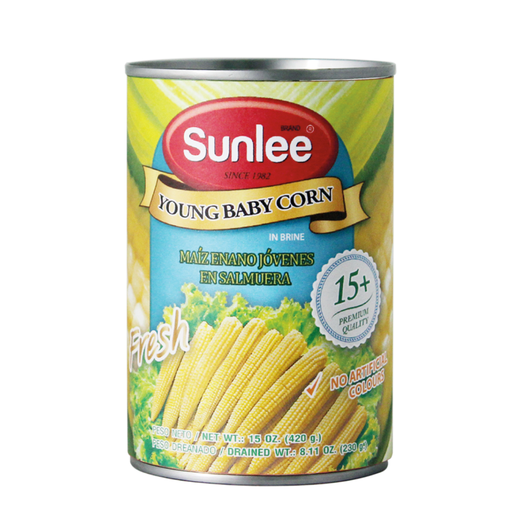 Image unavailable
If your recipe calls for baby corn rather than kernels, check that this shape is right for the dish you have in mind. The pack size is 420 g; check the drained weight to estimate how much you can use.
 Image unavailable
If your recipe calls for a 570 g pack, check the drained weight before deciding whether there’s enough for your meal. Follow the storage instructions for the product you’ve bought when storing leftovers.
Check the drained weight: this is the amount available once the liquid has been removed. The DGCCRF says this information must appear on the label when food is sold in a covering liquid; one Bonduelle product, for example, lists 285 g drained.
Follow the instructions on the tin you bought and put any leftovers in a suitable container in the fridge. For the products concerned, Bonduelle and Auchan product pages recommend eating them within 48 hours or two days.
Not necessarily: the DGCCRF says a product may still be eaten after its best-before date if the packaging is intact, although its taste and quality may change. Don’t confuse this date with a use-by date.
No, the two claims refer to different characteristics. For the product concerned, Bonduelle describes “no pesticide residue” in terms of a quantification threshold of 0.01 ppm and more than 500 molecules tested. If organic is what you’re looking for, check for that claim separately on the tin.