People avoiding added sugars
You’re looking for a tin made without added sugar, without assuming that sweetcorn contains no naturally occurring sugars.


If you want to avoid added sugar, look for the words “no added sugars” and check the ingredients list for the product you choose. This claim does not mean “sugar-free” or “reduced in sugars”: Bonduelle’s product information for its no-added-sugars sweetcorn lists 5.1 g of sugars per 100 g. For Christmas meals, also compare the drained weight you need and the storage instructions after opening.
You’re looking for a tin made without added sugar, without assuming that sweetcorn contains no naturally occurring sugars.
You’re choosing the right amount for a salad, side dish or buffet, while planning how to use the sweetcorn after opening.
You check the claim and ingredients for each product rather than assuming that all sweetcorn from the same retailer has the same recipe.
For your Christmas food shop, start with the factor that matters most to you, then check the pack size and other details on the label of the tin you choose.
| What to check | Look for | Who is it for? |
|---|---|---|
| Added sugars | The “no added sugars” claim and the ingredients list; if total sugars matter too, check the “of which sugars” line per 100 g. | I want to avoid a sweetening ingredient being added to the sweetcorn, without confusing this with the absence of natural sugars; around 46% of consumers would make this their priority. |
| Pack size and leftovers | The drained weight, the stated servings and the storage instructions after opening. | For a salad served to several guests, I want to buy an amount I can use without leaving too much sweetcorn open; this would be the priority for around 27% of consumers. |
| Other features | The salt content per 100 g and any specific claims that matter to you, checking the exact product. | If I prioritise salt or a particular range feature, I need to consider it separately from added sugars; around 27% of consumers would prioritise these factors. |
Sweetcorn naturally contains sugars. Bonduelle’s product information for its no-added-sugars product lists 5.1 g of sugars per 100 g.
If you’re comparing total sugars, also check the “of which sugars” line in the nutritional information.
The same aisle may include recipes with or without added sugar, as well as products carrying other claims, such as “organic” or “no added salt”.
Check the ingredients list and claims on the pack you intend to buy.
Once the tin is open, the manufacturer’s storage instructions become important. For its no-added-sugars product, Bonduelle advises storing it at a maximum of 4 °C and eating it within 48 hours.
Work out how much you’ll need for your meal and check the instructions for the product you choose before deciding on a pack size.
Bonduelle offers a no-added-sugars sweetcorn product that can be eaten hot or cold.
Carrefour offers Classic' sweetcorn with no added sugars in several pack sizes, including 285 g and 3 × 140 g.
Auchan’s range includes an Auchan Bio sweetcorn in a jar labelled “no added sugars”.
E.Leclerc offers crunchy Notre Jardin sweetcorn and organic Bio Village sweetcorn, both labelled “no added sugars”.
ALDI offers Fleur des Champs crunchy sweetcorn labelled “no added sugars”.
These canned sweetcorn products come in a range of pack sizes to consider for a Christmas salad or side dish. For each one, check the ingredients, stated quantity and any nutritional claims on the label of the product being sold.
 Image unavailable
This sweetcorn could be a good option for a Christmas side dish.
Pack size shown: 400 g. If no added sugars is important to you, check the ingredients and the claim on the label for this product.
 Image unavailable
This tin of sweetcorn may suit a meal where you’re looking for a 285 g pack.
The name of this variant refers to pesticide residues, not added sugars. Check the ingredients list and any sugar-related claims separately.
 Image unavailable
This 570 g pack could be a good option if your Christmas menu calls for more sweetcorn.
Joybuy’s product information lists sweetcorn kernels, water and salt. Check the drained weight and storage instructions after opening if you expect leftovers; “Supersweet” does not show that the product has a reduced sugar content.
 Image unavailable
Two 140 g tins can be useful if you prefer to open the sweetcorn separately for different meals.
The word “Organic” alone doesn’t tell you whether sugar has been added. Check the ingredients and nutritional information for this variant.
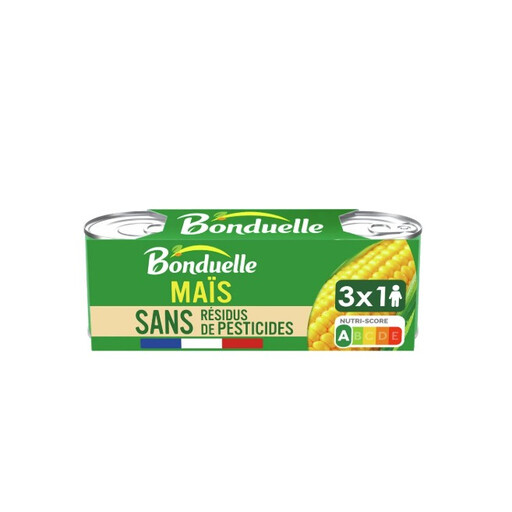 Image unavailable
This pack could be a good option for a Christmas salad or side dish.
The pack is listed as “1/4 x 3”: check the total weight and drained weight before planning your portions. Also check the ingredients list and storage instructions for the product you buy.
No. Sweetcorn can contain naturally occurring sugars even when no sugar has been added to the recipe. Bonduelle’s product information for its no-added-sugars sweetcorn lists 5.1 g of sugars per 100 g.
If you want to avoid added sugar, look for “no added sugars” and check the ingredients. On its own, this claim doesn’t mean that the total sugar content is lower than that of another sweetcorn product.
Follow the temperature and time limit shown on the packaging of the product you buy. For its no-added-sugars sweetcorn, Bonduelle advises storing it at a maximum of 4 °C and eating it within 48 hours of opening; the DGCCRF advises following the manufacturer’s instructions.
No. These claims relate to different criteria. Check the sugar-related claim and ingredients list on the specific product you’re considering.