Parents starting to introduce solids
The priority is to adapt the texture of the lentils to your child’s abilities and consider how they digest them, as Santé publique France advises for pulses.


If lentils are only for your toddler at dinner, a multipack of small tins of plain lentils lets you open one at a time. A larger tin may be more suitable if you’re sharing the meal, or if you can use the leftovers within the recommended time after opening. Either way, adapt the texture to your child’s abilities and check the ingredients, salt per 100 g and allergen information, especially for recipes that are already seasoned.
The priority is to adapt the texture of the lentils to your child’s abilities and consider how they digest them, as Santé publique France advises for pulses.
According to Santé publique France, children gradually start eating almost the same food as the rest of the family, in suitable quantities. The amount in each tin can help you choose between a small portion and a tin to share.
A multipack of separate tins means you can open one when you need it. Before choosing a format, compare the number of tins, the drained weight per tin and the instructions for use after opening.
Start with a texture your child can manage, then choose how much to open for dinner. Next, check the ingredients to help you decide between plain lentils and a prepared recipe.
| What to consider | What to check | Who is this for? |
|---|---|---|
| Texture and digestion | Check that the lentils are cooked, and plan to mash or blend them according to your child’s abilities. | I want to adapt the texture at the start of weaning and take into account how my child digests lentils; around 36% of consumers would put this need first. |
| Ingredients, salt and allergens | Read the ingredients list, salt per 100 g and allergen information on the tin you buy. | If I’m putting dinner together myself, I want to know what’s in the tin before adding other ingredients; around 29% of consumers would put ingredients first. |
| Amount per tin | Compare the drained net weight of each tin and the storage instructions for after opening. | When my child is the only one eating lentils, I’d rather open an amount that I can use up; around 21% of consumers would prioritise smaller portions. |
| Stocking up on tins | Check the number of tins, the amount in each one and the date shown on the packaging. | For evenings when I don’t have much time, I want to keep several separate tins in the cupboard; around 14% of consumers would make this their priority. |
Just because they’re already cooked doesn’t mean their texture is suitable as-is at every stage of weaning.
Mash or blend your child’s portion if needed, taking into account their abilities and how they digest pulses.
With a larger tin, you’ll need to plan how to use the leftovers after dinner. For its canned lentils, Bonduelle advises storing them at a maximum of 4 °C and consuming them within 48 hours of opening.
Choose a smaller tin if it’s a better fit for the meal, or plan to use the leftovers according to the instructions on the tin you buy.
Plain lentils and prepared recipes can contain different ingredients, including herbs and salt. Information about possible allergens also varies between products.
Read the ingredients and allergen information on the packaging, especially if your child has a known allergy.
Bonduelle’s plain, ready-cooked lentils are available in a 265 g drained-weight tin, a format to consider when sharing a meal.
The Carrefour Classic’ product comes as a pack of three tins, each containing 130 g drained weight of lentils.
Auchan offers a pack of three 130 g tins of lentils.
This product comes as a pack of three tins, each with a drained net weight of 130 g.
ALDI offers prepared lentils in a 530 g tin, a format to consider if several people will be eating them or if you plan to use them across several meals.
This prepared lentil product could work for a shared dinner if the recipe suits the meal you have planned. For a toddler, check the ingredients and adapt the texture and portion served.
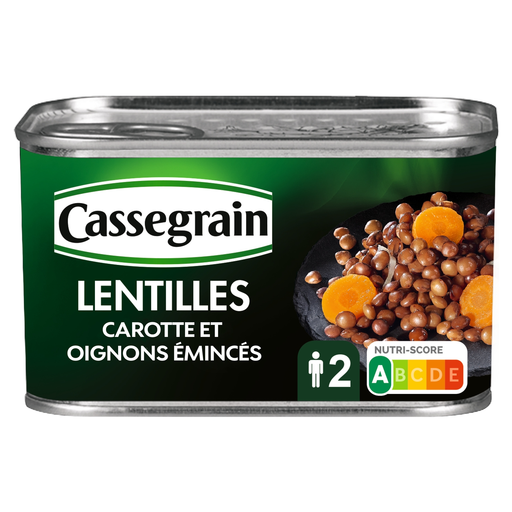 Image unavailable
This prepared recipe could accompany a shared dinner if its ingredients and texture suit your child. It gives you less control over the seasoning than a tin of plain lentils.
The tin contains 265 g. Joybuy’s product information lists 0.76 g of salt per 100 g and possible traces of gluten and soya. Check the label on the tin you buy and follow its instructions for use after opening.
Offer a texture that suits your child’s abilities. At first, lentils can be cooked until soft and blended smooth, then you can gradually change the texture. Santé publique France also recommends taking into account how your child digests pulses.
No. A tin provides an ingredient, not a portion or a meal that suits every child. Adjust the amount you serve to your child and plan the rest of the meal around their usual diet. Santé publique France notes that after the age of one, children gradually start eating almost the same food as the rest of the family, in suitable quantities.
Follow the storage instructions for the product you’ve bought. For its canned cooked lentils, Bonduelle advises keeping them at a maximum of 4 °C and consuming them within 48 hours of opening. Auchan advises putting leftovers in an airtight container in the fridge and consuming them within two days.
Choose plain lentils if you’d like to decide for yourself what other ingredients and seasoning to add to dinner. For a prepared recipe, read the ingredients and allergen information. Cassegrain’s carrot and onion recipe includes herbs and salt, and may contain gluten and soya.