Cooks keeping an eye on salt
You want to season your savoury crêpes yourself and compare nutritional values, rather than relying solely on the wording on the front of the pack.


To keep the salt in a savoury crêpe filling under control, start with passata or tomato purée with no added salt and compare the ‘salt’ value per 100 g. The Jardin BiO étic passata listed by Auchan contains 0.03 g per 100 g. A ready-made tomato sauce saves some preparation time, but its salt content and consistency need to suit your filling. Passata, on the other hand, may need reducing before you use it to fill your crêpes.
You want to season your savoury crêpes yourself and compare nutritional values, rather than relying solely on the wording on the front of the pack.
You’re choosing between a ready-made tomato sauce and a plain base that may need a little cooking to reach the right consistency.
You read the ingredients and nutritional information for the product you’ve chosen, then check that it’s available from your usual retailer before planning your filling.
For savoury crêpes at Candlemas, first decide whether you’d prefer to control the seasoning with a plain base or save time with a ready-made sauce. Then check the salt per 100 g and how well the filling holds together: a sauce that’s too runny can make your crêpe soggy.
| What matters | What to check | Who it matters to |
|---|---|---|
| Control over salt | Compare the ‘salt’ value per 100 g and check the exact wording, especially ‘no added salt’. | I want to choose the seasoning myself rather than guess the salt content from the recipe name. Around 42% of consumers would make this their top priority. |
| Filling consistency and flavour | Check the type of product—passata, purée or ready-made sauce—and any herbs or spices already added. | If the tomato might make my crêpe soggy or overpower the other ingredients, its consistency and seasoning come first. This would be the priority for around 33% of consumers. |
| Speed and availability | Check the retailer and whether the product is in stock; allow time to reduce the passata if needed. | When I’m making several crêpes, I prefer a filling that’s easy to find and quick to serve. Around 25% of consumers would prioritise this convenience. |
This wording refers to the recipe; it doesn’t mean the nutritional information will show no salt at all. For example, the Jardin BiO étic passata listed by Auchan contains 0.03 g of salt per 100 g.
Compare the ‘salt’ value per 100 g across similar products, then take into account how much you’ll use to fill your crêpes.
A sauce that’s already seasoned won’t necessarily meet your needs. The ingredients list for Panzani Provençale published by Carrefour includes salt. E.Leclerc lists 1.0 g of salt per 100 g for its Turini basil sauce and 2.0 g for the version with small vegetables.
If salt is a priority, check the nutritional information for the specific sauce you plan to buy. A plain base gives you more control over the seasoning.
Whether you can order a sauce depends on where you shop and which retailer you use. A product you’ve spotted in advance may not be available from your chosen shop.
Check availability before planning your crêpes, and keep another tomato base that meets your criteria as a back-up.
The same category includes passata to season yourself and ready-made sauces. Compare specific products rather than assuming their salt content based on the brand.
Passata with no added salt, to use as a sauce base.
Ready-made tomato sauces for anyone who’d rather not prepare a plain base.
Barilla France markets its Basilico tomato sauce as an accompaniment for pasta.
Ready-made tomato sauces with varying salt content depending on the recipe.
The retailer stocks, among other products, a Prosain tomato sauce labelled ‘no added salt’.
These two tomato purées are suitable if you’d like a base to season yourself for savoury crêpes. Before filling your crêpes, compare the nutritional information for the product you buy and check whether it needs reducing to reach the right consistency.
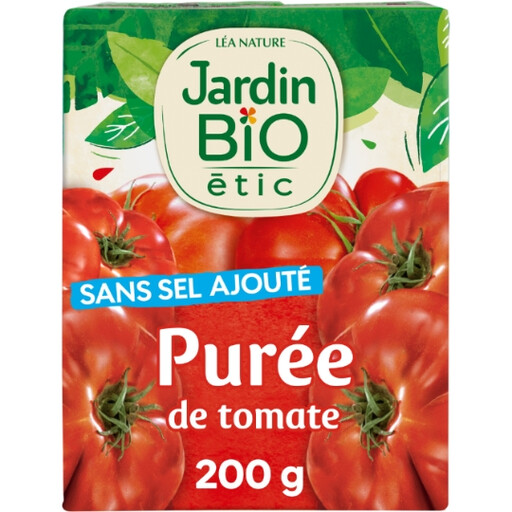 Image unavailable
A tomato base to season according to the other ingredients in your crêpe. Check its consistency before spreading it over the crêpe.
Size: 200 g.
 Image unavailable
A tomato purée to prepare as a filling. Check its salt content and consistency before using it in your crêpes.
Size: 500 g.
No. This wording doesn’t mean the ‘salt’ value in the nutritional information will be zero. The Jardin BiO étic passata listed by Auchan contains 0.03 g of salt per 100 g. Check the value for the product and pack you’re buying.
Yes, as long as you like the seasoning and it doesn’t make the crêpe soggy. For more control over the salt and herbs, start with a plain tomato base instead, reducing it if it’s too runny.
Read the exact wording of the claim and check the ‘salt’ value per 100 g. If it’s a comparative claim, also check which product it’s being compared with. The DGCCRF notes that nutrition claims on food are governed by European Regulation (EC) No 1924/2006: vague marketing wording is no substitute for nutritional information.