For Candlemas, start by choosing what matters most to you: a product explicitly described as a glass jar or a collectible glass if you want to display it and keep it afterwards; a recipe with ingredients that meet your requirements; or a size suited to the quantity you expect to need. In France, the Nutri-Score is optional. To compare products, also check the nutritional information per 100 g, the ingredients and allergens, then verify the container for the specific size you’re buying.
Who are these criteria useful for?
Anyone who wants to keep the container
If you’d like the jar to take pride of place on your pancake table too, look for information about the specific size you’re choosing. Carrefour describes Jardin Bio étic’s container as a glass jar, while Auchan presents Merveilles du Monde’s as a collectible glass.
Anyone comparing recipes
Hazelnut content, sugars, fats or ingredients: choose the criteria that matter to you and compare nutritional values on a like-for-like basis, per 100 g. The DGCCRF states that nutrition declarations are compulsory for prepacked foods, subject to the exemptions provided for by law.
Anyone serving guests with an allergy
Before offering a choice of spreads, check the label on every jar. Depending on the recipe, pay particular attention to hazelnuts, almonds, milk, soya and any warnings about possible traces.
What should you check before choosing?
When you’re making pancakes to share, start with your main priority, then check the recipe and label on the product you choose—even if the container is your first consideration.
| Criteria |
What to check |
Who it matters to |
| Glass container |
The wording “glass jar” or “collectible glass” for the size you’re buying. |
If I want to display the container with the pancakes and keep it afterwards, I need to know what it’s made from rather than relying on the word “jar”. Around 24% of consumers are said to prioritise the container. |
| Ingredients and nutrition |
The ingredients and nutritional information per 100 g, especially sugars and fats. |
If I’m comparing several recipes, a claim on the front of the pack isn’t enough to understand the differences. Checking the ingredients is said to be the priority for around 29% of consumers. |
| Allergens and ingredients to avoid |
Highlighted allergens and any warnings on the specific jar being served. |
If a guest needs to avoid an ingredient, I have to choose based on the label for the exact product. This is said to be the main concern for around 29% of consumers. |
| Quantity and serving |
The net weight and, if the recipe calls for it, instructions for mixing or storage. |
For a single gathering, I’m looking for a suitable quantity and a spread that’s easy to serve; for regular use, I might consider a different size. Around 18% of consumers are said to put these considerations first. |
What mistakes should you avoid?
-
Ruling out a jar because it doesn’t display a Nutri-Score
The Nutri-Score is optional in France, as the DGCCRF and economie.gouv.fr explain. Its absence alone doesn’t mean the product fails to meet labelling requirements.
If it is displayed, use it as an additional guide. To compare two recipes, also check their nutritional values per 100 g and their ingredients.
-
Judging the whole recipe by a single claim
Claims such as “organic”, “palm oil-free” or “no added sugars” describe different characteristics; none tells you everything about the nutritional values or allergens.
Check for the characteristic you’re looking for, then compare the sugars, fats and ingredients on the labels of the products you’re considering.
-
Assuming “jar” means “glass jar”
The name of the container or how it looks in a photo doesn’t necessarily confirm the material used for the size you’ve chosen.
Look for an explicit reference to glass in the product details, then check the container when it arrives before planning to keep it or display it on the table.
-
Serving several recipes without checking their labels again
Ingredients and allergen warnings vary between products: some contain hazelnuts, almonds, milk or soya, for example.
Keep the labels handy while serving and offer a separate option if a spread’s ingredients aren’t suitable for everyone.
Brands to consider, depending on what matters most to you
Nutella
A chocolate and hazelnut spread available in several jar sizes, according to Nutella France, so you can choose the quantity to suit how you plan to use it.
- Nutella France lists sizes from 220 g to 1 kg in the range reviewed.
- The recipe shown contains hazelnuts, milk and soya; check the material used for the specific size you choose.
Jardin Bio étic
The hazelnut spread described by Carrefour is for anyone specifically looking for a glass jar with a metal lid.
- The Carrefour listing states that it contains 80% hazelnuts and mentions using it on pancakes.
- It warns of possible traces of peanuts, other nuts and sesame; check the label before serving.
Merveilles du Monde
Auchan presents this 190 g hazelnut and almond spread with a collectible glass.
- The Joybuy description also mentions an illustrated glass to keep and collect.
- The recipe shown contains hazelnuts, almonds and milk, among other ingredients; Auchan lists 51 g of sugars per 100 g.
Novi
Worth considering if the stated proportion of hazelnuts is one of your main priorities.
- The Auchan listing for the product reviewed states that it contains 45% Italian hazelnuts and describes it as palm oil-free.
- It contains milk and soya and has 43.6 g of sugars per 100 g; if glass is essential, check the container material separately.
Lucien Georgelin
The product reviewed at Auchan is described as a hazelnut spread with no added sugars.
- Its listing states that it contains 20% hazelnuts from France and soluble vegetable fibre.
- The spread may separate, so you might need to stir it before serving; if you’re looking for glass, check the container for the specific product.
Chocolate spread with a collectible glass on Joybuy
This selection features a hazelnut and almond spread in an illustrated glass to keep—worth considering if the container matters as much as the recipe for your Candlemas table.
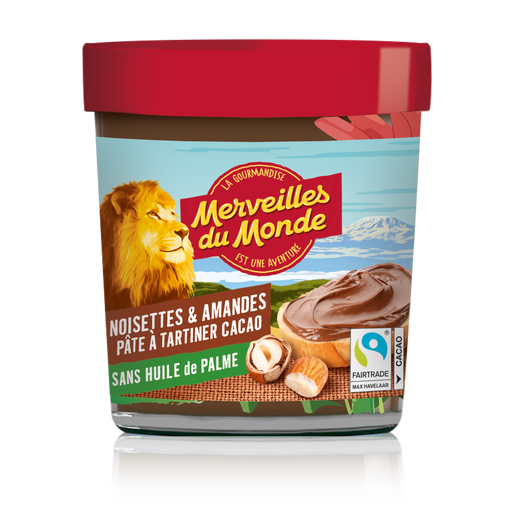 Image unavailable
Merveilles du Monde Collection, 190 g chocolate spread
Worth considering if you’d like to display an illustrated container with your pancakes, then keep it afterwards. The product contains 13.5% hazelnuts and 5% almonds, and has 51 g of sugars per 100 g; it also contains milk. Check the label on the jar you receive before serving it to anyone with an allergy.
View on Joybuy
Frequently asked questions
Is Nutri-Score compulsory on chocolate spread sold in France?
No. The DGCCRF and economie.gouv.fr state that Nutri-Score is optional. However, nutrition declarations are compulsory for prepacked foods, subject to the exemptions provided for by regulations.
How can I compare two jars if one doesn’t display a Nutri-Score?
Compare their nutritional information per 100 g, then check their ingredients lists and allergens. This helps you assess the criteria that matter to you without drawing conclusions about the ingredients from the presence or absence of a logo alone.
Is a recyclable jar always a glass jar that you can keep?
No. The word “recyclable” doesn’t tell you the material or whether you can keep the container for each size. Look for an explicit description, such as “glass jar” or “collectible glass”, and check the product when it arrives.
What should I do before serving chocolate spread to guests with allergies?
Read the ingredients list and warnings on the specific jar you’re going to serve. The products mentioned here don’t all contain the same ingredients or carry the same warnings about possible traces; don’t assume a product is free from milk, soya or other nuts based on the words “chocolate and hazelnut” alone.


