
Livraison le jour même ou le lendemain

Qualité garantie

Débloquez vos offres de bienvenue: Livraison GRATUITE | Jusqu'à -80 % | 30 jours d'essai gratuits à JoyPlus
Téléchargez l'application
The promise of a night under the stars is alluring, but reality can quickly turn into a nightmare: a damp tent, an endless setup, uncooperative poles… Choosing a camping tent seems simple, but the market is saturated with marketing promises that often lead to costly disappointments. Before you commit, it's best to know the common pitfalls that can turn a great investment for adventure into a bulky object collecting dust in your garage.
The three most common mistakes are:
This guide separates fact from fiction to help you find the shelter that truly meets your needs, whether it's a kids' play tent for the garden or a backpacking tent ready to hit the trails.
To make an informed choice, you need to read between the lines on product descriptions. Let's focus on three technical criteria that don't lie.
The ability of a waterproof tent to keep you dry is measured by its hydrostatic head (HH) rating, in millimetres (mm). This rating quantifies the fabric's resistance to water pressure.
Always check the rating for both the rainfly (the outer fabric) and the groundsheet, which endures pressure from your body as well as moisture seeping up from the ground.
The shape of the tent directly impacts its stability, internal volume, and ease of setup.
The capacity advertised by manufacturers is almost always optimistic. A 2-person tent will barely fit two thin sleeping pads, leaving no room for backpacks.
For a minimum level of comfort, our advice is simple: aim for one person more than the number of occupants. This is essential if you plan to store camping gear inside.
Weight is the name of the game for backpacking. A solo backpacking tent should ideally weigh under 2 kg. For car camping, where weight is no longer an issue, you can prioritise the comfort of a heavier but much more spacious family tent.
To put theory into practice, here are three models that meet very specific needs.
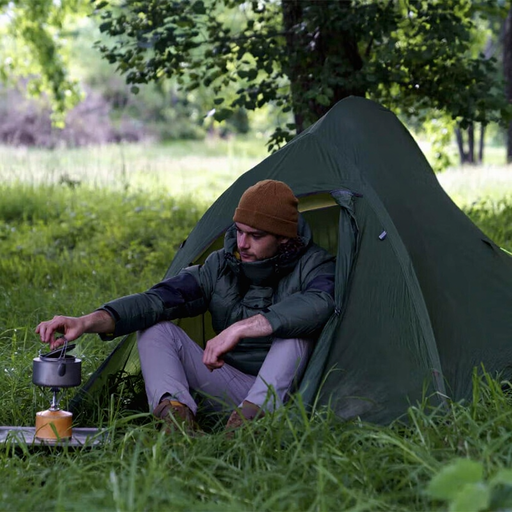
Why we chose it: For the hiker who counts every gram, this minimalist dome tent is a reliable shelter that won't weigh down your pack. It's built for solo adventures where performance is everything.
It perfectly solves the weight-vs-performance equation. With a total weight of just 1.5 kg and a 4000 mm waterproof rating, it makes no compromises on protection.
Its 7001 aluminium frame and 20D silicone-coated nylon fabric provide a perfect balance of low weight, durability, and weather resistance.
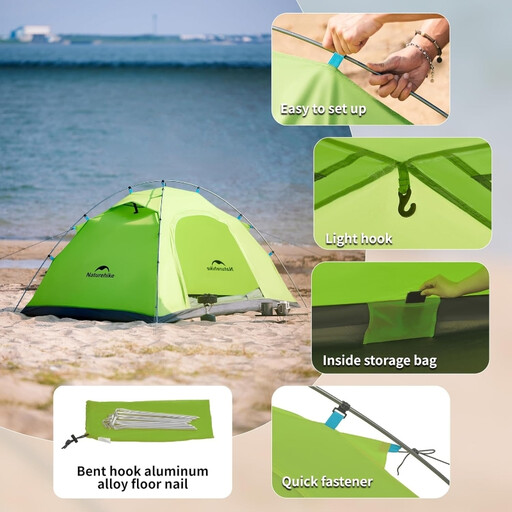
Why we chose it: Perfect for duos who camp from spring through autumn, and even during mild winters. Its 4-season tent design makes it versatile enough to handle unpredictable weather.
It doesn't just claim to be "waterproof." Its 4-season design ensures better insulation and increased wind resistance, while remaining very light for its class (1.65 kg).
Its versatility and UV protection (UPF) make it a reliable shelter for a variety of uses, from forest hikes to coastal camping.
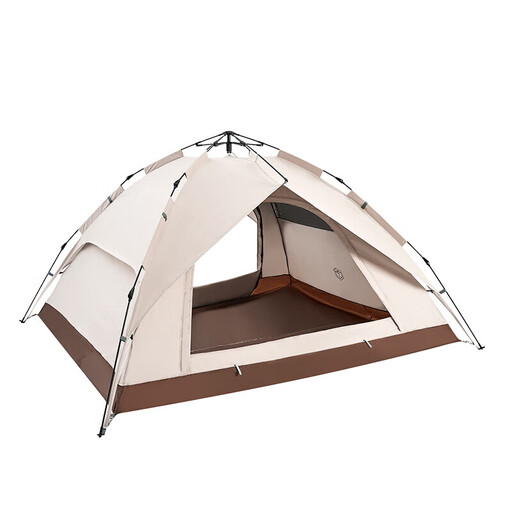
Why we chose it: Ideal for families or small groups who want a lightning-fast setup for their camping weekends. The automatic pitch lets you focus on what matters: enjoying the trip.
Unlike a basic pop-up tent, this model has a double wall (which reduces condensation) and a 3,000 mm waterproof rating, offering much more serious protection against rain.
Its automatic setup mechanism is a phenomenal time-saver, and its interior space is well-designed for a small family.
We have selected a complete range of tents that meet our quality criteria and the expectations of discerning campers.
A tent's lifespan depends on the quality of its materials, how often it's used, and, most importantly, how it's maintained. A well-cared-for model can last for many years. The key points are:
The hydrostatic head (HH) rating, expressed in millimetres (mm), measures the pressure a column of water can exert on the fabric before it penetrates. The higher the number, the more waterproof the tent. For all-around use, a 3,000 mm rating for the rainfly is an excellent baseline.
A 4-season tent isn't just for polar expeditions. It's designed to withstand stronger winds and light snow loads, thanks to more robust fabrics and fewer mesh panels. It can be an excellent choice for those who camp year-round, especially at altitude or on windy coastlines where the weather can turn quickly, even out of season. For purely summer use in milder climates, a 3-season tent is more than enough.