
Livraison le jour même ou le lendemain

Qualité garantie

Débloquez vos offres de bienvenue: Livraison GRATUITE | Jusqu'à -80 % | 30 jours d'essai gratuits à JoyPlus
Téléchargez l'application
A good night's sleep is sacred. Whether you're sleeping in a tent in the heart of the Alps or hosting friends unexpectedly, the quality of your sleeping setup makes all the difference. Yet, choosing a camping mattress can quickly become a headache. Between promises of absolute comfort and obscure technical specs, it's easy to make the wrong choice. As the Head of Product Selections at Joybuy, my mission is to help you see clearly and identify the criteria that truly matter.
Before diving into our selection, let's review the 3 classic pitfalls that could ruin your nights... and empty your wallet.
To avoid these disappointments, it's best to focus on objective characteristics. Here are the three points to check before you head to the checkout.
The term "camping mattress" actually covers several technologies, each suited to a specific need.
The R-Value is arguably the most important indicator for your thermal comfort. It measures the mattress's ability to resist heat loss. The higher the R-Value, the more insulating the mattress.
Ignoring this parameter is the number one cause of nights spent shivering outdoors.
The weight and size of the mattress when packed in its stuff sack are crucial criteria. For a multi-day hike, every gram counts. An ultralight camping mattress under 800g is an option to consider. For family car camping, you can opt for a heavier but much more comfortable 2-person camping mattress without worrying about its bulk.
Rather than searching for a one-size-fits-all solution, it's better to choose a model tailored to your user profile.

Why this choice? A simple and versatile solution, ideal for car camping or as a reliable guest bed. Its comfort is perfectly suitable for occasional use.
Its description clearly states that a pump (not included) is required, which prevents the unpleasant surprise of "impossible inflation."
The flocked sleeping surface provides a soft and warm feel, and its internal coil beam structure offers more even support than a basic entry-level air mattress.
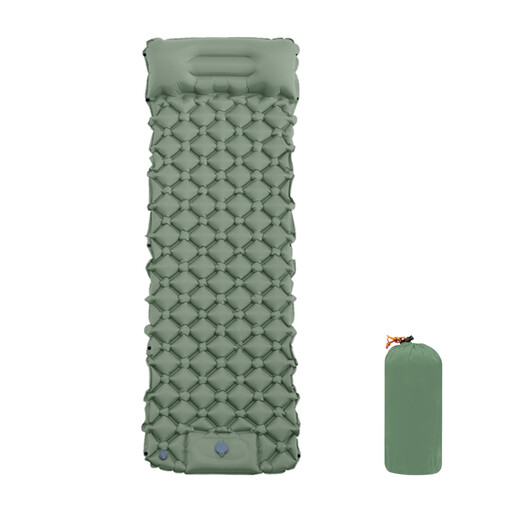
Why this choice? Designed for trekking and hiking, where every gram counts. Its ultra-compact packed size (26x10 cm) fits easily at the bottom of a backpack.
It bypasses the inflation hurdle by integrating a foot pump. No more exhausted lungs or carrying an external pump. Its 690g weight is a concrete fact, not just a marketing claim.
Express inflation (30 to 60 seconds) with simple foot pressure. Its 50D nylon fabric with TPU coating is designed to resist tears and moisture.

Why this choice? For those who prioritize comfort above all else and refuse to sleep on the ground. Perfect for long-term camping, fishing trips, or as an ultra-sturdy guest bed at home.
By its very nature as a camp cot, it automatically eliminates problems with insulation and punctures. Its 50 cm height creates an insurmountable barrier against cold and ground moisture.
Its steel frame supports up to 200 kg. No assembly is required: it unfolds in seconds. The side storage pocket is a convenient bonus.
We have curated a complete selection of products that meet our selection criteria and European safety standards.
Its longevity greatly depends on the type of mattress and how well it's maintained. A foam sleeping pad is nearly indestructible. A well-cared-for air mattress can last for many years. To maximize its lifespan, always use it on a cleared surface, avoid overinflating it, and store it clean and dry, ideally unrolled or loosely compressed, away from extreme temperatures.
Most quality mattresses come with a repair kit. To find the leak, inflate the mattress and submerge it in water (if possible) or wipe a sponge with soapy water over its surface: bubbles will reveal the leak's location. Mark the spot, dry and clean the area, then apply the glue and patch from the kit according to the instructions. Let it dry completely before reinflating.
No, not necessarily. Thickness primarily affects comfort by insulating you from uneven ground. Warmth, on the other hand, depends on its ability to limit air circulation and reflect body heat. This is the role of the insulation (down, synthetic, foam) and the internal structure. A very thick air mattress with no insulation can feel freezing, as the large air pocket inside it cools down from contact with the ground. The only reliable indicator is the R-Value.