For a sharing appetiser
If the camembert is served alongside bread, breadsticks and antipasti rather than as the main event, a standard 250 g size may be a good fit. Check the weight, type of milk and use-by date of the product you choose.


For a sharing cheeseboard, a classic pasteurised-milk camembert is a good choice if you want a cheese that needs no special preparation. For a hot dish, look for a product specifically intended for baking and follow its instructions. If the designation matters more to you, check for the name ‘Camembert de Normandie’ and the PDO logo. According to INAO, this designation requires raw milk, which is worth bearing in mind when choosing for your guests.
If the camembert is served alongside bread, breadsticks and antipasti rather than as the main event, a standard 250 g size may be a good fit. Check the weight, type of milk and use-by date of the product you choose.
If you specifically want Camembert de Normandie PDO, check for the full name and the PDO logo. According to INAO, this designation is reserved for cheese made with raw milk.
If you want to share the cheese straight from the oven, look for a product described as suitable for baking, or follow the instructions for the specific recipe and product you’re using. Don’t assume that every cheese box is oven-safe.
First decide whether you’ll serve the camembert cold or hot. Then check its designation, the type of milk and the quantity you’ll need alongside the other food.
| Criteria | What to check | Who is this for? |
|---|---|---|
| Designation | The name ‘Camembert de Normandie’ and the PDO logo, if you’re looking for this specific origin. | I want to tell a specific designation apart from a generic camembert for my cheeseboard. Around 27% of consumers prioritise this distinction. |
| Type of milk | Whether it says ‘raw milk’ or ‘pasteurised milk’, and the ingredients list. | Before serving the cheese to everyone, I want to know what type of milk it contains and take my guests’ needs into account. This is a priority for around 27% of consumers. |
| Baking | Whether it says ‘for baking’, or the baking instructions for the product and its packaging. | I’m planning to serve hot cheese to share rather than a cold cheeseboard; around 20% of consumers put this use first. |
| Size | The net weight and use-by date, based on the number of guests and the other dishes. | If the camembert is simply served alongside antipasti, I want to buy the right amount without planning an extra dish. For around 26% of consumers, size comes ahead of other criteria. |
The generic name doesn’t necessarily mean it’s Camembert de Normandie PDO. INAO explains that this designation applies to a raw-milk product made to a specific set of rules.
If this origin matters to you, look for the full name and the PDO logo rather than relying on the appearance of the box.
Two camemberts that look similar may carry different labels. Anses identifies soft, bloomy-rind cheeses made with raw milk, including camembert, as categories with a particular microbiological risk.
Check whether each product says ‘raw milk’ or ‘pasteurised milk’, and take your guests’ known needs into account.
The sizes included in this selection range from a small 150 g camembert for baking to several standard 250 g camemberts. They may not serve the same purpose in a meal.
Compare the net weights and plan the quantity according to the number of guests and the other food you’ll be serving.
Carrefour’s small camembert for baking is intended to be oven-baked in an earthenware dish. This doesn’t apply to every product or its packaging.
Follow the instructions for the specific product or a suitable recipe, and don’t put the box in the oven by default.
Président’s product listing describes a 250 g Camembert Classique made in Domfront with pasteurised cow’s milk, and states that it is of French origin.
Carrefour lists a 250 g Classic’ camembert made with pasteurised milk, as well as a small camembert for baking in the oven.
E.Leclerc lists Les Croisés and Bio Village camemberts, among others, in 250 g sizes and made with pasteurised milk. The Bio Village product listing states that it is organically produced.
Auchan’s listing for its 250 g camembert states that it is made with pasteurised cow’s milk of French origin and should be stored between +2 °C and +6 °C.
This selection is for camembert-based bites to prepare as a hot appetiser, rather than a standard camembert to serve on a cheeseboard.
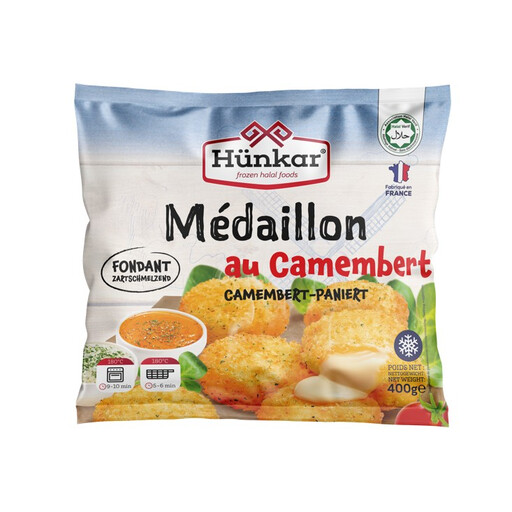 Image unavailable
These camembert-based medallions are suited to a hot appetiser rather than serving as they are on a cheeseboard.
400 g pack. Check the packaging for the type of milk, allergens, and preparation and storage instructions before serving.
Not necessarily. ‘Camembert’ is a generic name, whereas Camembert de Normandie has a protected designation of origin according to INAO. To identify the latter, look for the full name and the PDO logo.
Check the type of milk before choosing the cheese: according to INAO, Camembert de Normandie PDO is made exclusively with raw milk. Anses highlights the microbiological risk associated with soft, bloomy-rind cheeses made with raw milk. Choosing a product clearly labelled as made with pasteurised milk lets you check this when you buy.
No. Don’t assume the box or container is suitable for baking. A product described as suitable for baking will have its own preparation instructions. For any other product, follow only its instructions and those of the recipe you’ve chosen.
Serve it in portions with bread or breadsticks as part of the antipasti, or choose a hot preparation if you want the cheese to take centre stage. Either way, adjust the quantity to suit the other food you’re planning to serve.