Hosts looking for an easy-to-share option
You want something that’s easy to present or serve, while taking into account the number of guests and what else is on the cheeseboard.


For drinks with friends, choose a whole camembert if you’d like to share it on a cheeseboard, or portions if you’d rather avoid cutting it up. If the designation matters to you, look for “Camembert de Normandie” PDO (AOP): according to INAO, it must be made with raw milk. Also check storage instructions and your guests’ dietary requirements. Manger Bouger advises that pasteurisation alone does not make a soft cheese with a bloomy rind suitable during pregnancy.
You want something that’s easy to present or serve, while taking into account the number of guests and what else is on the cheeseboard.
You’re looking for a specific designation and production method. According to INAO, Camembert de Normandie PDO (AOP) is made exclusively with raw milk, a point to bear in mind for your guests.
You need to know about allergens and plan for your guests’ needs. Manger Bouger recommends avoiding soft cheeses with a bloomy rind, including camembert, during pregnancy.
First, check your guests’ dietary requirements, then choose the format and flavour profile you’re after. The cheese label will tell you what type of milk is used and how to store it.
| What to consider | What to check | Who is it for? |
|---|---|---|
| Serving and quantity | Check the net weight and, for pre-cut cheese, the number of portions. E.Leclerc, for example, lists a Les Croisés 240 g cheese in eight portions. | If I’m serving drinks standing up, I’d rather not have to cut the cheese. If I’m serving several cheeses, I’ll also check the quantity. Around 29% of consumers would put ease of serving first. |
| Type of milk and guests’ needs | Look for “pasteurised milk” or “raw milk” on the product label. Don’t assume this alone tells you how it tastes or how mature it is. | I want to know what cheese I’m serving without assuming it will suit every guest. Almost 36% of consumers would prioritise this clarity for the group. |
| Designation and character | For PDO status, look for the full name “Camembert de Normandie” and the AOP logo. According to INAO, this designation requires the use of raw milk. | If protected origin and production method guide my choice, I look for the designation rather than the word “camembert” alone. Around 21% of consumers would prioritise this. |
| Organic and ingredients | If organic certification matters to you, check the label on the product you’re considering, then check the milk’s origin and the ingredients list against your preferences. | I’d rather choose based on the information on the packaging than assume it applies to an entire range. About 14% of consumers would put these factors first. |
According to INAO, the “Camembert de Normandie” PDO (AOP) designation refers to cheese made exclusively with raw milk. The generic name “camembert” does not guarantee this designation.
If the designation is important to you, look for its full name and the AOP logo on the packaging.
Manger Bouger recommends avoiding camembert and other soft cheeses with a bloomy rind during pregnancy. The words “pasteurised milk” do not change this advice.
Plan ahead for your guests’ needs and provide a suitable alternative if anyone has specific dietary requirements.
The correct storage temperature depends on the instructions on the product. The French Ministry of the Economy advises following the storage temperature shown on the packaging.
Check the use-by date and instructions for after opening, then store any leftovers as directed.
Président describes its Camembert Classique as a pasteurised cow’s milk cheese, made in Domfront with French milk.
Carrefour lists, among other products, a 210 g pasteurised milk camembert and a Carrefour Bio product made with pasteurised cow’s milk from organic farming.
E.Leclerc describes a 250 g Les Croisés camembert made with pasteurised milk, as well as another 240 g product in eight portions.
Auchan lists a 250 g camembert made with pasteurised milk. Its product page recommends storing this particular product between +2 °C and +6 °C.
This option is for breaded camembert medallions to cook and serve with drinks, rather than a whole camembert to cut up on a cheeseboard.
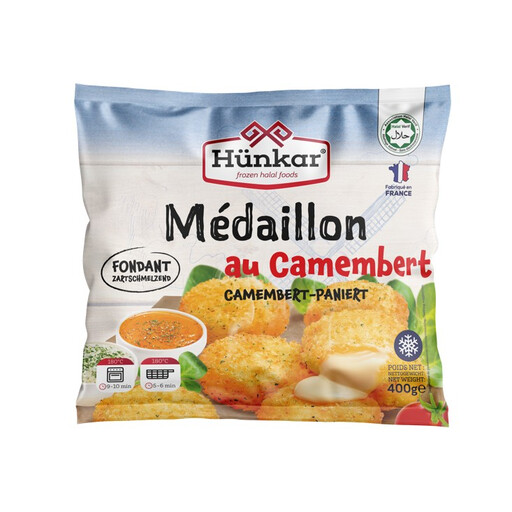 Image unavailable
If you’d rather serve medallions than a whole cheese, cook them in the oven and keep them in the freezer until you’re ready to prepare them.
If the type of milk matters to your guests, check it on the label. If anyone has an allergy, also check for milk and wheat, as well as any warnings about possible traces of soya or celery.
Look for the full name “Camembert de Normandie” and the AOP logo. According to INAO, this designation is made exclusively with raw milk. The word “camembert” alone isn’t enough to identify it.
Pasteurisation does not change Manger Bouger’s advice: during pregnancy, it recommends avoiding soft cheeses with a bloomy rind, including camembert. For advice about an individual situation, speak to the healthcare professional overseeing the pregnancy.
Follow the storage temperature, use-by date and after-opening instructions on the packaging. The French Ministry of the Economy advises following the stated storage temperature. The +2 °C to +6 °C range given by Auchan applies to the specific product described, not to all camemberts.
Auchan’s product page recommends taking its camembert out of the fridge half an hour before serving. For the cheese you’ve bought, follow its own instructions and return any leftovers to the fridge as directed on the packaging.
Check the ingredients and allergens on the packaging of the product you’re serving. The product pages for the camemberts mentioned list milk. For a camembert-based preparation such as breaded medallions, also check the label for any other listed allergens.