
Livraison le jour même ou le lendemain

Qualité garantie

Débloquez vos offres de bienvenue: Livraison GRATUITE | Jusqu'à -80 % | 30 jours d'essai gratuits à JoyPlus
Téléchargez l'application
A calligraphy pen set can quickly turn out to be disappointing if you rely solely on the number of colours or an attractive package. For bullet journals, invitations, handmade cards or illustration, the right choice really comes down to the nib, the type of ink and the paper you use.
A 60-colour set isn’t necessarily the best fit for classic calligraphy. It can be great for colouring or gradients, but a nib that’s too soft or poorly suited will make letters difficult to control. On the other hand, a more compact set offering several nib widths can support a wider variety of techniques.
Water-based inks are handy for blending and creating watercolour effects, but they can bleed through thin paper. Pigment ink pens are often preferred for achieving crisp, long-lasting lines. However, do check the manufacturer’s details regarding their resistance to water and light.
A felt-tip pen that isn’t capped properly dries out quickly, while a fountain pen or dip pen that isn’t rinsed thoroughly can become clogged. Small parts, such as caps and replacement nibs, also need extra care when the equipment is used by children.
Calligraphy felt-tip pens with a chisel nib make it easy to create consistent thick and thin strokes in classic styles. Watercolour brush pens and brush pens have a flexible nib that responds to pressure: a light touch produces a fine line, while more pressure widens it.
For beginners in hand lettering, a soft brush nib gives an expressive result but takes a bit of practice. A firmer nib offers more control for small letters and journaling pages.
Dual-tip markers usually combine a brush nib with a fine nib. This setup lets you trace letters, add details and fill small areas without constantly switching pens. However, check the stated widths: a 0.4 mm nib is good for details, while a brush nib from 1 to 6 mm covers a broader range of uses.
For lettering pens, choose a smooth, sufficiently thick paper. Paper designed for calligraphy or drawing reduces nib drag and minimises bleeding. For watercolour effects, a thick paper will handle the addition of water better.
Water-based inks blend easily but can bleed on certain surfaces. Pigment inks, especially those advertised as water-resistant or fade-resistant, are better suited to illustrations you want to keep. Always test on a scrap of paper before decorating an invitation or an important document.
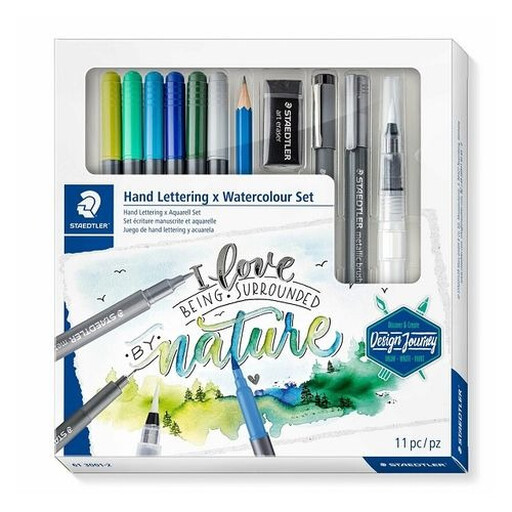
Why this choice suits this profile: This set combines watercolour brush pens, a water brush, accessories and a step-by-step guide. It’s ideal for anyone wanting to start hand lettering with a guided kit, for making cards, keeping a creative journal or working on craft projects.
The guide and water brush mean you don’t have to buy several accessories separately to experiment with blending.
Water-based pigments advertised as non-toxic, a synthetic fibre brush and several accessories for creating watercolour effects.
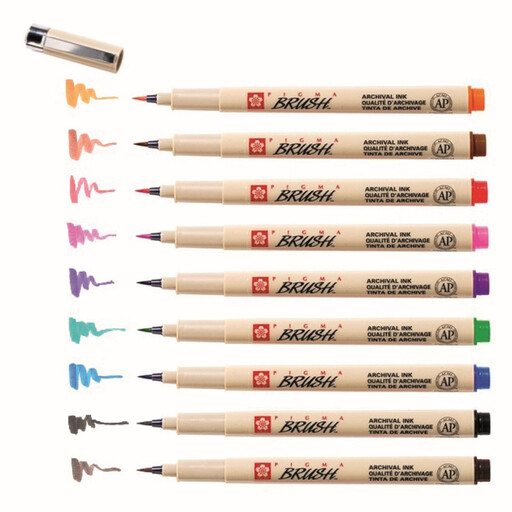
Why this choice suits this profile: This set of nine brush pens is aimed at illustrators and calligraphers who want a flexible brush nib capable of varying stroke width, in both black and colour.
The flexible brush nib lets you vary the stroke depending on pressure, rather than being limited to a fixed width.
Pigma pigment ink advertised by the manufacturer as water-resistant and fade-resistant, with a flexible synthetic nib.
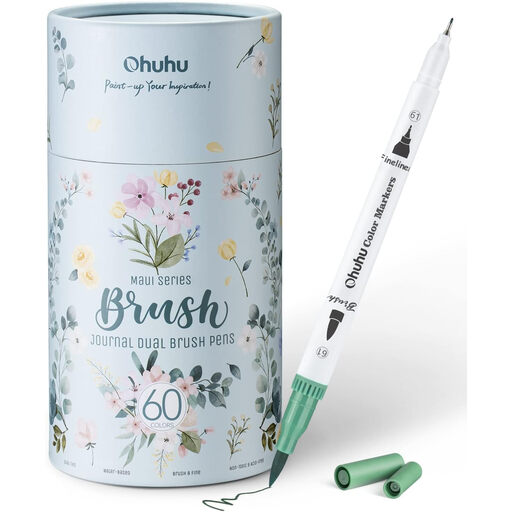
Why this choice suits this profile: Card makers, bullet journal enthusiasts and illustrators benefit from an extensive palette, a fine 0.4 mm nib and a brush nib from 1 to 6 mm.
The dual tip better justifies the variety of uses, while the colour chart helps you organise colours before you start.
60 colours, five replacement nibs and a water-based ink advertised as acid-free on the product page.
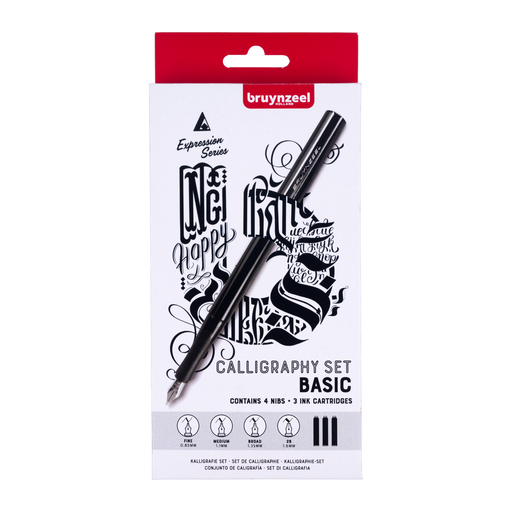
Why this choice suits this profile: This kit aimed at beginners focuses on learning thick and thin strokes with four brass nibs, a pen holder, a converter and three black ink cartridges.
The different nibs let you compare several widths instead of practising with a single so-called universal nib.
Fine, medium, broad and 2B nibs, a converter for bottled ink and instructions for use.
We’ve put together a comprehensive list, updated in real time, of products that meet these strict selection criteria and European safety regulations.
A lettering kit that includes a guide, a soft nib and a few colours lets you discover hand lettering quickly. For learning classic styles, a pen holder with several nibs offers a more gradual approach. The choice therefore depends on the technique you’re aiming for, not just the number of pens.
The lifespan varies depending on how often you use them, the pressure applied and how well you cap them. A brush nib wears out faster on rough paper. Capping pens promptly, storing them according to the manufacturer’s recommendations and using smooth paper all help preserve the nib and ink flow.
Yes, but the result depends largely on the paper’s weight and surface. Thin office paper can absorb the ink and cause bleeding. For watercolour gradients, choose a thick paper designed for drawing or watercolour instead.