Hoteliers responding to requests for caffeine-free drinks
They need a product whose packaging or product details they can check, so they can explain exactly what’s being served in the evening.


To meet demand for a caffeine-free evening drink, choose a product whose packaging or product details confirm the claim, rather than relying on the word “decaf” alone. Pure chamomile gives you a straightforward menu description; a blend offers a different flavour profile, but you’ll need to name its ingredients and check the information required for serving it.
They need a product whose packaging or product details they can check, so they can explain exactly what’s being served in the evening.
They’re looking for a herbal tea that’s easy to name on the menu and prepare consistently, both at the bar and for room service.
They may consider a blend with chamomile, fruit, spices or other botanicals, as long as it isn’t presented as pure chamomile.
For a hotel café menu, first confirm the “caffeine-free” claim you intend to use. Then choose between pure chamomile and a blend, and check the preparation instructions for the product you select.
| Criteria | What to check | Customers concerned |
|---|---|---|
| Caffeine-free claim | Check the claim on the packaging or product details for the item being served, as well as its ingredient list. | When customers specifically ask for a caffeine-free drink, I want to be able to refer to information about the product actually being served. Around 43% of consumers put this confirmation first. |
| Ingredients and serving | To describe it as pure chamomile, check that chamomile is the only ingredient. Also note the recommended infusion time and volume of water. | With a short menu, I prefer a drink name that’s easy to explain and a preparation method that staff can repeat consistently. Simple ingredients are a priority for around 29% of consumers. |
| Flavour profile | Compare the chamomile with the other ingredients in the blend, then choose a menu description that accurately reflects the recipe. | To offer more variety in the evening, I want to serve a blend with a distinctive taste without passing it off as pure chamomile. This flavour profile comes first for around 28% of consumers. |
A search term alone doesn’t describe the product being served. The Clipper Keep Calm product details viewed at Auchan describe it as naturally caffeine-free, while the Auchan Bio listing describes a 100% chamomile blend without making that claim.
Before describing a drink as “caffeine-free”, check the packaging or product details for the item you’ve bought, and make sure staff can access this information.
Clipper Keep Calm and Twinings Bonne Nuit both combine chamomile with other ingredients. A menu name that’s too brief doesn’t help customers distinguish these drinks from an infusion made with chamomile alone.
Make sure the menu name matches the recipe you’re actually serving, for example by mentioning the blend’s other flavours.
A name that suggests bedtime doesn’t demonstrate any effect on sleep. The DGCCRF reminds businesses that health claims used for food products must be authorised under the applicable procedure.
Describe the ingredients and flavours of the herbal tea without promising an effect on sleep or health.
The chamomile product viewed at Auchan contains 100% organic German chamomile and comes in a pack of 20 tea bags.
Keep Calm is a blend of chamomile, honeybush, cinnamon and lemon balm. The product details viewed at Auchan describe it as naturally caffeine-free.
Bonne Nuit Camomille, Tilleul & Framboise is a multi-ingredient herbal tea. Twinings France states that the recipe viewed contains 54% chamomile.
E.Leclerc offers, among other products, a chamomile herbal tea and TISEA Douce Soirée, both in packs of 25 tea bags.
These tea-bag products offer two ways to build your evening menu: serve a herbal tea labelled as chamomile, or choose a blend that contains it. Before serving, check the ingredients, caffeine-related claim and preparation instructions on each pack.
 Image unavailable
Worth considering for a menu centred on chamomile. Before describing it as a pure, caffeine-free herbal tea, check the ingredient list and the claim on the packaging of the product being served.
Also note the infusion instructions so you can give the same guidance every time.
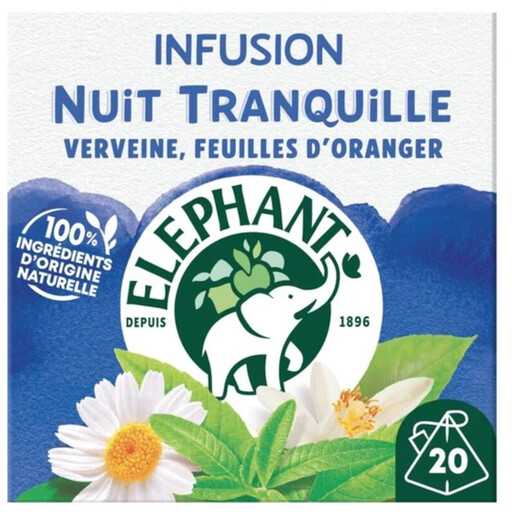 Image unavailable
Worth considering if your menu includes an evening blend rather than chamomile on its own. Check the ingredients so you can describe it accurately, then check the caffeine-related claim on the packaging before telling customers about it.
Follow the preparation instructions for the product you’re serving, rather than using the same infusion time for every drink.
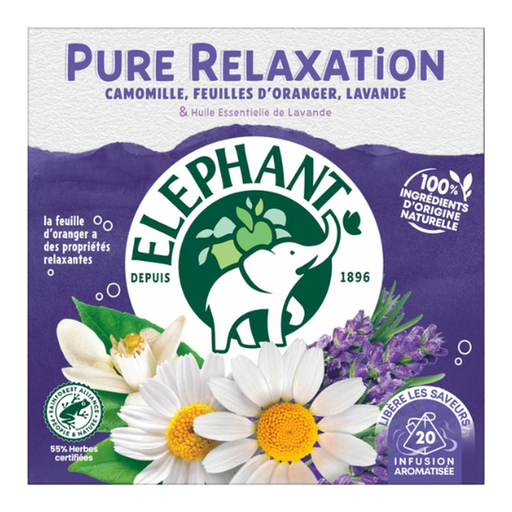 Image unavailable
Worth considering for an evening herbal tea option in tea bags. Check the ingredient list so you can describe the blend without presenting it as pure chamomile.
Before describing it as a caffeine-free option or setting serving instructions, check the information on the packaging.
No. To describe a drink as caffeine-free, refer to the claim for the product being served and check its ingredients. The Clipper Keep Calm product details viewed at Auchan say “naturally caffeine-free”; the Auchan Bio chamomile listing states that it contains 100% chamomile but doesn’t make this claim.
Follow the instructions for each product rather than using one standard infusion time. The Auchan Bio listing recommends 3 to 5 minutes in 200 ml of freshly boiled water; Clipper Keep Calm recommends 2 to 4 minutes at 100 °C, while Twinings Bonne Nuit recommends 5 minutes in 250 ml of freshly boiled water.
Describe it as a blend and mention the flavours that distinguish it from pure chamomile. Clipper Keep Calm contains honeybush and cinnamon, among other ingredients; Twinings Bonne Nuit combines chamomile with lime blossom and raspberry flavour.
Check the ingredient list and supplier information for the product actually being served, particularly if the tea bags are displayed outside their box. For substances or products listed in Annex II that are used as ingredients or processing aids and remain in the finished food, Légifrance specifies that the information must be made available to the final consumer and to catering establishments.
No. A range name doesn’t demonstrate an effect on sleep. The DGCCRF reminds businesses that only health claims authorised under the applicable procedure may be used. Instead, describe the ingredients and flavour of the herbal tea.