
Livraison le jour même ou le lendemain

Qualité garantie

Débloquez vos offres de bienvenue: Livraison GRATUITE | Jusqu'à -80 % | 30 jours d'essai gratuits à JoyPlus
Téléchargez l'application
A cafetière à piston has everything going for it: ground coffee, hot water, a few minutes of steeping and no paper filters to stock up on. But not all models are created equal, and more importantly, they don’t all suit the same needs. A poorly chosen capacity, a fiddly filter to clean or a carafe that’s too fragile can quickly turn a good idea into an impractical purchase.
Before choosing a French press, it’s worth looking beyond the design and checking a few essential points.
Manufacturers often list a number of “cups”. But these are usually small servings of around 120 ml, not the large mugs we typically use in the UK. A 1 L cafetière à piston advertised for 8 cups won’t necessarily fill eight large mugs.
For a single person, a 350 to 500 ml model is usually sufficient and avoids making too much coffee. For a couple or a small household, an 800 to 850 ml capacity offers more flexibility. Families and those who entertain often would be better off with a 1 L model.
A pretty carafe isn’t always pleasant to use. Check the stability of the frame, how comfortable the handle feels and whether the lid fits securely. Even when described as heat-resistant, glass can break. Thermal shock is a particular risk: don’t pour very hot water into a cold carafe.
Acacia wood gives a warm finish, but it usually requires hand washing and shouldn’t be left soaking in water. On the other hand, models that come apart and are dishwasher-safe make daily cleaning much easier.
A permanent stainless steel filter eliminates consumables, but its fineness and design have a direct impact on the result in your cup. A mesh that’s too wide will let more grounds through. Conversely, a very fine mesh can make pressing harder if the coffee is ground too finely.
A cafetière à café without a paper filter lets the coffee’s natural oils pass through. The brew often gains in body and intensity, at the cost of a few fine particles at the bottom of the cup. With a French press, that’s perfectly normal.
Here’s a simple guide to compare the different sizes:
Avoid filling the carafe to the brim. You need to leave room for the lid and the plunger’s travel.
Borosilicate glass handles temperature changes better than standard glass and lets you watch the steeping process. That said, it’s not unbreakable. Inspect the carafe before each use and discard it at the first chip or crack.
The plunger and stainless steel filter are reusable and don’t require any paper filters. A plastic frame reduces weight and can make the grip more comfortable. A stainless steel frame, meanwhile, feels more robust. The right choice depends on your priorities: weight, style, maintenance or portability.
A cafetière à piston works best with a coarse grind. A grind that’s too fine may pass through the filter or make the plunger difficult to press down. For freshly ground coffee, a manual coffee grinder is handy when you’re on the go or camping. An electric coffee grinder is more convenient for making several cups.
To start, use about one heaped teaspoon per 120 ml of water, then adjust the proportions to your taste. Heat the water, then let it cool slightly to around 92 to 96 °C to preserve the aromas. Leave it to steep for about four minutes, then press the plunger down gently, keeping it perfectly vertical.
After each brew, remove the grounds, rinse the filter and regularly take the plunger apart to remove any oil residue.
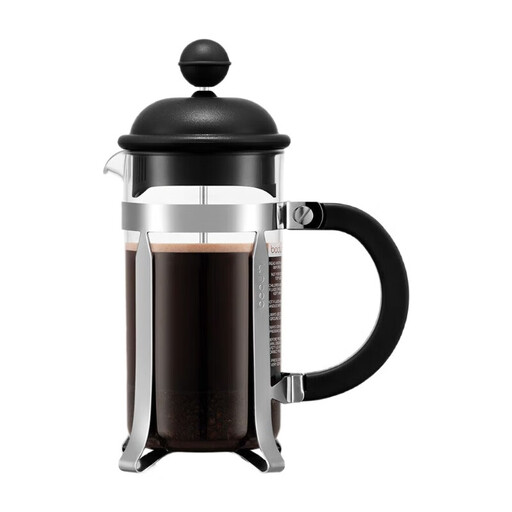
Why this choice suits this profile: Its compact size is ideal for one person, a student or an office where every centimetre counts.
At 350 ml, this cafetière stops you from making too much. Its reusable filter means no paper is needed.
Borosilicate glass carafe, stainless steel plunger and dishwasher-safe components according to the product sheet.
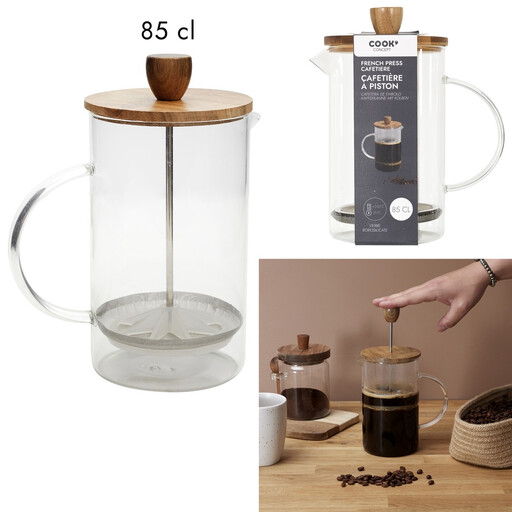
Why this choice suits this profile: The glass and acacia will fit right in on an open-plan kitchen or a table where presentation matters.
The product sheet states that the acacia must be hand washed. So there’s no risk of assuming all parts are dishwasher-safe.
85 cl capacity, borosilicate glass carafe and fine-mesh stainless steel filter.
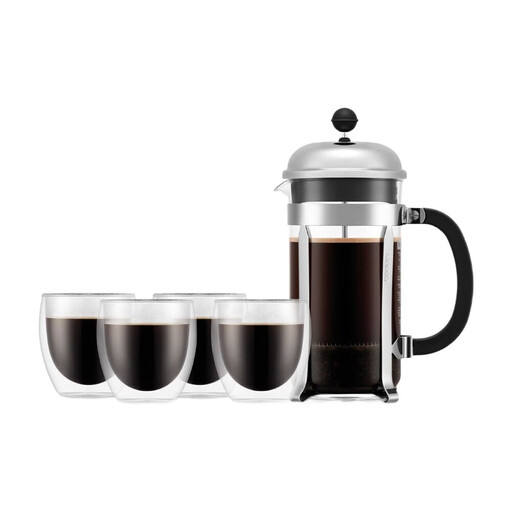
Why this choice suits this profile: The 1 L size and four 250 ml glasses are ideal for families, large gatherings and those who enjoy multiple servings.
The cafetière’s capacity and the number of glasses are listed separately, making it easy to estimate the portions you’ll serve.
Borosilicate glass carafe, stainless steel filter and four double-walled 250 ml glasses.
We’ve put together a full selection, updated in real time, of products that meet these exacting criteria as well as European safety standards.
Choose a coarse grind, similar to what you’d use for long-steeping methods. A grind that’s too fine can make the plunger hard to press down and leave more sediment in your cup.
Start with a steep of about four minutes, then adjust depending on the coffee you’re using, the quantity you’re making and your personal taste. Press the plunger down slowly and serve straight away to stop the coffee from continuing to extract in the carafe.
It doesn’t need capsules or paper filters. So the ongoing cost really depends on the coffee you choose. The permanent filter should be rinsed thoroughly after each brew and only needs replacing if it becomes warped or damaged. As for the glass carafe, it just needs a little care to last as long as possible.