
Livraison le jour même ou le lendemain

Qualité garantie

Débloquez vos offres de bienvenue: Livraison GRATUITE | Jusqu'à -80 % | 30 jours d'essai gratuits à JoyPlus
Téléchargez l'application
Buying your bike online promises a nearly endless selection and tempting prices, but this jungle of offers can quickly turn into a headache. How can you be sure that your dream bike won't become a disappointment once unboxed? My role, as a product expert at Joybuy, is to guide you through this maze. Let's review the common pitfalls and essential checkpoints for a successful purchase.
Navigating e-commerce sites can be disorienting. Behind attractive offers, there are sometimes hidden flaws that turn a great deal into a real hassle. Here are the three mistakes you should never make.
You don't need to be an expert to make the right choice. You just need to focus on a few essential criteria that determine the comfort, safety, and suitability of the bike for your needs.
This is THE fundamental criterion. Expressed in centimetres or inches, the frame size must correspond to your body measurements, particularly your height and inseam length.
A detailed size guide on the product page is a sign of a reputable seller. Don't ignore it!
The choice of brakes has a direct impact on your safety. There are two main types:
The frame material directly affects the weight, stiffness, comfort, durability... and of course, the price of the bike.
To help you get a better idea, here are a few concrete examples that perfectly illustrate the criteria we've just discussed.
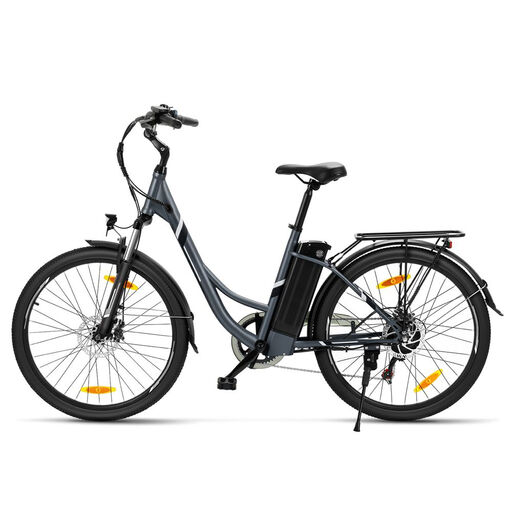
The User Profile: Perfect for bike commuting, this pedal-assist e-bike combines an easy-to-mount low-step frame with an assistance limited to 25 km/h, as required by law. A practical model, built for the city, with no superfluous gadgets.
It focuses on the essentials for urban use: a comfortable range, a practical frame, and reassuring disc brakes in the city. No overpriced and unnecessary technology here.
Its removable 15.6 Ah battery promises up to 90 km of range in assisted mode. This allows you to space out recharges, even for long commutes.
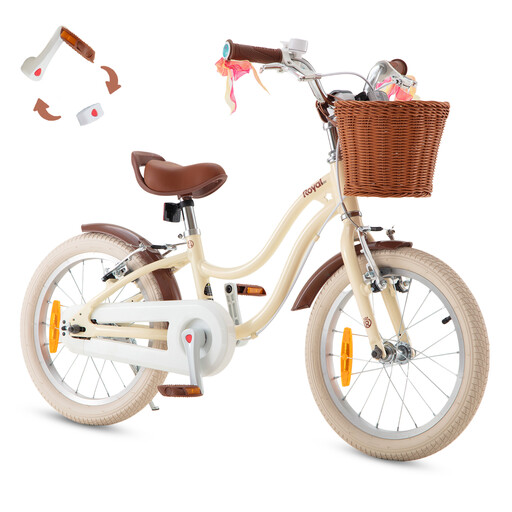
The User Profile: This bike is designed to support the first stages of learning to ride. Its patented system allows you to switch from balance bike mode (without pedals) to a classic bike in a flash and without tools. Smart and practical for parents!
It tackles the sizing problem with clear specifications (14 inches for a child from 91 to 96 cm). Its 2-in-1 concept saves you from buying a balance bike and then a pedal bike.
Its aluminium frame keeps the weight down to 9.2 kg. A real advantage for the manoeuvrability and balance of a child taking their first pedal strokes.

The User Profile: A mountain bike built for the trails. Its suspension fork absorbs impacts, while its 27.5-inch wheels offer an excellent compromise between obstacle-clearing capability and agility.
Here, the equipment isn't a marketing gimmick; it's justified by the intended use. The hydraulic disc brakes aren't a gadget but a guarantee of safety for powerful braking on descents or muddy terrain.
The hydraulic disc brakes provide braking power and modulation unmatched by other systems. This is a decisive advantage for safety and performance in off-road conditions.
We've curated a full range of bikes that meet our strict selection criteria and current safety standards.
1. How do I take care of my e-bike's battery to make it last longer? To extend its lifespan, avoid full discharges. Ideally, maintain a charge level between 20% and 80%. Also, remember to store it in a dry place at room temperature and unplug it once it's fully charged.
2. Is it complicated to assemble a bike bought online myself? The majority of bikes are delivered 85-90% pre-assembled. You will typically need to attach the handlebars, front wheel, pedals, and saddle. Basic tools are often included. For more advanced adjustments (brakes, derailleur), if you're not confident, don't hesitate to entrust this task to a professional bike mechanic.
3. What size bike should I choose for a fast-growing child? It's tempting to buy a bike "to grow into," but a bike that's too big is dangerous and discouraging. The size of a kids' bike is chosen based on the wheel diameter (12, 14, 16, 20, 24 inches). Rule of thumb: the child should be able to sit on the saddle and place the tips of their feet on the ground. Always rely on the manufacturer's size guide, which links wheel diameter to the child's height in centimetres.