What are the key factors when choosing a configuration?
First decide how much space you need for chilled and frozen food, then check that the configuration will fit in your kitchen and suit an appliance that runs continuously.
Fridge-freezer
Consider this if: you need both sections in one appliance.
The trade-off: the model you choose determines how capacity is divided between the fridge and freezer.
Fridge with a freezer compartment
Consider this if: you mainly store fresh food and only freeze things occasionally.
The trade-off: the space available for portions depends on the freezer compartment in the specific model.
Separate fridge and freezer
Consider this if: frozen food regularly takes up a lot of space and you can install two appliances.
The trade-off: you’ll need space for both appliances and should add together the annual energy consumption shown on their labels.
| What matters |
What to check |
Who is this for? |
| Space for frozen portions |
Freezer capacity in litres and drawer size, regardless of the total capacity. |
When I prepare several portions at once, I want to store them alongside my other frozen food without filling the freezer straight away. Around 29% of consumers make freezer space a priority. |
| Space and organisation for fresh food |
Fridge capacity in litres and the layout of the drawers and shelves. |
My fresh groceries and meals for the next few days need to be easy to reach without overfilling the shelves; this is the top priority for around 29% of consumers. |
| Space and installation |
Dimensions, door clearance and, for integrated models, the housing and fixings. |
If my kitchen has an alcove or a narrow doorway, I need to choose an appliance that can actually be installed and opened. This is the top constraint for around 21% of consumers. |
| Energy use and noise |
kWh/year and the noise level of each appliance; add together the kWh/year if you’re installing two. |
In an open-plan kitchen, I want to consider the noise and electricity used by an appliance that runs continuously. Around 21% of consumers say this is their main concern. |
The European Commission says that fridge and freezer labels show details including storage capacity, energy consumption and noise emissions. These details help you compare the models you’re considering. Don’t rely on total capacity alone to tell you how much space is available in each section.
Brands to consider for each configuration
These examples of ranges and models can help you identify different configurations; they’re no substitute for checking the specifications of the product you’re considering.
Bosch
The range includes fridge-freezers and fridges with freezer compartments, making it useful for comparing different ways of dividing up the cold storage.
- For the KGN36VXCT fridge-freezer, Bosch lists 218 L of fridge capacity, 103 L of freezer capacity and a width of 60 cm.
- If you freeze a lot of portions, check that the 103 L listed for this model will fit your containers and the other food you need to store.
Liebherr
The brand offers fridge-freezers as well as sets made up of several appliances, worth considering if you’d like to choose your storage sections separately.
- Liebherr lists a total capacity of 423 L for the CBNsdc 765i fridge-freezer and also offers side-by-side combinations.
- One side-by-side set listed by the brand is 1 204 mm wide. Check the dimensions and capacity of each appliance before planning its installation.
Beko
The brand’s integrated fridge-freezers can fit into a fitted kitchen, provided they’re compatible with the housing and existing doors.
- Beko describes the B3BCNA294HS as having a sliding-door fixing system and an open-door alarm.
- Check the housing, door and fixings before choosing this model; any claims about how its technologies preserve food come from the brand.
Whirlpool
Some fridge-freezers in the range offer a large total capacity in a single appliance.
- Whirlpool lists a capacity of 462 L for the WB70E973W.
- This model is 70 cm wide, 195,5 cm high and 75,5 cm deep. Check the space available, door clearance and delivery route.
Electrolux
A separate upright freezer can complement a fridge that already meets your needs when freezer space becomes the main constraint.
- Electrolux lists a freezer capacity of 212 L for the EUN7NE18S integrated upright freezer.
- This appliance doesn’t replace your fridge: check the housing and consider the energy consumption of both appliances together.
Fridge-freezers available on Joybuy
These models combine fridge and freezer storage in one appliance. They offer a range of fridge-freezer formats to consider for groceries and prepared meals. Choose one to suit the space you have and the capacity you need in each section.
 Image unavailable
Candy CFQQ5T817EPS, 467 L four-door fridge-freezer
Worth considering if you want to store fresh groceries and frozen portions in a four-door appliance. The model title lists a total capacity of 467 L, Total No Frost and an E energy rating. Check that its 83,3 cm width, as listed in the product information, leaves enough room to open the doors.
View on Joybuy
 Image unavailable
Haier HTW5618ENMG, 360 L three-door fridge-freezer
Worth considering if you’re looking for a three-door fridge-freezer to organise fresh and frozen food. The title lists a total capacity of 360 L, Total No Frost, My Zone, Wi-Fi and an E energy rating. Before choosing it for prepared portions, check that the space in each compartment suits your containers.
View on Joybuy
 Image unavailable
AEG NSC6M18FES, 249 L integrated fridge-freezer
Worth considering if you want your refrigeration appliances to fit into a fitted kitchen. The title lists a total capacity of 249 L, TwinTech No Frost and an E energy rating. Check the housing dimensions and fixings against your kitchen units, as well as the capacity of each section and the kWh/year figure on the label for the exact model.
View on Joybuy
 Image unavailable
CHiQ JR227LSE, 227 L fridge-freezer
Worth considering if the width of your kitchen is a key factor in your choice. The title lists a width of 54 cm, 153 L of fridge capacity, 74 L of freezer capacity, a reversible door, Low Frost and an E energy rating. Check the required clearances and energy consumption in kWh/year; Low Frost doesn’t mean you’ll never need to defrost it manually.
View on Joybuy
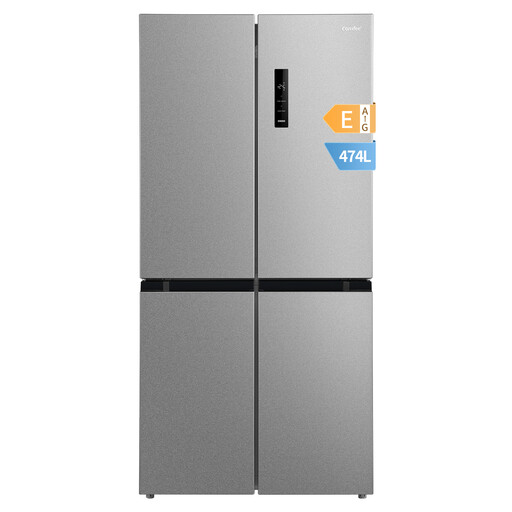 Image unavailable
COMFEE' RCF470LS2EU(E), 474 L four-door fridge-freezer
Worth considering if you want to access the compartments through four doors. The title lists a total capacity of 474 L, a three-temperature drawer and an E energy rating. To see how much space it offers for frozen portions, check the fridge and freezer capacities separately; also check the kWh/year figure, noise level and installation dimensions for the exact model.
View on Joybuy
Frequently asked questions
What should I compare on a fridge-freezer’s energy label?
Check the A to G rating, kWh/year, fridge and freezer capacities, and noise information. The European Commission lists these details on the labels of relevant appliances. The DGCCRF points out that the old A+, A++ and A+++ ratings were phased out when the scale changed in March 2021, so don’t compare them directly with current ratings.
Is a large total capacity enough for freezing prepared meals?
No: check the freezer capacity itself, then make sure the drawers will fit your containers. Total capacity includes the fridge section too, so it doesn’t tell you on its own how much space will be left for portions.
What temperature should I keep an eye on when storing meals in the fridge?
Anses recommends monitoring the temperature in the coldest part of the fridge, keeping it at 4 °C. Also follow the appliance instructions and avoid overfilling the shelves so air can circulate.
What should I do with my old appliance when replacing it?
ADEME says that a replaced fridge or freezer can be handed to the retailer or delivery driver, or taken to an appropriate collection point. Confirm the take-back arrangements before delivery rather than leaving the appliance with ordinary bulky waste.


