Buyers catering for lots of breaks or breakfasts
If you regularly hand out portions, check the number of units in each case and the weight of each one before choosing between a case and several smaller packs.


When buying in bulk, start by choosing the type of product you need: a case of bites, several packs of cereal bars and sharing chocolate bars all serve different purposes. Check that the exact product is certified organic, then look at the number of portions, their weight, the ingredients and allergens before buying multiple packs. The term ‘organic’ alone tells you nothing about sugar content.
If you regularly hand out portions, check the number of units in each case and the weight of each one before choosing between a case and several smaller packs.
Check the exact product rather than relying on the word ‘organic’ in its name. Agence BIO says that the Euro-leaf and AB logos identify products that meet organic certification requirements.
Compare the ingredients, sugars, fibre and allergens shown on the label. If the product displays a Nutri-Score, use it to complement this information, not replace it.
When buying in bulk, consider four things separately: certification, packaging, ingredients and the type of portion you plan to hand out.
| Factor | What to check | Who is it for? |
|---|---|---|
| Organic certification | Look for the Euro-leaf or AB logo on the exact product. | If organic certification is my top priority, a simple mention in the product name isn’t enough. Around 33% of consumers put this certification first. |
| Packaging | Check the number of units, the total weight and the best-before date. | If you’re organising regular distributions, you need to know how many portions each order actually contains. Around 27% of consumers prioritise pack size. |
| Ingredients | Check the sugars per 100 g and per portion, the ingredients list and any declared allergens. | If several people will be eating these products, you’ll want to check their ingredients before ordering. Around 27% of consumers put this check first. |
| Intended use | Tell cereal bars, bites, filled products and chocolate bars apart, and check the weight per portion. | For an on-the-go break, you need a format that’s easy to hand out as intended. Don’t assume a chocolate bar can replace an individually wrapped cereal bar. Around 13% of consumers prioritise this use. |
Organic certification relates to production standards; it doesn’t tell you how much sugar a product contains or list its allergens. According to Santé publique France, displaying the Nutri-Score is voluntary.
Check the nutrition information, ingredients and allergens for the exact product. Use the Nutri-Score as an additional guide if it appears on the label.
Bjorg’s catering cases include 30 g chocolate and peanut bites and 50 g dark chocolate-filled products. These aren’t the same format as a pack of cereal bars.
Check the product name, individual weight and allergens before ordering several cases.
Packaging that doesn’t suit your planned distribution could leave you with unused portions.
Bjorg offers a catering range that includes chocolate products sold in cases.
Carrefour offers organic chocolate cereal bars in boxes of six, with a total weight of 138 g.
E.Leclerc offers organic dark chocolate cereal bars in packs of six, weighing 138 g in total, as well as a 125 g product of organic milk chocolate-filled bars.
Alter Eco offers a range of chocolate and says its products are made with ingredients from organic farming.
This cocoa and hazelnut-filled cereal bar could work well for breaks or breakfast. If you’re considering it for a bulk order that requires organic certification, check the labelling and packaging first.
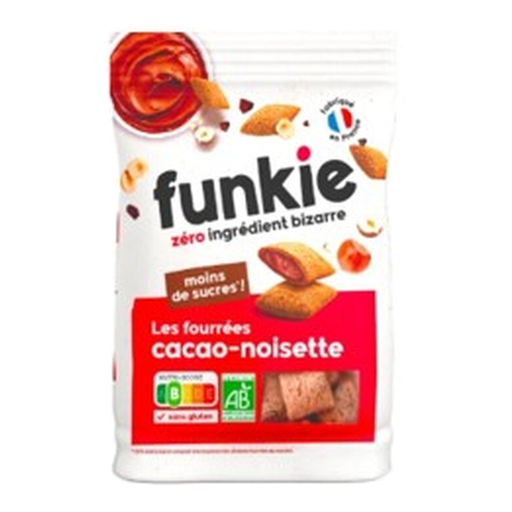 Image unavailable
If you’re planning to hand out individual portions, check the number of bars and their individual weight: the pack is listed as 250 g. If organic certification is essential, check the label on the exact product. Also check the allergen information, particularly for peanuts, and the nutrition information per 100 g and per portion.
Look for the Euro-leaf or AB logo on the exact product. According to Agence BIO, these logos identify products that meet certification requirements. For a processed product, at least 95% of its agricultural ingredients must be organic.
No. Santé publique France explains that producers display the Nutri-Score voluntarily. To compare products, read their nutrition information and ingredients list, whether or not a score is shown.
No. The number of units alone doesn’t make different formats interchangeable. Compare the product name, the weight of each portion and the packaging you need for your distribution.
It could work if you’re happy to prepare the portions yourself. If you need products that are already portioned for distribution, check the individual format, ingredients and weight per unit of the product you’re considering.