Households that buy in bulk
If your fridge-freezer no longer has room for bulk buys or bulky items, a chest freezer is worth considering. You’ll need to set aside floor space for it and organise the food you access less often.


For storing large quantities of food, consider a chest freezer if you have enough floor space and are happy with less compartmentalised storage. An upright freezer is a better choice if you access your food often and want to organise it in drawers. An under-counter model is more suited to providing extra capacity, provided its cabinet space and volume meet your needs. Before you buy, check the dimensions, climate class, stated power-cut storage time and annual energy consumption of the model you choose.
The amount you need to store isn’t the only factor when choosing a format: the space you have and how you access your food matter too.
If your fridge-freezer no longer has room for bulk buys or bulky items, a chest freezer is worth considering. You’ll need to set aside floor space for it and organise the food you access less often.
An upright freezer lets you organise food in drawers and find what you need without rummaging at the bottom of a chest freezer. Check its height, the route to its final position and the clearance needed to open the door and drawers.
An under-counter freezer can provide extra capacity if its volume is sufficient. For an integrated model, check the cabinet dimensions, ventilation and door fitting requirements in the manual.
First, work out what capacity and storage layout you need, then check that the freezer can be delivered to and operate in the room you have in mind.
Consider one: for bulk shopping if you have suitable floor space.
The trade-off: food at the bottom is less easy to reach than in the drawers of an upright freezer.
Consider one: if you open the appliance often and want to sort food into categories.
The trade-off: with a tall model, you’ll need to check the route to its position and the space required to open its drawers.
Consider one: for integrated extra capacity if the cabinet space and door fitting are suitable for the model.
The trade-off: its capacity may be too limited for bulk shopping.
| Factor | What to check | My needs |
|---|---|---|
| Capacity and access | Compare the net capacity with the amount and shape of the food you buy. Check the number of drawers or baskets and the clearance needed to open the door or lid. | I want to store bulk buys without having to move several items every time I look for something. |
| Location | Measure the appliance, the delivery route and the installation space. If it’s going in a cellar or utility room, compare the room’s temperatures with the climate class of the exact model. | The freezer needs to fit along the route to its position and be suitable for the room temperature all year round. |
| Power cuts | Compare the stated storage time in hours and how it is measured. In its test protocol, UFC-Que Choisir measures how long food stays below −9 °C during a simulated power cut. | If power cuts are a concern, I want to know the model’s storage time rather than trying to estimate it from its capacity. |
| Energy use and maintenance | Compare kWh/year figures for appliances with a similar capacity and format, then check how they defrost. ADEME points out that a freezer runs continuously. | I want to consider the appliance’s energy consumption and how much time I’ll need to spend maintaining it. |
A large chest freezer can be difficult to install or use if there isn’t enough clearance for the lid and food at the bottom is hard to reach.
Measure the floor space, delivery route and room needed to open the lid. Also check whether baskets are included to help organise the contents.
The room temperature may fall outside the operating range specified for the model. For example, Bosch states a range of 10 to 43 °C for climate class SN-T; this doesn’t automatically apply to every appliance.
Note the room’s minimum and maximum temperatures, then check the climate class and installation instructions for the freezer you’re considering.
The letter on its own doesn’t tell you the annual energy consumption or the available capacity. As a freezer runs continuously, both are important when making your choice.
Compare kWh/year and net capacity across models suited to a similar storage need, and check their defrosting method separately.
An under-counter appliance can provide extra space, but it may not suit the same shopping needs as a large chest freezer. For example, the Liebherr SUFNc 375i has a capacity of 80 L and requires a cabinet space of 86 to 92 × 60 × 56 cm, according to Liebherr.
Check the capacity you need, as well as the cabinet space, ventilation and door fixing required for the exact model.
These specifications apply to the models mentioned, not to every freezer from each brand.
The freestanding CF200EWN chest freezer is an example to consider for bulk shopping, provided you have enough floor space.
The UW8 F2D WHBI N 2 upright freezer is a useful point of comparison if you prefer vertical storage.
The SUFNc 375i is an example of an integrated under-counter freezer designed to provide extra capacity.
This selection includes upright and chest freezers with different capacities, for extra space or a dedicated storage area. An integrated under-counter appliance has different cabinet space and fitting requirements, so don’t assume a small freestanding model can take its place.
 Image unavailable
The drawers in this upright freezer let you separate food for easy access. The product title lists a capacity of 161 L, No Frost, a reversible door and energy rating C. Before choosing a location, check its installation dimensions, climate class, kWh/year and storage time in the event of a power cut.
 Image unavailable
With three drawers, this 60 L model is better suited to providing extra capacity for food sorted into categories than to storing very large quantities. The product title specifies a reversible door, freestanding installation and energy rating E. Check the dimensions and installation instructions: its small size doesn’t mean it can be fitted into a cabinet space.
 Image unavailable
This 99 L chest freezer can provide extra floor-standing storage, and its removable basket helps keep some food separate. The product title lists energy rating E. Check the type of lid and the clearance it needs before buying, as product descriptions for this model differ on this point. You’ll also need to defrost it manually.
 Image unavailable
This chest freezer offers 140 L of capacity for shopping that needs more space than a small extra freezer can provide. The product title mentions a basket, a counterbalanced lid and energy rating E. Check the floor space, lid clearance, climate class, kWh/year and the model’s storage time in the event of a power cut.
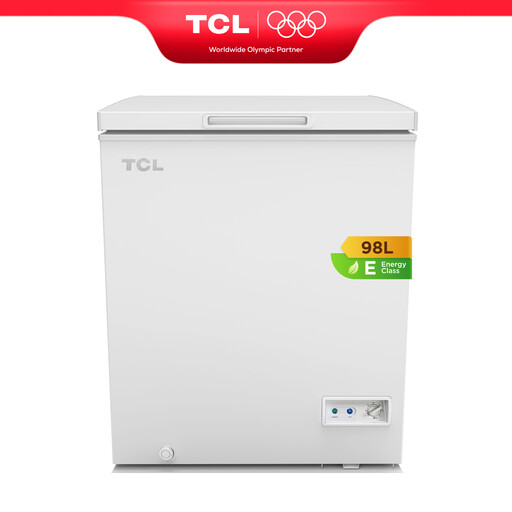 Image unavailable
This 98 L chest freezer with a basket can provide extra storage if its capacity suits your shopping needs. The product title mentions a counterbalanced lid and energy rating E. Measure the space and delivery route, then check the model’s climate class, kWh/year and storage time.
Start by considering a chest freezer if you buy bulky items and have enough floor space; an upright freezer may suit you better if drawers and easy access matter more. UFC-Que Choisir says some chest freezers have a capacity of up to 600 L, but that maximum doesn’t represent every model. An under-counter freezer is suitable for extra capacity only if its volume is sufficient and it fits the available cabinet space.
Yes, as long as the room’s actual temperatures are within the climate range and installation conditions specified for the model you choose. For example, Bosch gives a range of 10 to 43 °C for climate class SN-T. Check the class shown on the appliance and read its manual: don’t assume this range applies to a freezer with a different climate class.
Compare the stated times in hours, taking account of how they’re measured, rather than trying to estimate the storage time from the freezer’s capacity. In its test protocol, UFC-Que Choisir simulates a power cut and measures how long food stays below −9 °C.
No: also check the kWh/year figures, ideally for appliances with similar capacities and formats. ADEME points out that a freezer runs continuously. Check the stated consumption for each model rather than assuming that all appliances in the same energy rating class use the same amount of energy.
Not automatically. In France, the Ministry of the Economy states that the legal guarantee of conformity applies to new, second-hand and refurbished goods sold by a business to a consumer. Before taking out an optional extended warranty, check exactly what it covers and what it excludes; it doesn’t replace the legal guarantee.