What should you check before buying?
First rule out any models that aren’t compatible with your cabinet and planned installation. Then compare the cooking modes and features that suit the way you cook.
| Priority |
What to check |
My needs |
| Fit and electrical connection |
Compare the niche with the installation diagram for the exact model. Ask the relevant professionals to confirm the clearances, ventilation, door opening, power requirements and connection. |
I need to be able to open the door without obstructing the walkway and fit the oven into the planned cabinet. |
| Cooking modes |
Check which modes are actually available and how many shelves each is designed for. For steam cooking, check the water supply system and maintenance instructions. |
Do I mainly cook on one shelf, or do I regularly prepare several dishes at once? Do I often make recipes that would benefit from steam? |
| Cooking performance and ease of use |
Compare preheating times and temperature accuracy under like-for-like test conditions. Also look at the controls and test results for accessible surfaces. UFC-Que Choisir measures preheating and temperature stability in its tests. |
Several people use the oven, and I want clear settings I can choose easily rather than relying on the number of functions alone. |
| Energy use |
Check the energy rating and energy use per cycle for the exact model. Compare cycles using the same cooking mode, rather than assuming energy use from capacity alone. |
If I use the oven often, I want to compare its energy-use figures under equivalent conditions. |
Which brands and models should you consider?
These range examples can help you identify features to check on a specific model; they don’t represent every oven from each brand.
Electrolux
Electrolux lists a capacity of 72 L, built-in dimensions of 590 × 560 × 550 mm and a total electrical power rating of 3 490 W for its LOF6P16Z built-in oven.
- These figures can be checked against your cabinet plan and planned electrical connection.
- These specifications don’t apply to other Electrolux models. The brand states that its installation service doesn’t include carpentry or electrical work.
Bosch
Bosch lists external dimensions of 595 × 594 × 548 mm for the HBF134EB2, along with a 3D Hotair mode designed for cooking on three shelves.
- The product details tell you which cooking mode to look into if you use several shelves.
- External dimensions are no substitute for the niche measurements and ventilation requirements in the installation manual.
Whirlpool
Whirlpool describes the WOI4S8CM0SBAF as a 73 L built-in oven with fan-assisted cooking and catalytic cleaning. For the OWR551RR0B, the brand lists pyrolytic cleaning and SmartClean hydrolytic cleaning modes.
- These models illustrate different cooking and cleaning features to compare according to how you plan to use the oven.
- Check the instruction manual for your chosen model to find out what maintenance is required and which accessories you’ll need; features vary by model.
A built-in oven option on Joybuy
This multifunction oven may suit a household considering a fan-assisted mode as part of a kitchen renovation. You’ll need to check that it fits your kitchen by referring to its installation manual and your cabinet plan.
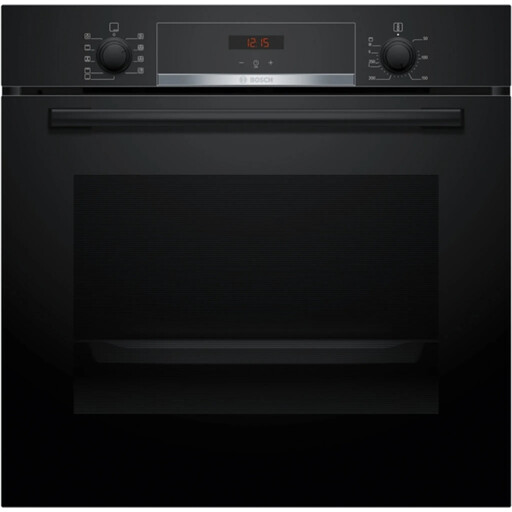 Image unavailable
Bosch HBA514BB3, 71 L built-in oven, 3D fan-assisted cooking, stainless steel
The 3D fan-assisted mode is worth considering if you cook on several shelves. The stated capacity is 71 L. Before choosing this model, compare its built-in dimensions and connection requirements with your kitchen plans.
View on Joybuy
Frequently asked questions
What measurements should I check before ordering a built-in oven?
Compare the cabinet’s internal dimensions with the built-in measurements for the exact model, then check the clearances and ventilation requirements in its installation diagram. For example, Electrolux lists a niche measuring 590 × 560 × 550 mm for the LOF6P16Z, while the 595 × 594 × 548 mm Bosch gives for the HBF134EB2 are external dimensions. These measurements aren’t interchangeable.
Is fan-assisted cooking useful if I don’t cook very often?
It’s most worth considering if you want to cook on several shelves regularly. If you only cook occasionally and mainly use one shelf, start by choosing modes that suit the dishes you make. UFC-Que Choisir recommends matching features to how you cook rather than simply opting for more functions.
When should I consider an oven with a steam function?
Consider one if you expect to use the function regularly and are happy to carry out the maintenance associated with water. UFC-Que Choisir distinguishes between combination ovens, which retain conventional cooking modes with or without steam. Then check the instruction manual for your chosen model to see how it takes in water and what maintenance is required.
What should I have checked about the electrical connection during a renovation?
Ask a qualified professional to confirm that the planned connection is suitable for the power requirements and instructions for your chosen oven. In France, Promotelec states that a new or completely renovated electrical installation must comply with the NF C 15-100 standard. Also check who will be responsible for any changes to the cabinet or electrical installation.
How can I compare the energy use of two ovens?
Compare energy use per cycle for the same cooking modes, using figures for the exact models rather than relying on the energy rating alone. The European Commission states that domestic ovens are subject to energy labelling requirements. These figures don’t, however, replace an assessment of cooking performance.


