
Livraison le jour même ou le lendemain

Qualité garantie

Débloquez vos offres de bienvenue: Livraison GRATUITE | Jusqu'à -80 % | 30 jours d'essai gratuits à JoyPlus
Téléchargez l'application
Renovating a kitchen or replacing an old hob is about more than just looks. A built-in induction hob needs to be compatible with your worktop dimensions, electrical installation and the pans you already own. The stated power, touch controls and integrated extractor can make a real difference day to day, but no feature can compensate for a technical incompatibility.
Here are the points to check before placing your order, along with a selection of models suited to different needs.
A 60 cm hob will not necessarily measure exactly 60 cm. More importantly, this measurement does not always correspond to the opening required in the worktop. Some models measure approximately 590 × 520 mm, while requiring a 560 × 490 mm cut-out. Others need an opening measuring 565 × 495 mm.
Before reaching for the jigsaw, measure the following carefully :
The description “60 cm induction hob” is therefore not enough to guarantee compatibility.
An induction hob with Booster speeds up heating, but the total power is still limited by the electrical connection and the load management system. A hob rated at 7 200 W will not necessarily be able to run all four zones at full power at the same time.
Check the rated power, connection type and circuit-breaker rating. For several built-in models, direct connection — without a plug — must be carried out by a qualified electrician.
Induction works with cookware whose base contains a magnetic material. An aluminium, copper or glass pan is therefore not automatically compatible. A quick test is all you need : place a magnet underneath the pan. If it sticks firmly, the saucepan or frying pan should work on an induction hob.
An induction-compatible non-stick frying pan should also have a flat, stable base with a diameter close to that of the cooking zone. A pan that is too small may not be detected properly or may heat less evenly.
For a standard kitchen, a cut-out of approximately 560 × 490 mm is common. However, this must be confirmed in the manual for the model you choose. Hobs with an integrated extractor require particular care : you need to allow for airflow, access to the filters and a compatible cabinet.
A hob with an integrated extractor can free up wall space and is particularly useful in an open-plan kitchen. However, installation is more demanding, and some fitting accessories may be available as optional extras.
A 4-zone induction hob is suitable for families and anyone who prepares several dishes at once. Look at the diameter of the zones, whether it has a Bridge or FlexZone function, and the number of power levels.
A 60 cm hob generally offers four cooking zones. An 80 cm model provides more space between pans, which can be useful when cooking with large saucepans. If you regularly use a large frying pan or griddle, the ability to combine two zones will often be more useful than a simple Booster function.
A touch-control hob is easy to clean because it has no raised buttons. For everyday use, the most useful features include :
The glass surface may remain hot after cooking, even though induction primarily heats the pan itself. Always wait until it has cooled before cleaning it.

Why this model is a good fit : This four-zone hob is ideal for a family kitchen looking for essential features without an integrated extractor. It is 59 cm wide and requires a 565 × 495 mm cut-out.
The hob and cut-out dimensions are listed separately, reducing the risk of measurement errors. However, the connection without a plug must be carried out by a professional.
Four zones, nine power levels, Booster mode, a timer of up to 99 minutes, pan detection and child lock.
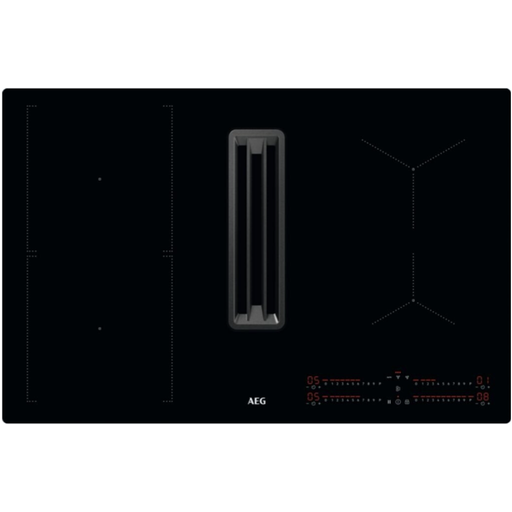
Why this model is a good fit : This 80 cm model combines four cooking zones with an integrated extractor. It is a practical choice for an open-plan kitchen where wall space is limited.
The product details state a connection power of 7.6 kW, installation across two phases and mandatory professional fitting.
Bridge function, Booster on the zones, separate timers, child lock and removable filters advertised as washable.
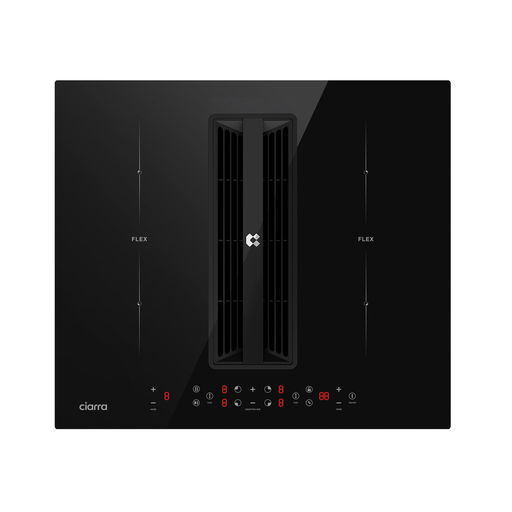
Why this model is a good fit : With its 59 cm format and two flexible zones, it may suit regular cooks with an open-plan or compact kitchen.
The product details specify that CBEHKIT installation accessories are sold separately. Allow for these in your budget and check the 560 × 490 mm cut-out before buying.
Four cooking zones, two FlexiZone areas, nine levels with Booster and an extraction rate stated as up to 484 m³/h in B mode.
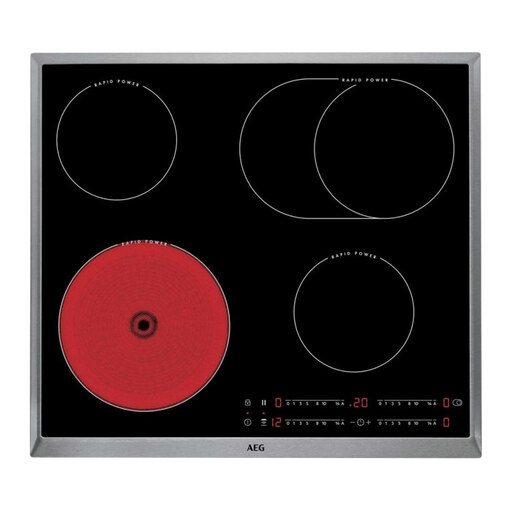
Why this model is a good fit : This built-in ceramic hob does not require you to replace your pans with magnetic cookware. With four zones, it is suitable for versatile everyday cooking.
Ceramic technology works with a wider range of cookware, but the surface remains hot after switching off : take note of the residual heat indicator.
Fourteen power levels, an extendable zone, four timers and a stated cut-out size of 560 × 490 mm.
Before ordering an induction hob, check the underside of every pan you intend to use. A magnetic steel or cast-iron base is essential. The 24 cm and 28 cm SENSARTE frying pans have a magnetic stainless-steel base and are advertised as compatible with induction, gas and several other heat sources.
To protect the non-stick coating, wash them gently, avoid metal utensils and never heat the pan when it is empty. These tips relate to product care and do not constitute a health performance claim.
We have brought together a complete, real-time selection of products that meet these purchasing criteria as well as European safety requirements.
The most common cut-out measures approximately 560 × 490 mm, but some appliances require a 565 × 495 mm opening. Always check the installation diagram for your model before cutting the worktop.
It depends on the power used, cooking time and electricity price. An induction hob heats a compatible pan directly, whereas a ceramic hob first heats its surface. To compare the two technologies, check the stated energy consumption and consider your cooking habits rather than looking only at maximum power.
Its lifespan depends on the quality of the installation, maintenance, frequency of heating cycles and compliance with the manufacturer’s recommendations. Clean the surface once it has cooled, using a non-abrasive product, do not block the ventilation grilles and have the connection checked if the appliance behaves unusually.