
Livraison le jour même ou le lendemain

Qualité garantie

Débloquez vos offres de bienvenue: Livraison GRATUITE | Jusqu'à -80 % | 30 jours d'essai gratuits à JoyPlus
Téléchargez l'application
Whether you're doing a complete kitchen renovation or simply looking to replace your old gas stove, choosing a hob is a crucial decision. Today, the built-in induction hob has become the gold standard: it's faster, safer, and much easier to clean. But with an overwhelming number of options on the market, how do you make the right choice without getting lost in marketing jargon?
Our mission: to guide you step-by-step. We've broken down the essential features and selected the best models to help you find the induction hob that will fit seamlessly into your daily life.
Before you dive in, a few points deserve your attention. There's no need to aim for the most expensive model if you won't use its features in your day-to-day cooking. Let's focus on what's essential.
The number of cooking zones you need depends directly on the size of your household and your cooking habits.
A good induction hob does more than just heat up. Its features are what will truly make a difference in your daily routine.
A seamless fit into your worktop and user safety are two non-negotiable points.
To put theory into practice, we've selected three models with excellent value for money, each tailored to a specific user profile.
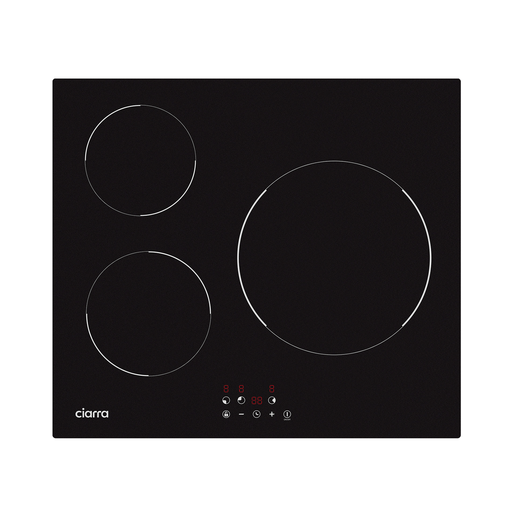
Its standout feature: This model stands out from the crowd with its three-hob configuration, which includes an extra-large 280?mm zone capable of reaching 2600?W. This versatility is a real bonus, allowing you to juggle a small saucepan for a sauce and a huge pot for the main course.
Advantages:
Who is it for? Ideal for families and those who regularly cook with various sizes of cookware. It strikes the perfect balance between the footprint of a standard hob and the need for a large cooking zone.

Its standout feature: At just 30?cm wide, this 2-hob induction hob is the queen of small spaces. Far from being a budget model, it packs all the essentials, including the valuable Boost function on both its zones.
Advantages:
Who is it for? Perfect for studio apartments, kitchenettes, student accommodation, or as a secondary hob in a larger kitchen. It's well-suited for individuals or couples looking for an efficient and ultra-compact cooking solution.

Its standout feature: A true powerhouse of performance and versatility. With four independent hobs, all equipped with the Boost function, and a combined power of 7200?W, this hob is designed for those who refuse to compromise on performance.
Advantages:
Who is it for? Aimed at large families and cooking enthusiasts who enjoy preparing elaborate meals. Its ability to run multiple zones at high power simultaneously makes it a prime ally for demanding cooks.
All the hobs in our selection include a child lock, an indispensable feature. If peace of mind in your home is your top priority, also consider securing other sensitive areas in the kitchen, such as cupboards, drawers, or the oven door.
For complete peace of mind, take a look at our selection of child safety devices.
It's like night and day! A ceramic hob heats a resistor under the glass plate, which then transfers the heat to the pan (a slow and inefficient process). Induction, on the other hand, creates a magnetic field that directly heats the base of the pan, without heating the hob itself. The result: faster, more precise, and more energy-efficient cooking that is much safer, as the surface remains barely warm.
Not necessarily! To be compatible with induction, the base of your pots and pans must contain iron (this is known as a ferromagnetic material). The foolproof trick to check this is to take a magnet (one from your fridge will do) and place it on the bottom of your cookware. If it sticks firmly, you're good to go!
Fitting the hob into the worktop cut-out is fairly simple. However, the electrical connection is another story entirely. High-power models (over 3500?W) require a dedicated electrical circuit and precise know-how to avoid any risks. Our advice: don't play with fire (or in this case, electricity). Always use a qualified electrician for a safe and compliant installation.