What should you check before choosing?
First rule out appliances that won’t fit the housing and its door panel. Features that affect day-to-day use are only useful for comparing models that can actually be installed.
Built-in fridge without a freezer
Worth considering: if you already have a separate freezer and want to use the housing entirely for fresh food.
Trade-off: it won’t replace your freezer, and its housing height and door fixing must also suit the kitchen unit.
Built-in fridge-freezer
Worth considering: if you want to keep the fridge and freezer together behind the housing doors.
Trade-off: the total capacity is split between the two compartments, so check each one separately.
Freestanding appliance with a kitchen refit
Worth considering: if the housing won’t fit the built-in appliances you’re looking for and you’re happy to change your kitchen layout.
Trade-off: you won’t be able to keep the existing door panel and housing as they are; installation becomes a separate kitchen refit project.
| Priority | What to check | What I need |
|---|
| Housing dimensions |
Measure the usable height, width and depth at several points. Compare these with the model’s housing dimensions and installation diagram, not just the appliance dimensions. |
I’m keeping the existing housing, so the new appliance must fit inside it and be secured in place. |
| Door-panel fixing |
Identify whether the door uses sliding rails or is fixed directly to the appliance door. Check the instructions for the installation method, opening direction and any restrictions that apply to the door panel. |
I want to keep my kitchen door panel and make sure both doors open properly. |
| Compartments and capacities |
Decide whether you need an integrated freezer. For a fridge-freezer, compare the fridge and freezer capacities in litres separately, and check the defrosting requirements listed for each model. |
I already have a separate freezer, or I need to keep a freezer compartment in the housing. |
| Energy consumption and noise |
According to the European Commission, fridge energy labels show details including the energy class, annual energy consumption, compartment volumes and airborne noise emissions. Compare these figures for appliances with similar functions and capacities. |
Noise matters to me in an open-plan kitchen, and I also want to compare the annual energy consumption of compatible models. |
| Ventilation and installation |
Locate the air inlets and outlets in the unit, then follow the model’s installation diagram. Check that the appliance is level and the doors close properly once it’s installed. |
I’m keeping the unit, but not at the expense of blocking the airflow needed for installation. |
Which brands should you consider?
These brands publish details of built-in models and installation guidance to help you check whether an appliance will fit. Compatibility always depends on the exact model.
Bosch
Bosch provides details of its built-in, single-door fridges and their fixing systems.
- Bosch’s guidance distinguishes between sliding rails and a door panel fixed directly to the appliance door.
- This guidance doesn’t mean that every Bosch model will fit an existing housing or door panel.
Electrolux
Electrolux offers built-in fridges in several sizes.
- The LFB3DE12S product details include housing dimensions, door fixing, capacity and noise level, which you can check against your kitchen unit.
- The features and specifications listed for this model don’t necessarily apply to other Electrolux models.
Liebherr
Liebherr offers single-door fridges and built-in fridge-freezers with different door-panel fixing systems.
- The product details for the IRe 3900 Pure and ICBSd 5122 Plus BioFresh specify their respective housing dimensions and door systems.
- Check the exact model number: these two models don’t use the same door-panel fixing system.
Whirlpool
Whirlpool offers single-door fridges and built-in fridge-freezers.
- Some Whirlpool product details list the door fixing, noise level and energy class, making it easier to compare specific models.
- Cold and frost management features listed for one model shouldn’t be assumed to apply to the whole range.
Built-in fridges available on Joybuy
This selection includes three built-in fridge-freezers for keeping both compartments in the kitchen unit, plus a single-door built-in fridge to consider if you have a separate freezer. For each one, check the housing, door panel and ventilation requirements before you decide.
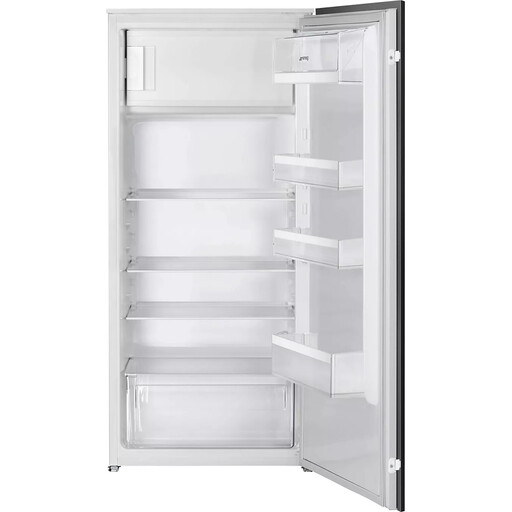 Image unavailable
SMEG S4C122E, 188 L built-in fridge-freezer
A compact freezer for a low housing: the product details list a 56 × 122.5 × 55 cm cavity, sliding-rail fixing, and capacities of 174 L for the fridge and 14 L for the freezer. They also state 146 kWh/year, 35 dB and manual freezer defrosting. The door panel isn’t included, so check the ventilation requirements and make sure your door panel is compatible.
View on Joybuy
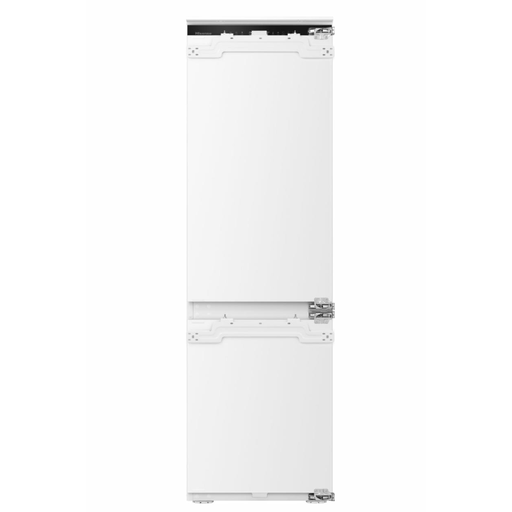 Image unavailable
Hisense RB3B250SAWC, 252 L built-in fridge-freezer
For keeping both compartments in the housing, the product details list a 176 L fridge and a 76 L freezer, as well as door-on-door fixing. They state 150 kWh/year, 34 dB(A), energy class C and No Frost. Check the instructions against your housing and door panel, and make sure the unit’s air vents will remain clear.
View on Joybuy
 Image unavailable
AEG NSC6M18FES, built-in TwinTech No Frost fridge-freezer
If you want to keep the fridge and freezer integrated, this model is listed with sliding-rail fixing, TwinTech Total No Frost, energy class E and 37 dB(A). Check the housing dimensions and ventilation requirements in the instructions, then confirm the capacity of each compartment before comparing it with another fridge-freezer.
View on Joybuy
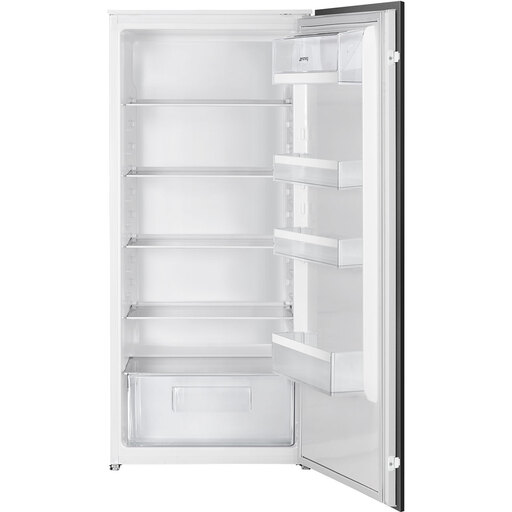 Image unavailable
SMEG S4L120E, single-door built-in fridge
Worth considering if you already have a separate freezer and are looking for a single-door built-in fridge. The product details state 101 kWh/year, 34 dB and automatic defrosting. Check the model’s capacity, housing dimensions and door-panel fixing before choosing it.
View on Joybuy
Frequently asked questions
What should I measure before ordering a built-in fridge?
Measure the usable height, width and depth of the housing, then compare them with the model’s specified housing dimensions, not just the appliance dimensions. Also check the door-panel fixing, opening direction and ventilation route shown in the instructions.
Can sliding rails be replaced with direct door-panel fixing?
Don’t assume the two systems are interchangeable. Bosch describes a rail connecting the doors in a sliding-rail system, while a pantograph-style fixing attaches the door panel directly to the appliance door. Identify your current system and check which one is allowed by the new model’s instructions.
How much ventilation space should I leave in the housing?
Keep clear the air passages shown in the installation diagram for your chosen model. Bosch recommends at least 200 cm² of clear space behind and beneath its fridges in its installation guidance; don’t apply this figure to another model without checking its instructions.
What should I compare on the energy labels of two compatible models?
According to the European Commission, fridge energy labels show details including the energy efficiency class, annual energy consumption, compartment volumes and airborne noise emissions. Once you’ve confirmed that both appliances will fit in your kitchen, compare kWh/year, litres per compartment and noise levels for models with similar functions and capacities.


