Before replacing a dishwasher in a fitted kitchen, check the cabinet space dimensions, plinth and fixings for the existing door panel. Choose a fully integrated model if you want to conceal the appliance and can fit a compatible door panel, or a semi-integrated model if you’re happy to have visible controls. If you can’t keep the integrated look, a freestanding model will change the appearance of your kitchen. Then compare the energy, water and noise figures for models that can be installed.
Who is this option for?
Households keeping their existing door panel
If you want to reuse your cabinet door, compare its dimensions, fixings and movement with the instructions for the new appliance. The cabinet space and plinth must also allow for installation and for the door to open.
Kitchens with a heavy or large door panel
Check the door-panel limits listed for the model you’re considering. For example, Electrolux describes reinforced sliding hinges for heavy, large or double-thickness doors on the KHGB7405L. This doesn’t confirm that your door is compatible with another model.
Households considering removing the door panel
A freestanding appliance may be an option if you’re not keeping the integrated look behind a cabinet door. According to UFC-Que Choisir, it already has its own exterior finish. Still check where it will go and, if you plan to place it under a worktop, whether its top can be removed.
What should you check before choosing?
Decide on the look you want, then check the measurements and the model’s instructions to confirm it can be installed. Once that’s settled, compare the appliances based on how you’ll use them.
Fully integrated
Choose this if: you want to conceal the appliance behind a cabinet door, with the controls on the top edge.
Bear in mind: the door panel and its fixing mechanism must be compatible with the model you choose.
Semi-integrated
Choose this if: visible controls suit the look of your kitchen.
Bear in mind: you’ll still need a compatible door panel below the control panel.
Freestanding
Consider this if: you’re happy to give up the integrated look behind a cabinet door.
The trade-off: the appliance has its own exterior finish and won’t match the integrated look.
| Priority | What to check | What matters to you |
|---|
| Cabinet space and plinth |
Measure the internal width, height and depth of the cabinet space. Compare the plinth height and door-opening clearance with the model’s installation diagram. |
I want the new appliance to fit its space and the door to open without catching on the plinth. |
| Door panel and fixings |
Note the dimensions and weight of the door panel. Check whether it uses fixed or sliding hinges, then consult the model’s instructions for the fixings and door clearance. |
If I keep my cabinet door, I need to be able to attach and open it using the new appliance’s mechanism. |
| Kitchen appearance |
Check whether the controls will be concealed on the top edge or visible on a control panel. For a semi-integrated model, check which door panel is needed below the control panel. |
I want to keep a door panel that matches my cabinets, or I’m happy to have a visible control panel. |
| Installation service |
Ask what’s included for the connections, fitting the door panel and any adjustments to the plinth or cabinetry. Also check the arrangements for taking away your old appliance. |
Before delivery, I want to know who will carry out each step needed for installation. |
| Everyday use |
Once you’ve confirmed the appliance can be installed, compare the energy label figures for kWh per 100 cycles, litres per reference cycle, Eco cycle duration and noise in dB. The ADEME explains what these figures mean. |
Noise matters to me in an open-plan kitchen. I also want to compare water use, energy use and cycle duration on the same basis. |
What mistakes should you avoid?
-
Relying on the stated width alone
A width of 60 cm or 45 cm doesn’t tell you whether there’s enough height and depth, or whether the plinth or door movement will cause a problem.
Measure the inside of the cabinet space and compare all the dimensions with the installation diagram for the model you’re considering.
-
Assuming the old door panel will fit in exactly the same way
Bosch distinguishes between fixed-door and sliding-door fittings. Check that the hardware and door movement will work with the new appliance.
Note the details of the door you’re keeping, then check the fixings, template and limits in the model’s instructions.
If the door panel isn’t compatible, you may need to replace it or adapt the cabinetry.
-
Assuming delivery includes full installation
What’s included depends on the service. Electrolux says its pre-installation service doesn’t include fitting or covering the door panel, or any carpentry work.
Before ordering, ask the retailer or installer to confirm what’s included for the connections, levelling, door panel, plinth and any adjustments that may be needed.
-
Comparing energy labels before checking the appliance will fit
Energy, water and noise figures won’t tell you whether a door panel can be fitted or whether the door will clear the plinth.
Check the cabinet space and door fitting first, then use the figures on the energy label, as explained by the ADEME, to compare compatible models.
A guide to the brands
Bosch
Bosch’s documentation covers fixed-hinge and sliding-hinge fittings. Check which is suitable for your kitchen door and plinth.
- Bosch lists dimensions of 815 × 598 × 550 mm and the VarioHinge system for the fully integrated SMH6ECX21E.
- These details don’t confirm that a particular door panel can be reused. Compare its measurements and fixings with the model’s installation instructions.
Electrolux
Some fully integrated Electrolux models are worth considering if your cabinet door is heavy or large.
- Electrolux lists reinforced sliding hinges for heavy, large or double-thickness doors on the KHGB7405L.
- This information applies to this model. Check its door-panel limits and installation diagram to see if it will suit your kitchen.
Miele
Miele’s range of fully integrated models offers a concealed finish behind a cabinet door, subject to installation compatibility.
- For the G 7293 SCVi Excellence, Miele lists an A energy rating, 43 dB, 8.4 L for the Eco programme and 54 kWh per 100 Eco cycles.
- These usage figures don’t replace checking the cabinet-space dimensions and door-panel fixings for this specific model.
Fully integrated models on Joybuy
These two dishwashers are designed for fitted kitchens where the appliance needs to be concealed behind a door panel. Before reusing your door, compare its fixings, the cabinet space and the plinth with the instructions for your chosen model.
 Image unavailable
Samsung DW80H72YBB0U1 — 60 cm, 13 place settings, B energy rating
Worth considering as a replacement behind a door panel: this model is described as fully integrated, with a fixed hinge. Check the instructions for the cabinet-space dimensions, plinth clearance and door-panel fixings. Before comparing it with other appliances, confirm the noise level on the product details for the variant you’ve chosen.
View on Joybuy
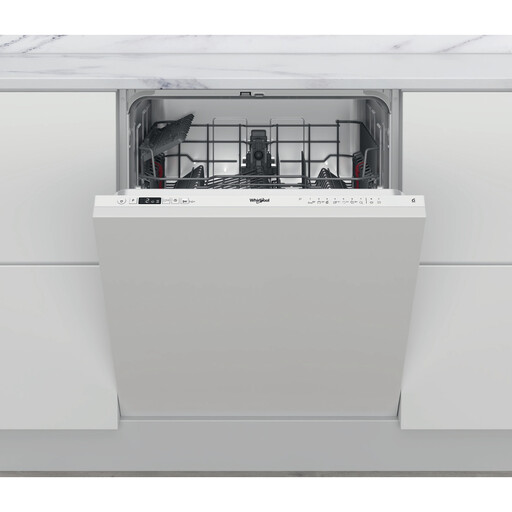 Image unavailable
Whirlpool W2I HD526 A — 60 cm, 14 place settings, E energy rating
This model is described as fully integrated, making it suitable for a fitted kitchen. Before keeping your existing door panel, check the instructions for the hinge or sliding mechanism, cabinet-space dimensions and plinth clearance. To compare it with other models, check the water and energy figures on its label.
View on Joybuy
Frequently asked questions
Can I reuse the door panel from my old dishwasher?
Yes, provided its dimensions, fixings and movement are compatible with the new model. Check whether it uses fixed or sliding hinges, the clearance above the plinth and the template specified in the instructions. An old door panel won’t necessarily fit a new appliance.
What’s the difference between fully integrated and semi-integrated?
A fully integrated dishwasher is concealed behind a cabinet door, with the controls on the top edge. A semi-integrated model has a visible control panel. Both require a compatible door panel; on a semi-integrated model, it sits below the control panel.
Does installation include fitting the door panel?
Not necessarily. Electrolux says its pre-installation service excludes fitting and covering the door panel, as well as carpentry work. Before delivery, ask your chosen installer to confirm exactly what they’ll do.
What should I compare on the energy label once installation is confirmed?
Compare the energy rating, kWh per 100 cycles, litres per reference cycle, Eco cycle duration and noise level in dB, including its rating. The ADEME explains these figures for dishwashers. Use them to compare models that are already suitable for installation in your kitchen.


