You’re replacing a built-in appliance
If you’re keeping the cabinet space, plinth and door panel, check their dimensions and the door mechanism before comparing the new appliance’s features.


Choose a fully integrated model if you want to hide the appliance behind a matching cabinet door, or a semi-integrated model if you’d prefer the controls to remain visible. In either case, measure the cabinet space and plinth, then check the door mechanism and panel fittings in the instructions for the exact model. Only consider a freestanding appliance if you can change your kitchen layout.
If you’re keeping the cabinet space, plinth and door panel, check their dimensions and the door mechanism before comparing the new appliance’s features.
You can choose the cabinet, door panel and appliance together. A fully integrated model is concealed when the door is closed, as long as you allow for a compatible door panel and its installation.
The available width will help you choose between 45 cm and 60 cm models. If you have an open-plan kitchen, also compare the noise level on the label, along with water and electricity use for the reference programme.
Consider this if: you want to conceal the appliance completely behind a door panel that matches your kitchen units.
You’ll need: a suitable door panel and the right fittings. The controls won’t be visible on the front of the door.
Consider this if: you want the control panel to remain visible at the front.
You’ll need: a cabinet door panel below the control panel, which will remain visible.
Consider this: only if you can change your kitchen layout and no longer need the appliance to fit into the cabinet space.
Bear in mind: the appliance won’t be concealed behind a kitchen door panel.
| Priority | What to check | Your needs |
|---|---|---|
| Cabinet space, door and panel | Measure the width, usable height, depth and plinth. Check the instructions for the door movement, door panel dimensions and fittings. Bosch recommends looking at sliding-door systems if your plinth is less than 9 cm high; always check the exact model reference. | I want the appliance to fit in the cabinet, but I also need the door to open without hitting the plinth and the chosen panel to fit securely. |
| Width and loading | Compare the model’s width with the cabinet space: UFC-Que Choisir distinguishes between 45 cm and 60 cm built-in models. Then check the stated place-setting capacity and the basket layout. | If the cabinet space is narrow, I’m looking for a model that will fit. If I have a wider space, I want to load my usual dishes without overlooking the internal layout. |
| Noise and consumption | On the labels of the models you’re comparing, check the kWh per 100 cycles, litres per cycle and noise level in dB. Bear in mind which programme these figures relate to. | My kitchen is open-plan or I use the dishwasher often, so I want to compare noise and consumption on a like-for-like basis, rather than looking at the energy rating alone. |
| Installation and connections | Check access to the water supply, drainage and electricity. Ask separately whether removal of the old appliance, fixing the dishwasher to the cabinet, fitting the door panel and any work on the plinth are included. | I’m replacing an appliance in an existing kitchen and want to know what work will be carried out to install the new model. |
Two 45 cm or 60 cm models can have different heights, depths and door mechanisms. Even if a door panel fits the cabinet space, it could still hit the plinth when opened.
Take all the necessary measurements and compare them with the installation diagram for the exact model, including the clearance needed for the door.
A fully integrated model hides the appliance behind a door panel, while a semi-integrated model leaves the control panel visible. UFC-Que Choisir notes that freestanding models already have their own outer casing.
First choose an installation type that works with the kitchen units you’re keeping, then check what kind of door panel you’ll need.
Connecting the appliance and fitting the door panel are separate tasks. If a necessary task isn’t included, you may need to arrange another visit before the appliance can be used.
Ask for written confirmation of what’s included, such as removal of the old appliance, connections, fixing the dishwasher to the cabinet, fitting the door panel and any work on the plinth.
The energy rating alone doesn’t tell you the kWh per 100 cycles, water use per cycle or noise level. In an open-plan kitchen, it’s worth checking the noise level separately.
Compare the label figures for models that fit your cabinet space, taking into account the stated reference programme.
Bosch offers built-in dishwashers in different heights, as well as models with fixed or sliding doors.
The French range includes built-in models with a visible control panel, as well as fully integrated models.
Electrolux offers, among other options, 60 cm fully integrated dishwashers.
Miele also offers fully integrated models designed for narrow cabinet spaces.
These two 60 cm models are for kitchens designed for a fully integrated dishwasher. Before choosing one, check its instructions against your cabinet space, plinth and the door panel you plan to fit.
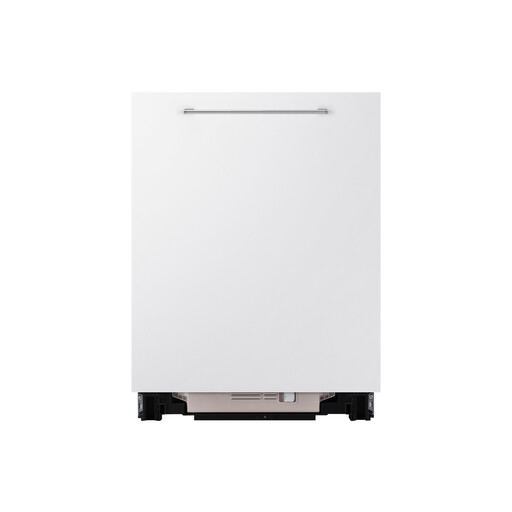 Image unavailable
Worth considering for a cabinet space designed for a 60 cm fully integrated appliance. The product title lists 13 place settings and a B energy rating; check the installation dimensions and door panel compatibility in the instructions.
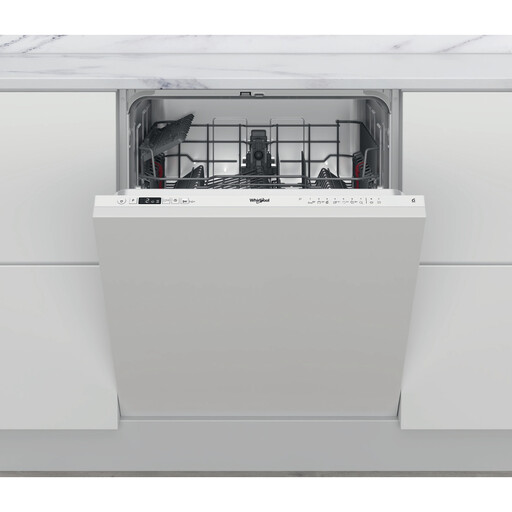 Image unavailable
Another model to consider for a cabinet space that can accommodate a 60 cm fully integrated appliance. The product title lists 14 place settings and an E energy rating; check the door mechanism, door panel fittings and dimensions in the instructions.
Measure the width, usable height and depth of the cabinet space, then the height of the plinth and the dimensions of the door panel. Compare these measurements with the installation diagram for the exact model, paying particular attention to the clearance needed to open the door.
Yes, if its dimensions, weight and fittings are suitable for the new dishwasher. Check the instructions for your chosen model: don’t assume that a panel fitted to a fixed door will work with a sliding-door system.
A dishwasher needs a water supply, a waste outlet and an electricity supply, as UFC-Que Choisir points out. Check where they are located and follow the installation instructions for your chosen model.
Not necessarily: connecting the appliance and fitting the door panel may be separate tasks. Before ordering, ask exactly what’s included, particularly the door panel fittings and any work needed on the plinth.