How do the two options compare?
Your choice depends first on the space available and whether you need to use two appliances at the same time. A standalone built-in oven doesn’t meet your microwave needs unless you have a microwave available elsewhere.
Built-in combi oven
Consider this if: you need one housing unit for both microwave and convection functions.
Bear in mind: you can’t use the oven and microwave functions in two separate cavities at the same time.
Separate oven and microwave
Consider this if: you have space for two appliances and want to use them independently.
Bear in mind: each appliance has its own installation, maintenance and servicing requirements.
| Criteria |
What to check |
Who it matters to |
| Functions in one housing unit |
Check the microwave, convection and combination modes available on the model, then confirm its built-in dimensions. |
When there’s only room for one housing unit, I want an appliance that can handle both reheating and oven cooking; around 33% of consumers make this their top priority. |
| Capacity and simultaneous use |
Compare the cavity with the dishes you usually cook and decide whether you’ll sometimes need to cook and reheat at the same time. |
For large dishes or reheating while something is cooking, I prioritise capacity and two independent functions; this is the top priority for around 27% of consumers. |
| After-sales support |
Check the manuals, parts information and service terms for the model you choose. |
If several functions depend on a single oven, I want to know how it can be maintained if something goes wrong; reliable service is the top priority for around 20% of consumers. |
| Energy use |
Compare data for the model and cooking mode, using similar dishes and loads. |
I don’t want to assume how much energy I’ll use based solely on the presence of a microwave mode; around 20% of consumers prioritise an energy comparison suited to the way they cook. |
Brands and models to consider
These examples can help you compare the formats and features of specific models. They don’t necessarily reflect other models from each brand.
Bosch
The CMG7241B1 is an example of a compact built-in oven with a microwave function.
- Bosch lists this model as measuring 455 × 594 × 548 mm, with a 45 L cavity and a maximum microwave power of 900 W.
- These appliance dimensions don’t replace the installation diagram you’ll need to check whether it fits your housing unit.
Electrolux
The KVLAE2XH is a compact combi oven to consider, with microwave, fan cooking and combination modes among its features.
- Electrolux specifies a housing unit measuring 450 × 560 × 550 mm and a 44 L cavity for this model.
- Check the manual for installation requirements and the functions included in the version on offer.
Siemens
The CM585AMS0 and HN978GQM1 are two microwave combi oven formats to consider, depending on the space available.
- Siemens lists a 44 L capacity for the compact CM585AMS0 and 67 L for the 60 × 60 cm HN978GQM1.
- These models suit different housing unit sizes and capacity needs; check their functions and installation documents separately.
Sauter
Two Sauter models appear in separate categories in the National Consumer Institute and ADEME study.
- The sample included the SKC6302LW combi oven and the SOP2434X convection oven.
- Results for these models don’t represent the performance of the entire Sauter range.
Samsung
The NQ5B6753CAK was among the built-in combi ovens assessed by the National Consumer Institute and ADEME.
- This model was one of the four combi ovens included in their energy test.
- The small number of combi ovens tested and differences in energy use between models mean the results can’t be applied to the entire brand.
Built-in ovens for use with a separate microwave
These built-in ovens suit the option of keeping oven cooking in a dedicated appliance. If you also want to reheat food in a microwave, allow space for a separate appliance and check the functions and built-in dimensions of each model.
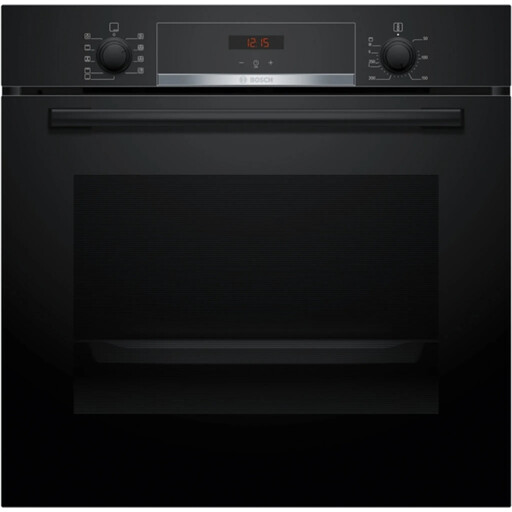 Image unavailable
Bosch HBA514BB3 built-in oven, 71 L
Consider this if you’re looking for a built-in oven dedicated to cooking and have a separate microwave.
- Stated capacity: 71 L; the product name mentions 3D hot air cooking.
- Check the housing unit dimensions against the manual before buying.
- Confirm the number of compartments for this model with the seller.
View on Joybuy
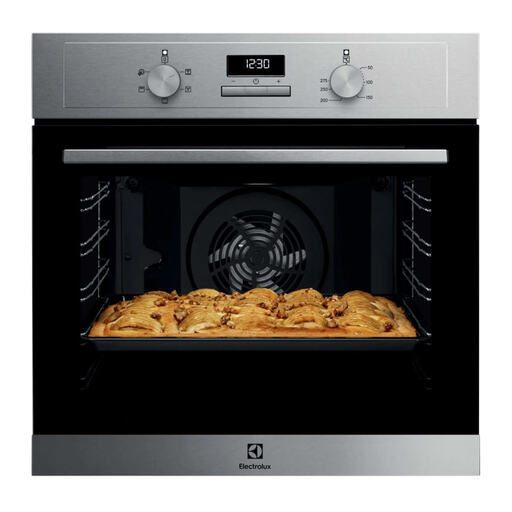 Image unavailable
Electrolux EOM3H00X AirFry built-in oven, 72 L
Consider this if you want a dedicated oven cavity for cooking, with a separate microwave for reheating.
- Stated capacity: 72 L; the product name mentions the AirFry function.
- Check the manual for housing unit dimensions and ventilation requirements before choosing this model.
View on Joybuy
Frequently asked questions
Is a housing unit described as “45 cm” enough to choose a compact combi oven?
No. Check all three built-in dimensions and the model’s installation diagram, including its ventilation requirements. For example, Electrolux specifies a 450 × 560 × 550 mm housing unit for the KVLAE2XH; this doesn’t apply to other models.
Does a combi oven always use less energy than a convection oven?
No. You can’t assume one type of appliance will always save energy. The National Consumer Institute and ADEME test, which covered four combi ovens and ten built-in convection ovens, found no significant overall energy difference between the groups tested. Compare model data based on the way you cook.
Does a faster stated cooking time mean lower energy use?
No. A faster cooking function doesn’t, on its own, tell you how much energy is used. To compare two modes, look at data for a similar dish, load and cooking result.
What protection applies if an oven bought in France is faulty or not as described?
If a consumer buys an oven from a professional seller in France, the statutory guarantee of conformity applies to new, second-hand and refurbished goods, according to the Directorate-General for Competition Policy, Consumer Affairs and Fraud Control. A commercial warranty is separate from the statutory guarantee and doesn’t replace it.


