
Livraison le jour même ou le lendemain

Qualité garantie

Débloquez vos offres de bienvenue: Livraison GRATUITE | Jusqu'à -80 % | 30 jours d'essai gratuits à JoyPlus
Téléchargez l'application
The brush pen has become a favourite tool for artists, illustrators, and crafting enthusiasts. And for good reason: its flexible tip combines the grace of a traditional paintbrush with the simplicity of a pen. Whether you're into calligraphy, drawing, adult colouring, or addicted to your bullet journal, the right set of pens can literally transform your work.
But with a dizzying array of options, how do you find your way? Should you opt for watercolour pens? A single tip or a dual tip? As a product expert at Joybuy, my mission is simple: to give you the keys to making the right choice, fully informed and free from marketing jargon. This guide gets straight to the point to help you find the pen set that perfectly matches your projects and your style.
Before diving into our selection, let's review the key points that will help you find the perfect drawing markers for you.
This is the core component of your brush pen. A single, flexible tip is perfect for calligraphy and lettering. It glides across the paper, allowing you to modulate your strokes with incredible ease to create those famous thick and thin lines.
Dual-tip pens, on the other hand, offer maximum versatility. They typically combine:
This duo is particularly effective for illustration, manga, or managing your journal, where fine details are just as important as expressive freedom.
The type of ink determines the full creative potential of your pens. Watercolour pens, with their water-based ink, can be reworked almost infinitely with a wet brush, even after they've dried. This opens up a world of possibilities:
These pens are a blessing for illustration and adult colouring, unlocking immense creative potential without the clutter of extra supplies. A word of advice: for a flawless finish, use dedicated watercolour paper that is thick enough (high grammage) to prevent buckling when wet.
The choice of colours is, of course, crucial. A lettering pen set with a dozen shades is perfect for getting started. For complex illustrations or subtle colour schemes, a brush pen case with 36, 60, or even over 100 colours will offer you near-infinite freedom.
Also, consider the mood you want to create: bright, saturated hues will bring your characters to life, while pastel or earthy tones are perfect for landscapes or more delicate atmospheres. The icing on the cake? Some sets include a colourless "blender" pen—the magic tool for seamlessly merging colours and achieving flawless transitions.
Here are three options that stand out for their quality, versatility, and the creative possibilities they offer.
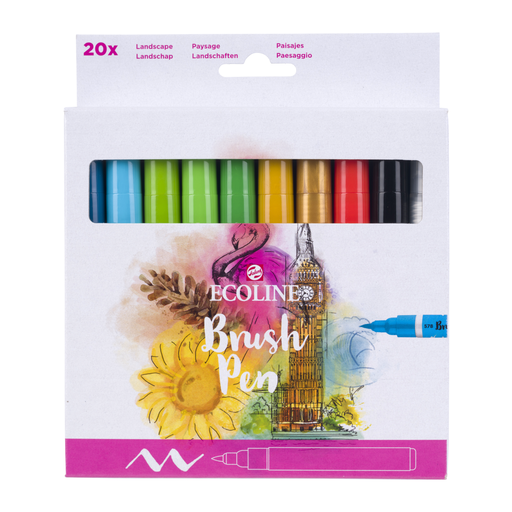
Why it stands out: This set is the ultimate portable watercolour studio. Ecoline ink, formulated with pure dyes and gum arabic, is renowned for its unparalleled brilliance and transparency. It guarantees watercolour effects with striking intensity.
Pros:
Who is it for? Illustrators and artists seeking luminous colours and an authentic watercolour finish. Perfect for those who want professional-grade ink without the hassle.
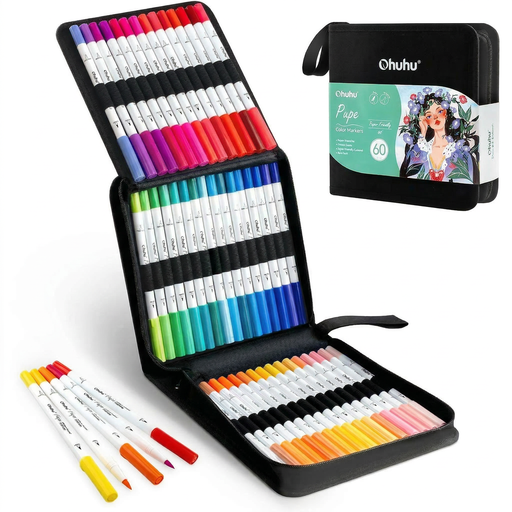
Why it stands out: The creative's Swiss Army knife! This case is a true all-in-one solution. With 60 colours and a dual tip, it delivers on all fronts, from visual note-taking to modern calligraphy.
Pros:
Who is it for?Bullet journal enthusiasts, hand lettering fans, and illustrators (beginners or advanced) looking for a complete arsenal of colours and the versatility of a dual tip.
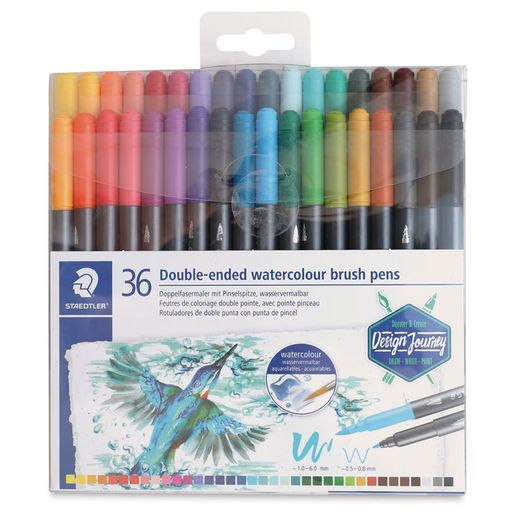
Why it stands out: The reliability of a major brand dedicated to creativity. This STAEDTLER set is the perfect balance of quality and versatility. It features a well-designed palette of 36 colours and the practicality of a dual tip, with high-quality pigmented ink.
Pros:
Who is it for? Artists of all levels, from students to seasoned hobbyists. A reliable choice for illustration, adult colouring, mixed-media projects, and brush lettering.
Our selection highlights versatile products, but every artist has unique needs. If you're looking for sets with more colours, alcohol-based inks, or specific tips, other options are available.
? Explore our full collection of watercolour drawing pens to discover other brands and formats.
1. What is the difference between a brush pen and a classic marker? It's all in the tip! A classic marker has a rigid nib (chisel or bullet) that delivers a line of uniform thickness. The brush pen, however, has a long, tapered, and flexible tip. This flexibility is what changes everything: by varying the pressure, you can modulate the line width from an ultra-fine line to a generous wash, just like with a real paintbrush.
2. How do you use watercolour pens? Several techniques are at your disposal. The most direct method: apply the colour to the paper, then go over it with a slightly damp brush to dilute and spread it. Another method, closer to traditional watercolour: dab some ink onto a palette (a ceramic saucer or a piece of plastic will do) and pick it up with a wet brush. Finally, for perfect gradients, apply two colours side-by-side and merge them with a damp brush or your blender pen.
3. What paper should I use with a brush pen? Paper choice is critical to avoid two mortal enemies: ink bleeding and paper pilling. For watercolour pens, definitely opt for watercolour paper (cold-pressed, with a weight of at least 200 g/m?). For all other brush pens, a smooth and fairly thick drawing paper (like Bristol, layout, or special marker paper) is ideal. It will preserve the vibrancy of your colours and the sharpness of your lines.