For baby-led weaning, a brioche multipack isn’t a priority purchase: Santé publique France recommends limiting sugary and fatty foods for young children. If you’re thinking of offering brioche occasionally, compare the ingredients and allergens before choosing between slices to portion out and individual pieces to take with you. For a school lunchbox, also check the school’s rules and, if your child has one, their individual healthcare plan (PAI).
Who are these options for?
Parents keeping an eye on sugary foods
You’re considering brioche as an occasional treat and want to compare sugar levels and serving sizes, rather than choosing based on convenience alone. Santé publique France recommends limiting sugary and fatty foods for young children.
Families preparing food to take out
For home, a day out or a lunchbox, sliced brioche you can portion out and individual rolls you can count serve different needs. The format alone doesn’t determine how much to serve your child.
Families managing allergies or school requirements
Depending on the recipe, the brioche products featured here contain ingredients such as wheat, eggs or milk. Before sending brioche to school, check the pack you’ve bought and the requirements that apply to your child, including those in their individual healthcare plan if they have one.
What should you check before buying?
If you’re considering brioche as an occasional food during baby-led weaning, check the ingredients and allergens first; then choose a format to suit how you plan to use it.
| Consideration |
What to check |
Who it matters to |
| Sugar and frequency |
Compare the “of which sugars” figure per 100 g across recipes, then consider how much you plan to serve. |
If I sometimes offer brioche to a young child, I want to compare sugar levels without making it a regular habit. Around 42% of consumers would put managing sugar intake and frequency first. |
| Allergens and school |
Read the ingredients and any “may contain” information on the pack you’ve bought; check the school’s rules and the PAI, if applicable. |
Before preparing a lunchbox, I need to know whether this recipe meets my child’s dietary restrictions and the school’s requirements. Around 33% of consumers would prioritise managing allergens and these requirements. |
| Sharing and taking it with you |
Check the number of pieces or slices, whether the bag can be resealed and the storage instructions. |
For a day out or sharing with the family, I want a format that makes it easy to portion out, without mistaking a whole piece for the right amount to serve. Ease of sharing and transport would come first for around 25% of consumers. |
Common mistakes to avoid
-
Assuming “less sugar” means you can eat it more often
Brioche Pasquier lists 8.8 g of sugars per 100 g for its Brioche Tranchée -30 % de sucres. This figure lets you compare recipes, but it doesn’t change Santé publique France’s guidance to limit sugary foods for young children.
Compare the nutritional values per 100 g, and factor in both frequency and serving size when making your decision.
-
Trusting the format without checking the allergens
A brioche that’s easy to take with you may contain wheat, eggs or milk, depending on the recipe, and may also carry “may contain” warnings. The packaging format doesn’t tell you whether it’s suitable for a child with dietary restrictions.
Check the ingredients and any “may contain” information on the pack you’ve bought, then check the school’s requirements before preparing a lunchbox.
-
Assuming one individual piece is the right portion
A small roll or bite is a unit of sale, but it isn’t necessarily the amount you want to serve your child.
Decide how much to offer based on your child and how you plan to use it, rather than letting the pack size make the decision for you.
Brands to compare
Brioche Pasquier
Two sliced brioche products from the brand let you compare a plain recipe with one labelled “-30% sugar”.
- Brioche Pasquier lists 12 g of sugars per 100 g for its Brioche Tranchée Nature and 8.8 g per 100 g for its Brioche Tranchée -30 % de sucres.
- Both product listings mention wheat and eggs; the plain recipe also mentions butter. Being pre-sliced doesn’t mean the slices are individually wrapped.
Harry's
Harry's offers a Brioche Tranchée Nature and a Brioche Tranchée Complète, both described by the brand as “additive-free”.
- For its Brioche Tranchée Complète, Harry's lists 7 g of fibre and 15 g of sugars per 100 g. Consider these figures together rather than assuming wholemeal flour alone makes it a recommended choice.
- The recipes reviewed contain wheat and eggs, as well as butter or milk depending on the product. The brand also warns that they may contain traces of soya, nuts and sesame.
Carrefour, distributeur
A Carrefour listing features Regent's Park brioche rolls in a pack of six: this is a product by that brand, sold by the retailer.
- The number of pieces shown on the listing helps you plan for sharing or taking them with you.
- The listing mentions wheat, milk and eggs, as well as possible traces of soya and mustard. This information doesn’t apply to other brioche products sold by Carrefour.
A brioche option on Joybuy
This option is for savoury brioche bites to share after baking, not ready-to-eat sliced brioche for a lunchbox.
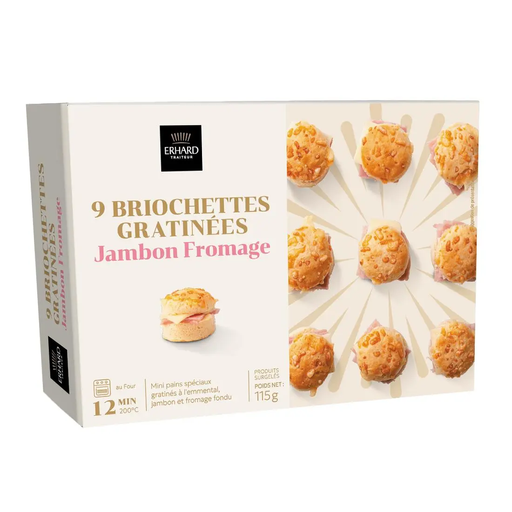 Image unavailable
ERHARD mini ham and Emmental brioche bites x9, 115 g
For sharing at home, this pack contains nine savoury brioche bites. They must be thoroughly cooked before eating, so don’t put them straight into a lunchbox. Check the pack for storage instructions, salt content and allergens, including gluten, milk and eggs. The number of bites doesn’t mean they’re individually wrapped.
View on Joybuy
Frequently asked questions
Is brioche a priority food during baby-led weaning?
No. Santé publique France describes weaning as a gradual move towards a varied diet and recommends limiting sugary and fatty foods for young children. If you’re thinking of offering brioche, treat it as an occasional food rather than the main part of a meal.
How can I compare two packs of brioche?
Compare the nutritional information per 100 g, particularly sugar, fat and salt, then check the ingredients and allergens. In France, the DGCCRF states that the nutrition declaration for relevant food products is given per 100 g or 100 ml. This makes it possible to compare packs of different sizes.
Is an individually wrapped format always better for a lunchbox?
No. It may make food easier to carry or count, but it doesn’t guarantee a particular nutritional profile or a suitable amount for your child. Slices prepared at home can also work if you want to adjust the portion. Either way, check the recipe and the school’s requirements.
What should I check before sending brioche to school in France?
Check the allergens on the pack you’ve bought and ask about the school’s requirements. France’s Ministry for the Economy states that allergens in pre-packed foods must be listed and highlighted. If your child has an individual healthcare plan, follow its arrangements: the Ministry of National Education explains that such a plan can include adjustments to meet a child’s needs.


