When choosing a brioche for your children’s snack, first check the allergens and the school’s rules, then compare the recipe and the nutritional information on the pack. A lower-sugar brioche, an additive-free recipe and a richer, buttery brioche each meet different priorities; none of these claims alone guarantees that a product is suitable for your child.
Who is this guide for?
Families navigating school rules or food allergies
Before choosing a recipe, check the brioche’s allergens and the arrangements for snack time. France’s Ministry of National Education states that an individualised support plan, or PAI, can include adjustments for a pupil with a food allergy.
Families comparing nutritional information
Check the sugars, fibre and other nutritional values per 100 g, then consider the portion you’ll serve. If the pack displays a Nutri-Score, use it to complement your assessment, not as a substitute for the ingredients list.
Families looking for an indulgent recipe
Butter, eggs, sourdough starter or a regional speciality can all help you choose a brioche for an occasional treat. Remember to compare the fat and saturated fat content shown on the pack, too.
What should you check first?
If the snack is for school, start with the school’s rules and, where relevant, those set out in the PAI. Then compare suitable brioches based on what matters most to your family.
| Criteria |
What to check |
Who is it for? |
| Allergens and school rules |
The ingredients, any ‘may contain’ warnings, and the school’s or PAI’s requirements for the exact product. |
If my child has an allergy, or their school has rules for snacks, I need to choose a product that meets those requirements. This is the top priority for around 33% of consumers. |
| Nutritional values |
Sugars, fibre and other values per 100 g across comparable brioches, followed by the portion served. |
For a regular snack, I want to compare recipes rather than rely on a claim on the front of the pack. Around 27% of consumers prioritise this nutritional comparison. |
| Indulgent recipe |
Featured ingredients such as butter, eggs or sourdough starter, as well as saturated fat. |
For an occasional snack, I’m mainly looking for a recipe with ingredients that appeal to me. Around 20% of consumers put the recipe ahead of other criteria. |
| Convenient format |
Net weight, number of slices and how easy it is to prepare portions. |
When I’m preparing several snacks, I prefer to know how many slices are in the pack. Pack size and portioning are the top priority for around 20% of consumers. |
Common misconceptions to avoid
-
Assuming ‘organic’ or ‘additive-free’ means ‘allergen-free’
These claims describe different characteristics. Auchan’s product listing for Harrys classic brioche, for example, lists wheat, eggs and milk, and warns that it may contain traces of other allergens.
Check the ingredients and any ‘may contain’ warnings on the pack of the product you’re buying, especially if a PAI applies.
-
Taking ‘less sugar’ to mean ‘sugar-free’
Brioche Pasquier lists 8.8 g of sugars per 100 g for its ‘-30% sugar’ sliced brioche. The stated reduction is a comparison; it doesn’t mean the product contains no sugar.
Compare the sugars per 100 g in brioches of the same type and consider the portion you plan to serve.
-
Choosing a buttery recipe without checking its nutritional values
Auchan’s product listing for a braided brioche states that it contains 16% butter and 12 g of saturated fat per 100 g. The proportion of butter alone doesn’t tell you its nutritional profile.
If the recipe appeals to you, also check the fat and saturated fat per 100 g.
-
Relying on the Nutri-Score alone
Santé publique France describes the Nutri-Score as a complement to nutritional information. E.Leclerc notes that the Nutri-Score D shown on its Epi d’Or brioche listing is based on the previous calculation method, which applied before April 2025.
Check the detailed values and ingredients, and, where stated, which version of the calculation is shown.
Brands and ranges to compare
Brioche Pasquier
Plain sliced brioches and a lower-sugar option, to compare according to the recipe you’re looking for.
- For its ‘-30% sugar’ product, Brioche Pasquier states a Nutri-Score B, 8.8 g of sugars and 7.4 g of fibre per 100 g.
- The products described contain wheat and eggs, so the sugar claim doesn’t tell you whether they’re suitable for someone with an allergy.
Harrys
The range includes a classic sliced brioche marketed as additive-free, as well as a lower-sugar option.
- Auchan’s listing for the classic recipe makes it easy to check the ‘additive-free’ claim.
- The same listing shows that it contains wheat, eggs and milk, and may contain traces of soya, nuts and sesame.
Epi d’Or (Marque Repère / E.Leclerc)
A sliced brioche worth looking at in terms of pack size and ingredients.
- E.Leclerc’s listing describes a 500 g pack containing 18 slices, made with wheat flour, fresh eggs and concentrated butter.
- The Nutri-Score D shown on this listing is based on the previous calculation method, which applied before April 2025.
Auchan, gamme Viennoiseries
A braided brioche cut into thick slices, with a recipe that highlights butter, fresh eggs and sourdough starter.
- Auchan’s listing states that this product contains 16% butter.
- It also lists 12 g of saturated fat per 100 g and contains wheat, eggs and butter.
Nos Régions ont du Talent (E.Leclerc)
A sliced Vendée brioche with PGI status, to consider if you’re looking for a regional speciality and declared ingredient origins.
- E.Leclerc’s listing states that the flour, eggs and butter in this product are sourced from France.
- Its Nutri-Score E, based on the previous calculation method, should be considered alongside the detailed nutritional values.
A brioche for a delicious snack
This Joybuy selection features a butter brioche for families who prefer this type of recipe. If you’re packing a school snack, check the pack label and follow any applicable rules before choosing it.
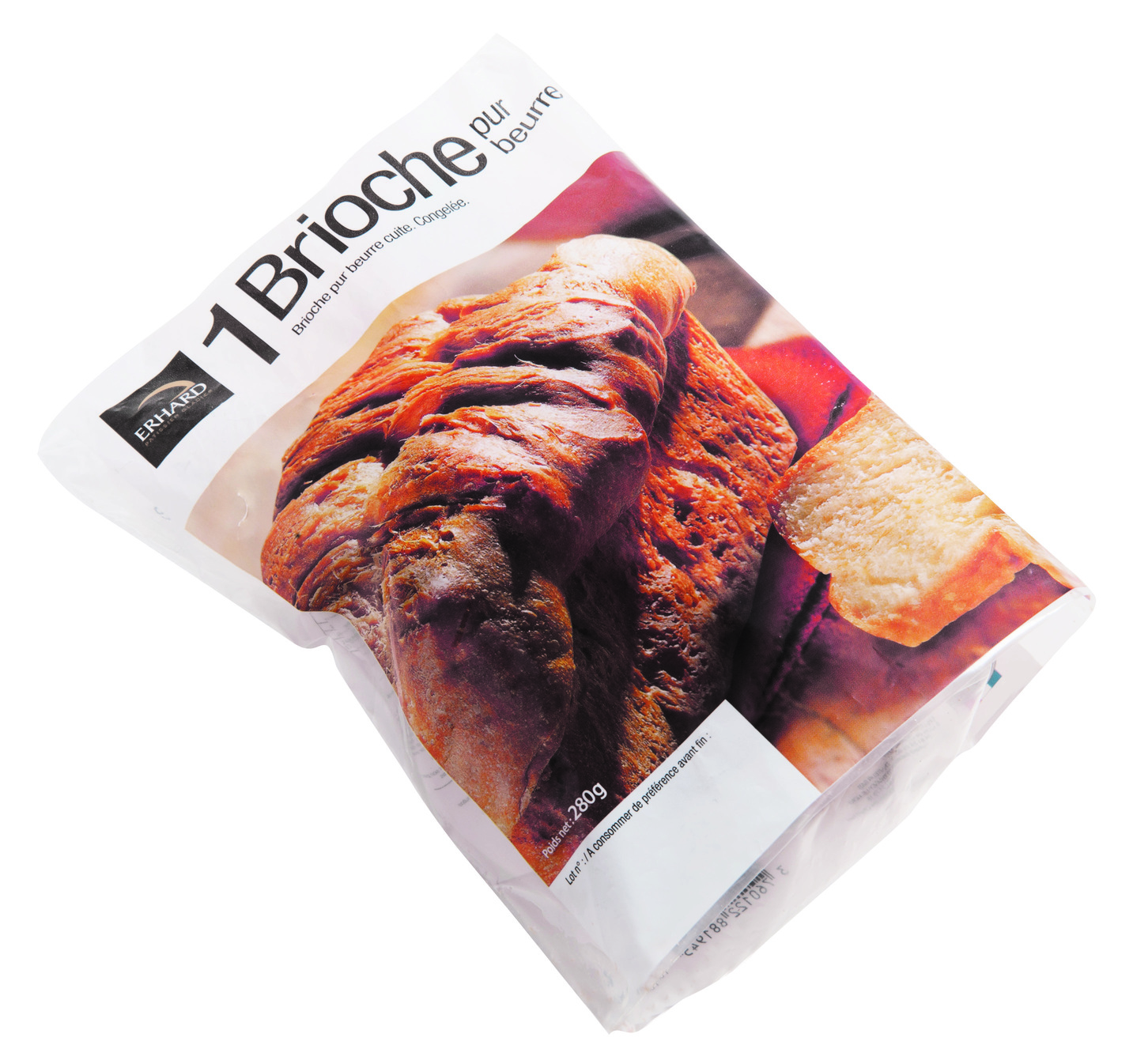 Image unavailable
ERHARD Pure Butter Brioche 280 g
Worth considering if you’re looking for a butter brioche for a delicious snack. The pack is listed as 280 g. If you’re preparing several portions, check how many slices it contains, as well as the allergens and any ‘may contain’ warnings on the packaging before packing it for school.
View on Joybuy
Frequently asked questions
Is a brioche described as ‘premium’ automatically suitable for children’s snacks?
No. This description alone doesn’t tell you about allergens or nutritional values. Compare the ingredients, sugars, fat and portion size of the brioche you’re considering, then check any school rules that may apply.
Is the Nutri-Score enough to choose a brioche?
No. Santé publique France presents it as an additional guide, so check the ingredients, allergens and nutritional values per 100 g as well. If the listing says the score is based on an older calculation method, bear this in mind when comparing products.
What should you check before taking brioche to school if your child has an allergy?
Check the label on the exact product and the arrangements agreed with the school. France’s Ministry of National Education states that a PAI can include adjustments for a pupil with a food allergy. The rules for snack time should reflect what has been arranged for that child.
Is an additive-free brioche also allergen-free?
No. Auchan’s listing for Harrys classic additive-free sliced brioche shows that it contains wheat, eggs and milk, and may contain traces of soya, nuts and sesame. Always check the information on the specific product you buy.


