
Livraison le jour même ou le lendemain

Qualité garantie

Débloquez vos offres de bienvenue: Livraison GRATUITE | Jusqu'à -80 % | 30 jours d'essai gratuits à JoyPlus
Téléchargez l'application
Positioned between a compact camera and a DSLR, the bridge camera appeals to many photography enthusiasts. Its secret? The perfect compromise between the simplicity of a compact and the versatility of a DSLR. Its key advantage is a super-powerful zoom, all in a single body, without the hassle of interchangeable lenses. But be warned, the market is a jungle of often misleading marketing promises. Before you take the plunge, it's essential to know the pitfalls to avoid to ensure you invest in a camera that truly suits you.
Our mission: to help you see things more clearly. Let's break down the points to watch out for and the criteria that really make a difference.
Marketing loves big numbers, but they aren't always a guarantee of quality. Here are the two most common traps that can spoil your experience.
high-zoom camera worthy of the name draws its power from its optical zoom, and only from its optical zoom.To avoid making a mistake, focus on the features that truly matter for the quality of your photos.
This is the very DNA of a bridge camera. A powerful optical zoom (indicated by a multiplier: 25x, 40x, etc.) allows you to frame distant subjects without moving an inch and without sacrificing quality. For travel, wildlife, or sports photography, an optical zoom of at least 25x is an excellent starting point. Steer clear of mentions of "digital" or "intelligent" zoom, which are nothing more than marketing gimmicks.
As we've said: quality over quantity. A BSI CMOS sensor, for example, will perform much better when light is scarce. A resolution of 16 or 20 MP is more than sufficient for most uses, including large-format prints. Bonus: the files are smaller, making them easier to store and share.
When you push the zoom to its maximum, the slightest hand tremor is magnified and can ruin a photo by making it blurry. Optical Image Stabilisation (OIS) is a mechanical system built into the lens that compensates for these micro-movements. It's a non-negotiable feature on a high-zoom camera to ensure sharp shots, especially when shooting handheld.
Here is our selection of models that check all the right boxes, for different types of photographers.
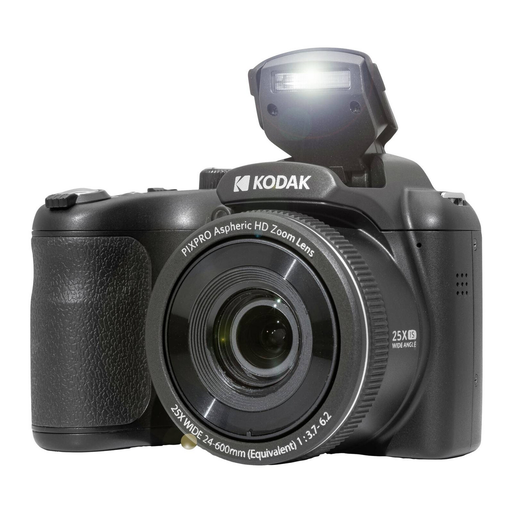
Why it stands out: It's the quintessential beginner's camera. Its handling is intuitive, its automatic scene modes make life easy, and its AA battery power is a real plus: it's impossible to run out of power, as long as you have a spare set of batteries in your bag.
This model focuses on the essentials: an effective 25x optical zoom and optical stabilisation, without trying to inflate the numbers with a gimmicky digital zoom.
Its versatility and simplicity make it the perfect entry ticket into the world of high-zoom photography, all at an affordable price.
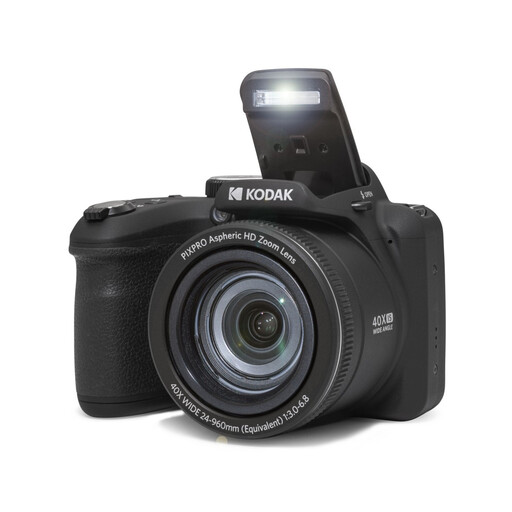
Why it stands out: With its 40x optical zoom and 20 MP sensor, this Kodak Astro Zoom is the ideal travel companion. It allows you to capture everything from wide-angle landscapes to distant architectural details, all with a single device.
It bets everything on its powerful optical zoom, supported by effective stabilisation (OIS). The result: high-quality images even at full zoom, far from the disappointing promises of digital zoom.
The perfect balance between a powerful zoom, good resolution, and optical stabilisation makes it a reliable and high-performing travel ally.
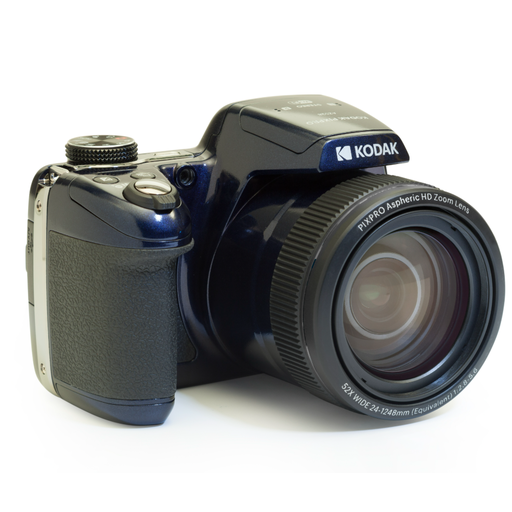
Why it stands out: For those who want to capture the most distant details, this model and its 52x optical zoom are unbeatable. Ideal for wildlife photography or capturing very remote subjects, it also includes Wi-Fi for instant sharing.
It doesn't just boast an impressive zoom number. It combines it with a 16 MP CMOS sensor and Wi-Fi, offering a coherent and genuinely useful package, far from a simple marketing claim.
Stunning optical zoom power, coupled with modern features like Wi-Fi to control the camera and share your shots in the blink of an eye.
We have selected other cameras for you that meet our quality criteria and safety standards.
Yes, and the difference is striking on one key point: the zoom. Smartphones mostly rely on digital zoom (a simple crop) or a very limited optical zoom (2x, 5x). A bridge camera, however, packs a true, much more powerful optical zoom (25x and beyond), capable of capturing distant subjects with incomparable sharpness. Its sensor, generally larger than a smartphone's, also makes a difference, especially when light is scarce.
The main difference is the lens. A bridge camera has a fixed, non-interchangeable, but ultra-versatile lens, capable of going from wide-angle to super-telephoto in an instant. A DSLR (or a mirrorless camera) allows you to change lenses depending on the situation (macro, portrait, landscape, etc.), which offers greater flexibility and often superior image quality. The downside: a much higher cost and bulk. The bridge camera is the all-in-one solution: simpler, more compact, and more accessible.