
Livraison le jour même ou le lendemain

Qualité garantie

Débloquez vos offres de bienvenue: Livraison GRATUITE | Jusqu'à -80 % | 30 jours d'essai gratuits à JoyPlus
Téléchargez l'application
The appeal of a bridge camera is clear: it offers the versatility of a powerful zoom in a single body, without the need to juggle an array of expensive and bulky lenses. It's the ideal solution for moving beyond smartphone photography. But be warned—the market is saturated with marketing promises that can easily be misleading. To avoid buyer's remorse, it's crucial to understand the most common pitfalls.
As a product expert for Joybuy, my mission is to help you navigate the options. Let's break down the two most common mistakes to avoid.
To make an informed choice, ignore the marketing hype and focus on the features that have a real impact on your photo quality.
Optical zoom uses the lens elements to magnify the subject with zero loss of quality. Digital zoom, in contrast, simply enlarges the pixels in a section of the image, often resulting in a pixelated and unsharp picture.
For wildlife photography, travel, or sporting events, a 40x optical zoom or higher will allow you to capture details from a great distance. For more versatile use (portraits, landscapes), a 25x zoom is already highly effective. Ignore any digital or "combined" zoom values—they are not an indicator of performance in any way.
An optical stabiliser is an internal mechanism in the lens that compensates for the micro-movements of your hands. It's essential on a bridge camera for several reasons:
Always check for "Optical Stabilisation" or "OIS" on the spec sheet. Digital stabilisation (EIS) is far less effective.
While a high megapixel (MP) count may seem tempting, the sensor's size and quality are at least as important. A larger sensor captures more light, which translates to better low-light performance and richer, more detailed images overall. For a beginner's camera, a 16 to 20 MP sensor is more than enough to produce quality prints and crop your photos without a noticeable loss of quality.
To provide some concrete examples, here are a few models that meet different needs while avoiding the pitfalls we've just discussed.
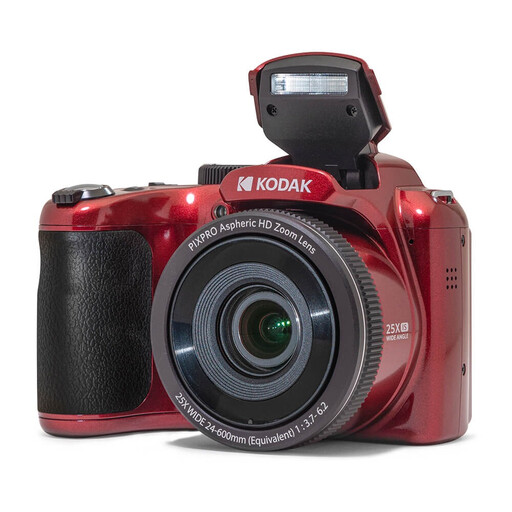
Why it's a great choice: Ideal for stepping up from a smartphone without the complexity. Its 25x zoom is highly versatile for holidays, family photos, or landscapes, all without the learning curve of a DSLR. Its AA battery power is a real bonus when travelling.
It focuses on the essentials: a quality 25x optical zoom paired with an optical image stabiliser (OIS) that guarantees sharp images, even when handheld and fully zoomed in.
16 MP sensor for detailed images; 24mm wide-angle lens ideal for landscapes; 22 scene modes to easily adapt to any situation.
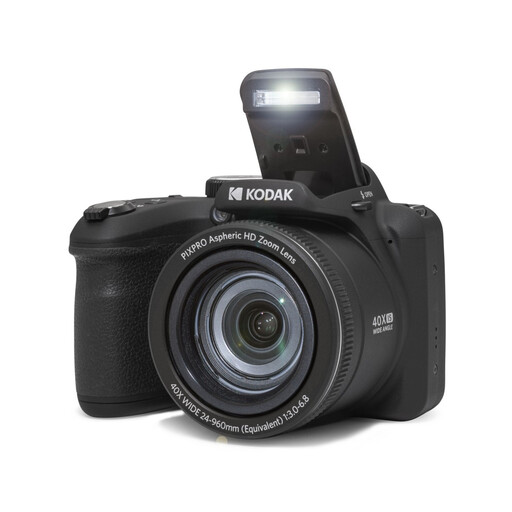
Why it's a great choice: Perfect for nature lovers and wildlife photography enthusiasts. The powerful 40x optical zoom lets you capture distant subjects (birds, wild animals) without disturbing them, all while maintaining excellent image quality.
This Kodak Pixpro model makes no compromises: its zoom is 100% optical and is paired with a high-performance optical stabiliser, which is essential for getting sharp shots at such a long focal length.
20 MP CMOS sensor for greater detail; Full HD 1080p video; subject tracking for moving scenes; 24mm wide-angle lens.
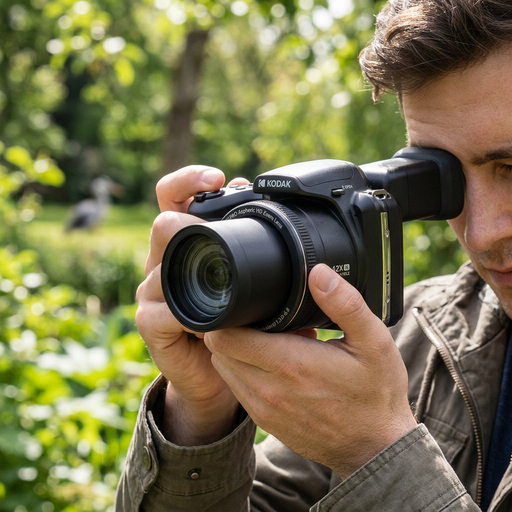
Why it's a great choice: For those seeking maximum power and features. Its formidable 42x optical zoom is perfect for architecture, sporting events, or safaris. Its rechargeable battery and Wi-Fi connectivity make it more modern and convenient for heavy use.
It combines the winning trio: a powerful 42x optical zoom, an effective optical image stabiliser (OIS), and a high-resolution 20 MP sensor for sharp, detailed images, even from very far away.
42x optical zoom; rechargeable Li-ion battery (more economical than AA batteries); Wi-Fi connectivity for easy photo sharing.
We've compiled a complete selection of products that meet our demanding selection criteria.
Absolutely. It's an excellent entry point into photography. It offers far superior image quality and versatility than a smartphone, while remaining much simpler to use than a DSLR with interchangeable lenses. The automatic and scene modes allow you to get great results without needing advanced technical knowledge.
To put it simply: optical zoom uses the lens elements to magnify the image with no loss of quality. It's a true "mechanical" zoom. In contrast, digital zoom is just a software crop that enlarges the pixels, leading to an inevitable loss of sharpness and detail. For a quality result, only the optical zoom number matters.
It's highly recommended for achieving maximum sharpness, especially when you push the zoom to its full power (40x and above). Even with a good optical stabiliser, a tripod eliminates all risk of motion blur and becomes essential for long exposures or low-light photography. For spontaneous, on-the-go shots, however, the stabiliser remains a very effective ally.