Hosts catering for a large group
If you’re expecting lots of guests or planning to serve snacks on several occasions, a box with plenty of individual packs means you only need to open the portions you need.


For drinks with friends, choose a pack size that suits the number of guests and how many biscuits you plan to open at once. A large box with individually wrapped portions works well for a big gathering or several occasions. For a smaller group, a two-pack of 125 g may be enough, while smaller individual packs make it easier to serve portions. Before choosing, check the total weight, how the biscuits are actually divided into packs and the ingredients.
If you’re expecting lots of guests or planning to serve snacks on several occasions, a box with plenty of individual packs means you only need to open the portions you need.
If the biscuits are just one part of your spread, compare a 125 g pack with a two-pack before opting for a large box.
If you’re serving anyone with an allergy, check the ingredients list and any warnings about possible traces on the exact product you’re buying.
To compare pack sizes, first estimate how much you’ll need to share, then consider whether you’ll want to open the biscuits in stages.
| What to consider | What to check | Who is it for? |
|---|---|---|
| How much you need to share | The total weight and the number of biscuits or packs listed. | When I’m sharing the biscuits with lots of guests, I want to make sure there’s enough without having to buy lots of separate packs. Around 38% of consumers prioritise the quantity available to share. |
| Individually portioned packs | The number of inner packs and biscuits in each one: two packs don’t necessarily mean two sets of individual portions. | If I’m serving the biscuits in stages or popping some into a lunchbox, I’d rather open only the portions I need. Around 31% of consumers say portioning is their main consideration. |
| Ingredients and nutritional information | The ingredients list and allergens for the exact product; nutritional values per 100 g when comparing similar products. | Before serving the biscuits, I want to check the ingredients for any guests who need to be careful and compare the nutritional information. For around 31% of consumers, these checks are the priority. |
A 2 × 125 g multipack means two packs, not necessarily individually wrapped portions inside. By contrast, St Michel lists 24 packs of 3 biscuits in its 900 g Roudor box, while Auchan Bio lists 4 packs of 2 biscuits in its 125 g pack.
If you want to serve the biscuits over several occasions or pack portions to take with you, check the packaging for the number of individual packs and what each one contains.
A 900 g box could mean a lot of biscuits if they’re only one part of your drinks spread.
For a smaller group, compare the 125 g pack with the 2 × 125 g multipack first. Save the large box for bigger groups or several occasions.
The St Michel and Auchan products described here list wheat, milk and eggs among their ingredients; some product listings also warn that other allergens may be present.
Before serving anyone with an allergy, read the ingredients and any warnings about possible traces on the packaging of the product you’ve bought.
These products show how pack sizes can vary. The brand name alone won’t tell you how many individual packs are inside or how much will suit your gathering.
St Michel’s 900 g Roudor box comes in 24 packs of 3 biscuits, making it worth considering for a large group or several occasions.
Auchan offers Breton biscuits in a 2 × 125 g multipack, as well as an Auchan Bio 125 g pack divided into 4 packs of 2 biscuits.
E.Leclerc offers P'TIT DELI Breton biscuits in a 2 × 125 g multipack, worth comparing if you want two packs without moving up to a 900 g box.
Carrefour Original offers butter Breton biscuits in a 125 g pack, a straightforward option to enjoy alongside other drinks and nibbles.
If you’d like to add something to your drinks spread without going straight for a large pack, here’s a 125 g box of Breton biscuits.
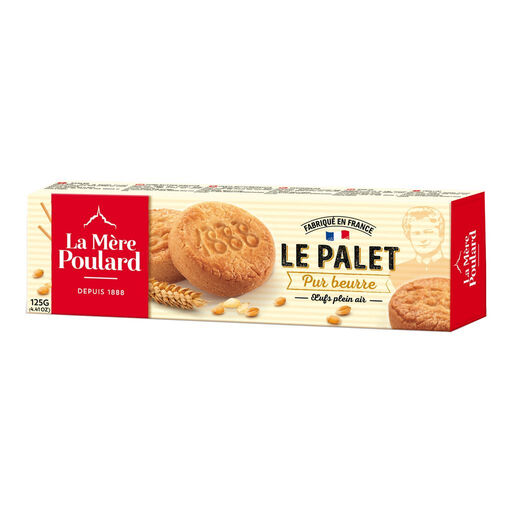 Image unavailable
This box is a handy addition to a drinks spread with other snacks. It contains 125 g of biscuits. If you plan to divide them into individual portions, check the inner packaging before you buy. If anyone you’re serving has an allergy, also check the ingredients on the packaging.
Start with the number of guests and how prominent the biscuits will be among the other snacks, rather than working to a fixed amount per person. To compare pack sizes, St Michel’s Roudor box contains 900 g and 24 packs of 3 biscuits, while the Auchan and P'TIT DELI multipacks mentioned here each contain 2 × 125 g.
Yes, if you’re looking for portions that are already separated and the packaging clearly confirms this. Auchan Bio offers 4 packs of 2 biscuits, while St Michel offers 24 packs of 3 biscuits. A multipack of two 125 g packs doesn’t, by itself, mean that individual portions are included.
At the very least, check the ingredients and any warnings about possible traces on the product you’ve bought. The product listings for several items mentioned here include wheat, milk and eggs, while some also warn of possible traces of other allergens. In France, the DGCCRF states that allergenic ingredients must be listed and highlighted on the labels of relevant food products.
Compare their nutritional values on the same basis, particularly per 100 g, and look at sugars, fat and salt. If the products you’re comparing display a Nutri-Score, it can offer an additional point of reference; it won’t tell you about allergens or how many biscuits you’ll be serving.