Households looking to control serving sizes
An individual portion gives you a set amount before breakfast; with a jar, you can also measure out a specific serving. Coffee Choc, for example, sells Nutella 15 g portions in multipacks.


To control how much spread you serve at breakfast, choose an individually portioned pack or measure out a serving from a jar. If you want something you can eat without bread or a knife, a filled wafer or a snack with breadsticks serves a different purpose: compare it as a complete snack, not simply as a portion of spread.
An individual portion gives you a set amount before breakfast; with a jar, you can also measure out a specific serving. Coffee Choc, for example, sells Nutella 15 g portions in multipacks.
If you’re comparing sugars, fats or allergens, check the nutrition information per 100 g and the ingredients list for each specific product. If a Nutri-Score is displayed, it doesn’t replace this information.
Nutella B-ready is an individually wrapped filled wafer; Nutella & Go pairs spread with breadsticks. These snacks can be eaten without preparing a slice of bread, but they aren’t for spreading on your own bread.
Your choice depends first and foremost on what you want to serve: a pre-measured amount of spread, spread you portion yourself, or a snack that also includes a wafer or breadsticks.
Choose this if: you want to know how much spread is in each serving.
Bear in mind: the portion is pre-set, and these packs may be sold in multipacks.
Choose this if: you want to spread it yourself on bread, brioche or pancakes.
Bear in mind: a jar doesn’t determine how much you take out each time.
Choose this if: you want to eat the product as it is, without bread or a knife.
Bear in mind: the wafer or breadsticks are part of the product and its overall serving.
| Factor | What to check | Who this matters to |
|---|---|---|
| Serving size | Check the weight of the individual portion, or decide how you’ll measure out spread from a jar. | I want to know how much spread I’ll be serving, rather than estimating it from a large jar. Around 42% of consumers put this need first. |
| Ingredients | Compare sugars and fats per 100 g, then check the ingredients and allergens for the specific product. | For my household, the recipe matters more than the product’s presentation: I need to be able to read the ingredients before choosing. Around 33% of consumers make this their priority. |
| Pack size | Check the total weight and, for multipacks, the number of units to make sure they suit how often you’ll use them. | If I regularly serve toast, I prefer to choose a pack size that suits the number of breakfasts I’m buying for. Around 25% of consumers put this first. |
Nutella B-ready includes a wafer; Nutella & Go pairs spread with breadsticks. The weight of either product includes all its components.
If you want to spread it on your own bread, look for an individual portion containing spread only, or choose a jar.
In France, the Ministry of the Economy states that displaying Nutri-Score is optional. The DGCCRF presents the nutrition declaration as the basis for checking values per 100 g or 100 ml.
Whether or not a logo is displayed, check the nutrition information and ingredients list before comparing two products.
These claims describe features of the recipe; they don’t mean it’s free from hazelnuts, milk or soya, or from possible traces of other nuts.
Read the ingredients list and allergen information on the specific product you’re thinking of buying.
The brand offers spread in jars as well as individual snacks, including B-ready and Nutella & Go.
A cocoa and hazelnut spread sold in a jar, so you can choose how much to serve.
A cocoa and hazelnut spread in a jar, made for spreading.
An organic spread in a 350 g jar, so you can serve as much as you like.
This selection includes ready-to-eat snacks and jars of spread that you can portion yourself. If you want a pre-measured serving of spread on its own, look for an individual portion instead.
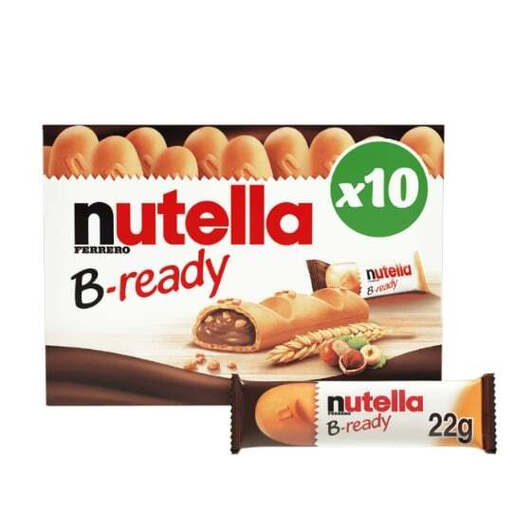 Image unavailable
Worth considering if you’d rather take a filled wafer with you than spread something on your own bread.
220 g T10 pack; Nutella describes B-ready as an individually wrapped wafer. To compare what you’ll be eating, check the serving’s nutrition information on the packaging.
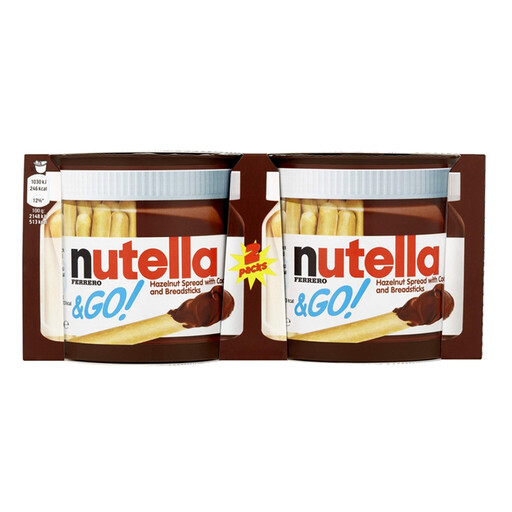 Image unavailable
One to consider if you want to enjoy spread with breadsticks without making a slice of toast.
The product shown weighs 78 g in total: this isn’t the weight of the spread alone. Check the packaging for the ingredients and nutrition information for the serving you’ll eat.
 Image unavailable
A jar to consider if you want to spread it yourself and decide how much to serve.
250 g jar; unlike an individual portion, it doesn’t set the amount for each serving. If allergens are a factor in your decision, read the ingredients for the specific product you choose.
 Image unavailable
This jar is a good choice if you want to decide how much to spread each time.
200 g jar. If you’re comparing its ingredients with another spread, check the ingredients list and the nutrition information, making sure the basis and units are clearly shown on the label.
 Image unavailable
Worth considering for spreading at home if you prefer to portion each serving yourself rather than use a pre-packed portion.
400 g jar: this isn’t an individual serving size. Check the ingredients list and allergen information on the label for this product.
No. The levy described by the Ministry of the Economy applies to sugary drinks, not spreads. To compare spreads, check the amount of sugars shown in their nutrition information.
No. According to the Ministry of the Economy, displaying Nutri-Score is optional in France. The nutrition declaration required for pre-packed food lets you compare values per 100 g; the absence of a logo isn’t enough to judge a product.
Read the ingredients and any precautionary allergen statements for the specific product, including snacks with a wafer or breadsticks. A claim such as “organic” or “palm oil free” doesn’t tell you whether allergens are present.
Follow the date and storage instructions on the pack you buy, especially after opening if instructions are given. The DGCCRF notes that the labelling of pre-packed food includes the relevant date information for the product.