Bread ready when you wake up
You prepare the bread pan the night before and want to set when the cycle finishes without the overnight kneading disturbing your household. Que Choisir lists a delay-start function among the features to consider.


To prepare bread the night before, choose a machine with a delay-start function and programmes that suit the time you want it ready, then match the loaf size to how much you usually eat. If it will be running overnight, check how noisy the kneading is and how much space you have. A larger capacity or more programmes won’t make up for an appliance that’s bulky or disruptive.
You prepare the bread pan the night before and want to set when the cycle finishes without the overnight kneading disturbing your household. Que Choisir lists a delay-start function among the features to consider.
You want to match the amount you bake to how much you usually eat, which can vary from one meal to another. Que Choisir also recommends comparing the loaf sizes on offer.
You need to find space for the appliance and consider how noisy it is if it will be running at night. Check the dimensions and noise levels of the specific model you’re considering.
Start with the time you want your bread to be ready, then check that the loaf size and programmes suit your routine. If the machine will run overnight or stay on your worktop, add noise and size to your list of things to consider.
| Feature | What to check before you buy | Who it matters most to |
|---|---|---|
| Finish time | Built-in delay-start function, compatible programmes and cycle duration in the instruction manual. | I want to prepare the bread pan the night before for breakfast or a meal at a set time. Around 36% of consumers prioritise when the bread will be ready. |
| Loaf size | Available loaf sizes and how much you eat between bakes, rather than just the maximum capacity. | When how much we eat varies, I’d rather bake a useful amount than always make a large loaf. Around 29% of consumers prioritise a loaf size that suits their household. |
| Programmes | Cycles for the recipes you actually plan to make and the duration of each programme you’re considering. | If I mainly bake standard bread, I want the settings to suit how I use the machine rather than choosing based on the total number of programmes. Around 21% of consumers put usefulness first. |
| Noise and space | Dimensions, including enough clearance to open the lid, storage space and noise levels for the exact model. | In a small kitchen or near bedrooms, I need to know where to keep the machine and whether the kneading will be disruptive at night. Around 14% of consumers prioritise size or noise. |
The 15 hours advertised for the QMP 440 refer to the timer’s programming window, not the duration of each cycle.
Check the duration of your chosen programme and the displayed finish time before planning a bake.
The stated capacity doesn’t tell you how much you’ll usually bake. A loaf that’s too large can leave you with leftovers.
Start with how much you eat between bakes and compare it with the loaf sizes available on the model.
A timer doesn’t mean that every recipe and its ingredients are suitable for being left in the bread pan for a long time.
Check the recipe and instruction manual, especially for ingredients that need to be kept chilled.
The number of programmes doesn’t tell you how much space the appliance takes up or how noisy it is when kneading.
Measure the space available and look for a noise assessment of the exact model if the machine will be running overnight.
The OW210130 and OW610110 offer different loaf-size and programming options to compare.
The SD-B2510WXE and SD-PN100 address different considerations: noise levels for one, published dimensions for the other.
The QMP 440 lets you compare several loaf sizes and an advertised timer for planning your bakes.
Consider the BM-4586 if you’re looking for a single-pan machine with a digital timer.
These models are featured for preparing a loaf in advance, with capacity and programming features to compare against your routine.
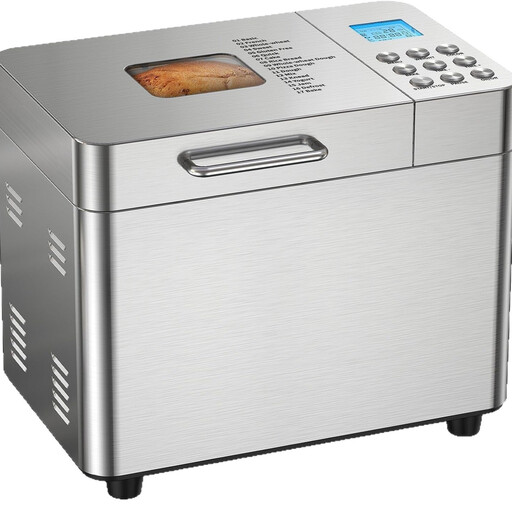 Image unavailable
The delay-start function mentioned in the title may suit you if you prepare the bread pan in advance and want to schedule a bake.
The product is listed with a 1 kg capacity, 650 W of power and 19 programmes. Its description mentions bread, dough, jam and yoghurt.
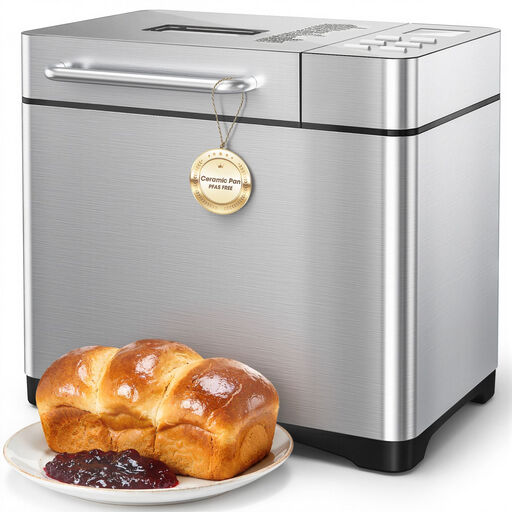 Image unavailable
The three loaf sizes listed may help you match the amount you bake to how much your household eats.
The product is listed with loaf sizes of 500 g, 750 g or 1 kg, a 15-hour timer and 19 programmes. Check the instruction manual to see which cycles can be used with the timer.
Choose the programme and loaf size, then use the built-in delay-start function as instructed to set when the cycle should finish. Check the displayed duration before leaving the machine running overnight: not every programme is necessarily compatible with delay start.
Measure the available space, allowing room to open the lid, then follow the model’s instructions for cleaning the bread pan and kneading blade. Riviera&bar lists dimensions of 35 × 29 × 22.5 cm for the QMP 440; also leave enough clearance around the appliance.
No. Check the recipe and instruction manual before setting a long delay, especially if any ingredients need to be kept chilled. Anses notes that refrigeration slows the growth of micro-organisms; this guidance doesn’t mean every bread-maker recipe is suitable.
The right to cancel an online purchase is generally at least 14 days, subject to applicable exceptions and conditions. The French Ministry of the Economy explains that the legal guarantee of conformity applies to new, second-hand and refurbished goods sold by a trader to a private individual; it is separate from a commercial warranty. Check the cost and availability of parts for the specific model separately.