
Livraison le jour même ou le lendemain

Qualité garantie

Débloquez vos offres de bienvenue: Livraison GRATUITE | Jusqu'à -80 % | 30 jours d'essai gratuits à JoyPlus
Téléchargez l'application
Glassware appeals with its transparency, elegance, and the promise of healthy, PFAS-free cooking. However, beneath its apparent simplicity lie details that can turn a great deal into a real disappointment. Before upgrading your kitchenware, it's crucial to know how to avoid marketing traps and understand the criteria that truly make a difference.
As the Head of Product Recommendations at Joybuy, I'm sharing the keys to making the right choice. Here are the points you should absolutely check before choosing your next borosilicate glassware.
The market is flooded with glass products, but they are far from equal. Here are the most common mistakes that can prove costly in the long run.
Many glass dishes are labelled "heat-resistant", but this claim is often misleading. A dish that can withstand oven heat isn't necessarily designed to go on a stovetop. Tempered (soda-lime) glass and borosilicate glass have very different properties. Borosilicate glass offers far superior resistance to thermal shock—that is, sudden changes in temperature. An unsuitable product is likely to crack if you move it from the refrigerator to the microwave without a transition period.
You've found the perfect borosilicate glass dish, but have you inspected its lid? It's often the weakest link. A lid that isn't perfectly airtight compromises the proper storage of your food. If it's not microwave-safe, it loses much of its versatility. Worse still, some low-quality plastics can warp with heat or are not guaranteed BPA-free, completely negating the health benefits of the glass container.
While glass is by nature an inert material that doesn't react with food, not all glass cookware is created equal in terms of quality. The absence of coatings like PFOA or PTFE is a good start, but the purity of the glass itself is what ensures it won't absorb odours, stains, or flavours. Poor-quality or porous glass can alter the taste of your dishes, ruining one of the main benefits you're looking for.
To make an informed choice, focus on these three criteria that determine a product's quality and durability.
This is the main advantage of borosilicate glass. Always check the maximum supported temperatures. A good product must clearly state its compatibility with the oven and microwave. For glass casserole dishes or stockpots, compatibility with stovetops (gas, electric, and sometimes induction with a relay disc) is a major versatility factor. This information must be explicit, not just implied.
High-quality borosilicate glass is non-porous. In practical terms, it won't retain the colour of your tomato sauce or the smell of your fish after a simple wash. This is a guarantee of hygiene and purity for healthy cooking. Verify that the product is clearly identified as borosilicate glass and, for storage containers, that the lid is certified BPA-free.
Versatility is key: a good piece of cookware is one you'll use every day. Consider the use case:
Rather than an endless list, here are a few products that perfectly illustrate our selection criteria by meeting specific needs.
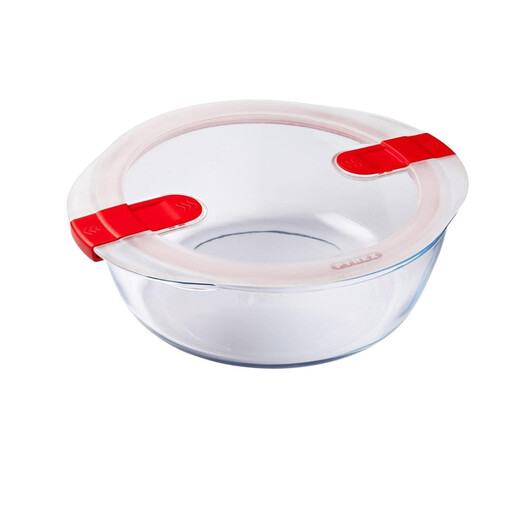
Why it's the right choice: Ideal for meal prepping (*batch cooking*) or storing family leftovers. Its large 2.3 L capacity allows it to go directly from the oven (without the lid) to the table, and then to the refrigerator.
It solves the problem of the lid, which is often the weakest link. This model includes an airtight lid with a silicone seal and a steam valve, specifically designed for safe reheating in the microwave.
An all-in-one system for cooking, storing, and reheating. The sturdy glass withstands heavy use, and its leak-proof lid is a great asset for transport.
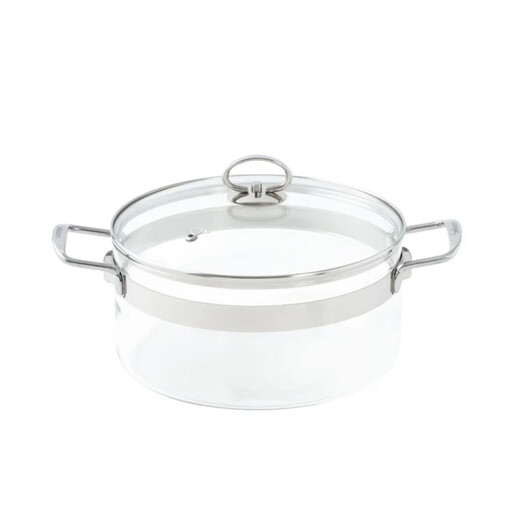
Why it's the right choice: For those who want to cook directly on the flame in a neutral, healthy material. This stockpot is perfect for making soups, stews, or cooking pasta while keeping a constant eye on the process.
It clears up the ambiguity around "heat resistance." This product is specifically designed for use on gas and electric stovetops, a rare feature for glassware. Its technical sheet guarantees it is PTFE/PFAS-free.
Total transparency for perfect visual control over your cooking. Its inert material ensures that no unwanted tastes or substances migrate into the food.
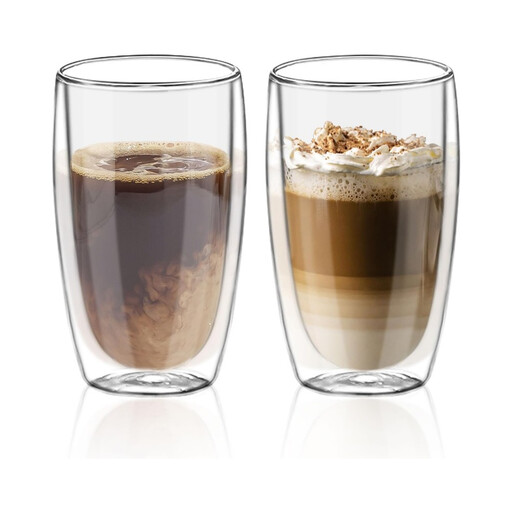
Why it's the right choice: Perfect for those who appreciate the aesthetics of their beverages. Its large capacity is ideal for lattes, iced teas, or smoothies, and the double wall beautifully showcases the different layers of the drink.
This isn't just any glass. Its double-walled design is a true technical feature that provides effective thermal insulation, preventing condensation and keeping the outer wall cool to the touch.
Its thermal insulation, which keeps drinks at the right temperature for much longer. The borosilicate glass makes it lightweight, durable, and microwave-safe.
Find our complete selection of products that meet our strict selection criteria and current safety standards.
No, this is strongly discouraged. Even though borosilicate glass is very resistant, such an extreme temperature difference (from around -18°C to over 180°C) can cause it to shatter from thermal shock. The golden rule: let the dish return to room temperature for a few minutes before putting it in the oven.
Visually, it's nearly impossible to distinguish it from ordinary tempered glass. The only reliable way is to check the manufacturer's technical specifications. Explicitly look for the term "borosilicate glass" in the product description. Reputable brands like PYREX (for its European lines) or Bodum are generally a safe bet.
No. Borosilicate glass is more resistant to thermal and mechanical shock than standard glass, but it is not unbreakable. A sharp impact or a drop onto a hard surface can shatter it. Therefore, it should be handled with the same care as any other glassware.