
Same-day & Next-day Delivery

Quality Guaranteed

Unlock Your Welcome Offers: FREE Delivery | Up to 80% OFF | Free 30-day JoyPlus trial
Download the APP
The trend towards healthy, transparent cooking is bringing raw, inert materials back into the spotlight. Among them, the borosilicate glass pot stands out. It's prized for its chemical inertness and transparent design, which lets you watch your food as it simmers. But be warned: not all glass cookware is created equal. To help you avoid any unpleasant surprises, here are the common pitfalls to sidestep and the essential criteria to check before you buy.
The market is flooded with glass models, but some design flaws or vague product descriptions can quickly turn a good investment into a disappointment.
For a successful purchase that combines safety, durability, and cooking enjoyment, there are three criteria to examine closely.
Borosilicate glass is chemically inert, meaning it doesn't react with food, even acidic ingredients like tomatoes or lemon. It guarantees healthy, PFAS-free and PTFE-free cooking, as it has no coating that could degrade over time. Its non-porous surface is another major advantage: it doesn't absorb odours, stains, or flavours. The taste of your dishes is perfectly preserved. Insist on seeing "borosilicate glass" explicitly mentioned in the product specifications.
A pot compatible with gas and electric hobs is the baseline, but versatility doesn't stop there.
Think about your daily needs. A 2 to 3-litre capacity is usually enough for a couple, while a family will want to look for a glass pot of 4 litres or more. The lid, also made of glass, is a real plus: it allows you to monitor cooking at a glance without lifting it and losing heat or moisture. Finally, don't overlook the details that make all the difference, like a pouring spout for serving soups and broths without making a mess.
To guide you, here is a selection of products that check all the boxes, tailored for different profiles.
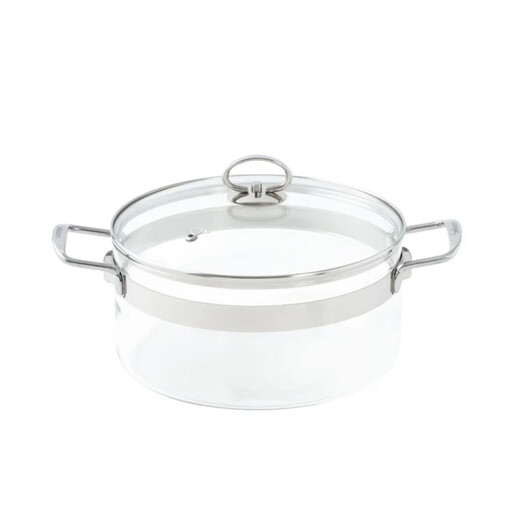
Why it's a great choice: Its generous 4.2 L capacity is perfect for family-sized soups, pasta, or slow-cooked meals. Its fully transparent design lets you monitor the cooking process without ever lifting the lid.
The product specs are clear: this is inert borosilicate glass, free of PTFE and PFAS. Its compatibility (gas, electric, oven-safe up to 180°C) is precisely stated, leaving no room for unpleasant surprises.
Its large family-friendly capacity and practical pouring spout for mess-free serving. Its non-porous material won't retain odours or flavours.
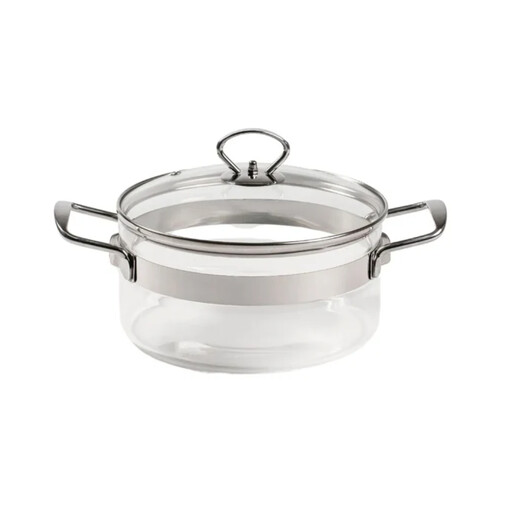
Why it's a great choice: With a 2.5 L capacity, it's ideal for one or two people. Its compact size is easy to store, even in kitchens where space is at a premium.
It removes any doubt about the material by confirming it is genuine borosilicate. Its versatility (gas, electric, oven, and even induction via an adapter disc) is clearly and unambiguously stated.
All the benefits of healthy cooking in a compact, easy-to-handle format. The pouring spout is included here too—a thoughtful detail.
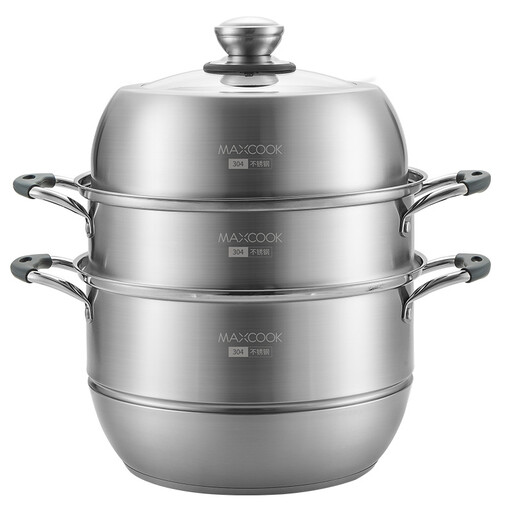
Why it's a great choice: For die-hard fans of steam cooking, this model is the perfect compromise: it combines a sturdy 304 stainless steel body (another healthy, coating-free material) with a glass lid to maintain visual control over the cooking process.
It offers a clever alternative: a food-grade stainless steel body compatible with all hobs, while retaining the key advantage of glass—a transparent lid to monitor cooking without heat loss.
Its multi-level design allows you to cook an entire meal at once. It is compatible with all hobs, including induction.
Explore our full selection of products that meet our safety and quality standards.
No, not directly. Glass is not a ferromagnetic material, so it cannot interact with the magnetic field of an induction hob. To work around this, you must use an induction adapter disc. This is a simple metal plate placed between the hob and the pot, which acts as a bridge to transfer heat. Check if the manufacturer offers one or if you need to purchase one separately.
Thermal shock is the number one risk. To avoid it, follow a few golden rules:
The main health advantage of borosilicate glass is its total inertness. It contains no controversial chemicals like PFAS (or "forever chemicals") that can be found in some non-stick coatings, especially if they are old or damaged. It releases absolutely no substances, even when cooking acidic foods or at high temperatures. It is a top-tier choice for anyone wanting to ensure their cooking is free from chemical transfer.