
Livraison le jour même ou le lendemain

Qualité garantie

Débloquez vos offres de bienvenue: Livraison GRATUITE | Jusqu'à -80 % | 30 jours d'essai gratuits à JoyPlus
Téléchargez l'application
Preparing several meals, storing leftovers or keeping the family fridge organised calls for containers suited to every situation. Borosilicate glass food storage containers are popular for their transparency, versatility and range of sizes. However, a well-presented product listing is not enough to guarantee the right choice.
When buying a set of glass food containers, certain pitfalls come up time and again:
Borosilicate glass is designed to withstand temperature changes better than some standard types of glass. Its resistance nevertheless depends on the product’s overall design and the manufacturer’s instructions.
Before placing a container in an appliance, check the symbols or product listing to confirm its compatibility with:
Avoid significant thermal shocks, such as moving directly from a very cold container to an intense heat source, unless otherwise stated by the manufacturer. After a fall, also inspect the glass: even the smallest crack or chip means the container should be replaced.
For transporting lunch or storing liquid food, it is best to choose airtight glass food containers with a clearly described closing system. A removable seal makes cleaning easier, as residue tends to collect in the grooves.
A detachable lid also simplifies washing and storage. Nevertheless, check the care instructions: some components, particularly those made from wood or silicone, cannot be cleaned in the same way as glass. Finally, a closure advertised as leakproof will only prevent leaks if the lid is correctly positioned and locked.
A versatile set will generally include several capacities:
The external dimensions are just as important as the capacity. A container may fit perfectly in your fridge but not be suitable for your lunch bag or a freezer drawer. For a family, a set of 8 food containers in different sizes will often be more practical than an assortment available in just one format.
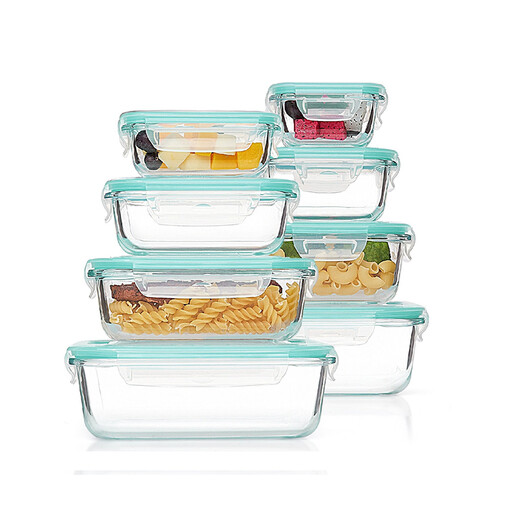
Why this choice suits this profile : This set includes eight rectangular containers ranging from 150 to 1 040 ml. A versatile foundation for storing leftovers, preparing individual portions or taking your lunch with you.
The range of capacities means you will not need to buy mismatched containers later. However, the removable lids should be checked and cleaned separately.
Borosilicate glass specified in the product name and eight different capacities: 150, 200, 320, 370, 520, 640, 800 and 1 040 ml.

Why this choice suits this profile : With its 2 litre capacity, this model is suitable for large portions, meal preparation and storing family-sized dishes in the fridge.
The product listing states that it is compatible with the dishwasher, microwave and freezer. In the microwave, the lid must be removed and space must be left for liquids to expand.
A 2 litre capacity, a removable silicone seal and a closure advertised as airtight. The listing states that it can withstand thermal shocks of up to 200 °C.
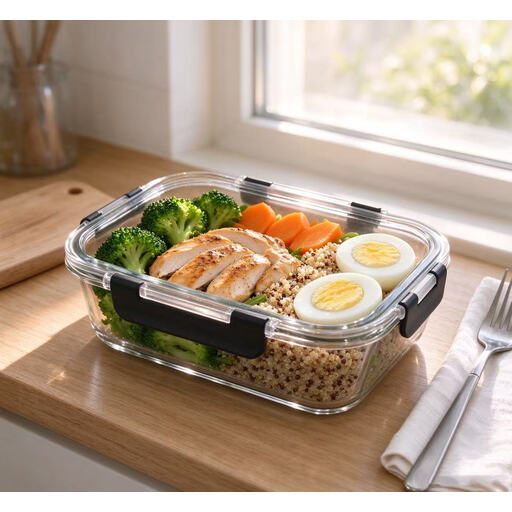
Why this choice suits this profile : The five 1 040 ml containers and five 370 ml containers are ideal for people who regularly prepare their lunch or several portions in advance.
The two-capacity split means you do not have to use a large container for a small portion. The clip-on lids are advertised as leakproof; check that they are locked before carrying the container.
Ten borosilicate glass pieces: five 370 ml containers and five 1 040 ml containers. A well-balanced selection for organising meals regularly.
We have selected a complete, real-time updated range of products that meet these demanding selection criteria and European safety standards.
To extend the life of a glass container intended for fridge storage, a few simple habits can make all the difference:
Food storage containers with removable lids are especially practical when their separate parts can easily be rinsed under running water or placed in the dishwasher. For a glass container used for meal preparation, also remember to note the preparation date and divide portions according to your usual eating habits.
Yes, provided the manufacturer explicitly states that it is. The container must be in perfect condition and retain some empty space to allow food or liquids to expand. Sudden temperature changes should still be avoided.
Some models are designed for this, but the instructions vary from one product to another. The lid will generally need to be removed. Also check that the container is not intended solely for storage, and never use it on a hob unless this is specifically stated.
It depends entirely on the condition of the glass, lid and seals. Glass can remain usable for many years if it has no cracks or chips. However, a seal that no longer closes properly or a damaged lid must be replaced. Otherwise, avoid using the container to transport or store liquid food.