
Livraison le jour même ou le lendemain

Qualité garantie

Débloquez vos offres de bienvenue: Livraison GRATUITE | Jusqu'à -80 % | 30 jours d'essai gratuits à JoyPlus
Téléchargez l'application
Preparing meals in advance, storing leftovers or organising your ingredients becomes much simpler with the right containers. Borosilicate glass food containers appeal to families, students and busy professionals looking for a versatile solution for the fridge, freezer, transport and, depending on the model, reheating.
Not all food containers are created equal, however. A large number of pieces doesn't guarantee practical storage, while a lid advertised as airtight can prove unreliable for transporting soup in a bag. Here are the criteria to consider before choosing a set of 8 food containers or a more specialised assortment.
Borosilicate glass is valued for its better resistance to temperature changes compared to some standard glass types. That doesn't mean it can go straight from the freezer to an intense heat source, though. Thermal shock can damage any glass container.
Before buying, check the manufacturer's instructions regarding:
Seal integrity depends on several factors: the gasket, the clips, how well the lid fits, and the condition of the parts after several washes. A container may be perfectly fine for fridge storage without being secure enough to transport soup in a bag.
For a portable lunch box, choose a well-fitted lid, easy-to-operate closures and a stable shape. Even with airtight glass containers, it's still best to transport liquid preparations upright.
A set made up entirely of large containers quickly takes up space and isn't very practical for small portions. Conversely, a collection of small containers may be too limited for a composed salad or a family meal.
A well-thought-out assortment combines several capacities. Containers from 150 ml to 1040 ml can therefore suit sauces, dried fruit, individual portions, side dishes and dinner leftovers.
Borosilicate glass is often chosen for its resistance to temperature changes. However, simply mentioning the material doesn't mean you can ignore the usage instructions. Check the product sheet and the pictograms on the packaging.
Also, avoid filling a container completely before placing it in the freezer: food can expand. Leave enough space and wait for hot preparations to cool before sealing the container.
A lid with a removable gasket generally makes cleaning easier, as residue can build up in the grooves. However, this design means you must put the gasket back correctly after each wash.
For food storage, check in particular:
Don't assume perfect sealing from a simple photograph or a product title.
Stackable glass containers help optimise space, but their effectiveness depends on the regularity of the dimensions and the shape of the lids. Rectangular models generally make better use of shelf depth than irregularly shaped containers.
In a family kitchen, a graduated assortment is particularly practical: small containers for condiments, medium sizes for individual portions and a large container for sharing dishes. Also, remember to measure the available height between your fridge shelves.
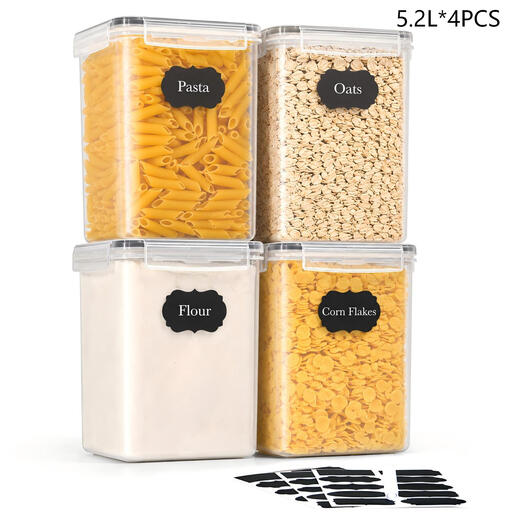
Why this choice suits this profile: This format lets you start with a few containers for rice, pasta, flour or sugar, without accumulating boxes from your first purchase. The included labels and markers make it easy to identify the contents in your cupboard.
The limited number of pieces reduces the risk of buying an oversized assortment before you've figured out your needs. However, check the dimensions and closure system on the product sheet.
Set of 4 containers with included identification accessories, mainly intended for storing dry foods.
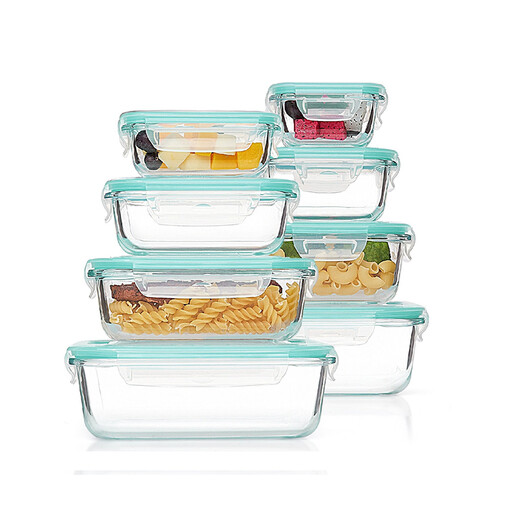
Why this choice suits this profile: This set offers eight capacities, from 150 ml to 1040 ml. It's ideal for a kitchen where you want to meal prep, store leftovers and transport your lunch in a glass lunchbox.
The variety of sizes prevents you from accumulating containers you never use. The advertised removable design also makes it easier to check the different lid parts before each use.
Borosilicate glass, rectangular shape and 8 advertised capacities: 150, 200, 320, 370, 520, 640, 800 and 1040 ml.
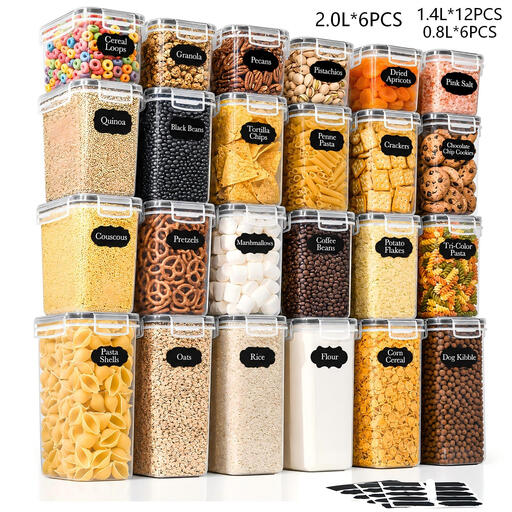
Why this choice suits this profile: A 24-piece set is aimed at households that organise many dry ingredients or several categories in the pantry. It can also suit a kitchen that gets heavy daily use.
The large number of pieces makes it easy to sort by food type, but measure your shelves before buying to avoid turning your cupboard into a puzzle.
24-piece assortment, advertised labelling accessories, designed for storing pasta, rice, flour, sugar and other dry goods.
We've put together a comprehensive list, updated in real time, of products that meet these demanding selection criteria and European safety standards.
To extend the life of your food containers with lids, adopt a few simple habits:
A scratched, cracked container or one with a warped lid should be thrown away, especially if you plan to use it for transport. For meals at the office or university, also choose a capacity that suits your usual portions and a bag that's rigid enough.
It can be compatible with both uses, but it all depends on the manufacturer's instructions and the specific model. Check the pictograms, remove the lid if necessary and avoid sudden temperature changes. Never place a very cold container directly into a hot oven.
For an individual portion, a medium size may be enough. A container of 800 ml to 1040 ml will give you more room for a full meal or a composed salad. Smaller sizes from 150 ml to 370 ml are better suited to sauces, toppings and snacks.
Wash the container promptly after use, clean the gasket separately and let each part air dry. Glass generally retains fewer odours than some porous materials, but residue can get trapped in the grooves of the lid.