
Livraison le jour même ou le lendemain

Qualité garantie

Débloquez vos offres de bienvenue: Livraison GRATUITE | Jusqu'à -80 % | 30 jours d'essai gratuits à JoyPlus
Téléchargez l'application
A bookshelf can declutter a living room, make the most of a narrow bedroom or turn a home office into a more functional space. But some purchases quickly disappoint: a unit that's too deep, a structure that lacks stability, or storage capacity that's been misjudged. Before choosing a bookshelf based on a photo alone, take the time to check a few concrete criteria.
A multi-shelf unit gives an impression of space, but that doesn't mean every shelf can bear the same weight. The stated load may refer to the total capacity of the unit or that of a single compartment. These two figures are not interchangeable.
If you plan to store heavy books, ring binders or boxes, look for a clearly stated maximum static load. Also, avoid placing the heaviest items on the top shelf – this can throw the whole unit off balance.
A narrow bookshelf easily fits into a hallway, a studio flat or a living room corner. Yet just a few extra centimetres can block a door from opening or restrict movement. Measure carefully:
A tall, shallow model makes good use of height. However, it should generally be fixed to the wall using the supplied device, especially in a home with children.
An industrial bookshelf, a cube unit or a wooden-finish shelf can fit perfectly with your décor. But its appearance tells you nothing concrete about the rigidity of its structure. Instead, check for a metal frame, a back brace, adjustable feet and an anti-tip kit.
Terms like "rustic", "modern" or "farmhouse" describe the style first and foremost. To compare models objectively, base your decision on dimensions, materials, the stated load and included accessories.
In a small space, a width of 30 to 40 cm can work well in an alcove or hallway. A unit of 60 cm or more offers more room for books and decorative items, but needs a sufficiently clear wall.
A 6-tier shelf lets you store items up high without taking up much floor space. However, make sure each level remains easily accessible and that the total height doesn't make assembly tricky. In a bedroom or office, also measure the space around the bed, chair and desk.
Particle board is commonly used for shelves, giving them a smooth surface. However, it needs to be protected from excessive moisture and isn't suitable for outdoor use. A steel frame can reinforce the whole unit, provided the joints are properly tightened.
For a storage shelf intended for books, check the stated static load and distribute the weight across the different levels. For a cube bookshelf, look at the maximum load per compartment rather than just the total capacity.
A tall unit can tip over if it's poorly positioned or unevenly loaded. Adjustable feet help compensate for small floor irregularities, while back braces keep the structure square.
Wall fixing isn't just a decorative extra. Use the supplied anti-tip kit with wall plugs suited to your wall type, then follow the assembly instructions carefully. If you're renting, check the terms before drilling.
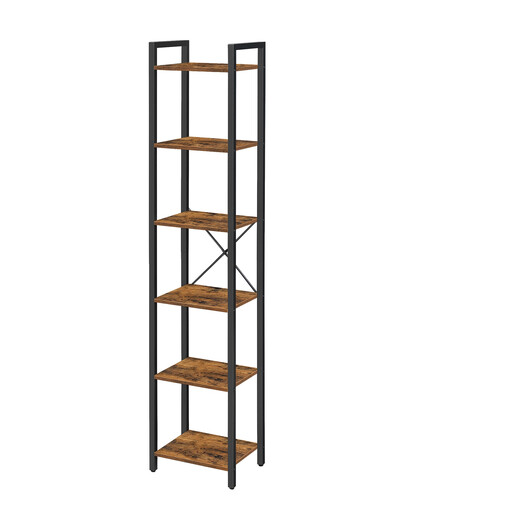
Why this choice suits this profile: At 40 cm wide and 30 cm deep, this model works well for a first living room, office or hallway setup when floor space is limited.
Its dimensions and stated maximum load of 50 kg are clearly specified. The steel frame, adjustable feet and anti-tip kit address the main points to check.
Six tiers, particle board panels and a steel structure, with a rustic brown and black finish. Stated total maximum load: 50 kg.
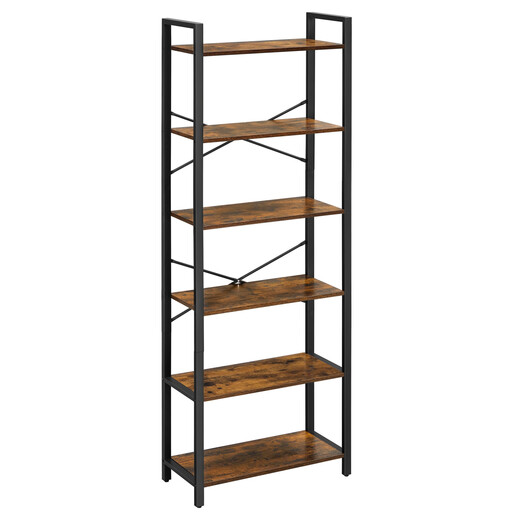
Why this choice suits this profile: At 66 cm wide, it makes more of a statement in a living room or office. Its greige and black finish complements a range of interior styles.
The depth stays at a compact 30 cm, while the structure includes an X-brace, adjustable feet and wall fixing. The stated total load reaches 60 kg.
Six tiers, a stated steel and particle board structure, dimensions of 30 x 66 x 186 cm and a stated total static capacity of 60 kg.
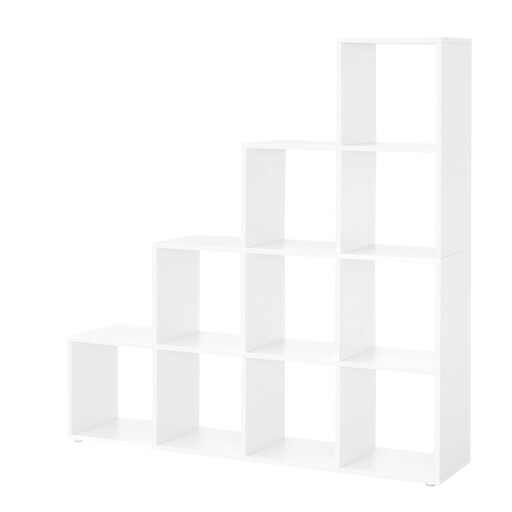
Why this choice suits this profile: Its ten compartments let you separate books, boxes, plants and decorative items in a living room, bedroom or office.
Each compartment holds up to 10 kg according to the product page. This indication helps avoid overloading a single cube. The manufacturer also supplies a wall fixing kit.
Ten open cubes, a depth of 29 cm, a width and height of 129.5 cm, with a stated static capacity of 10 kg per compartment.
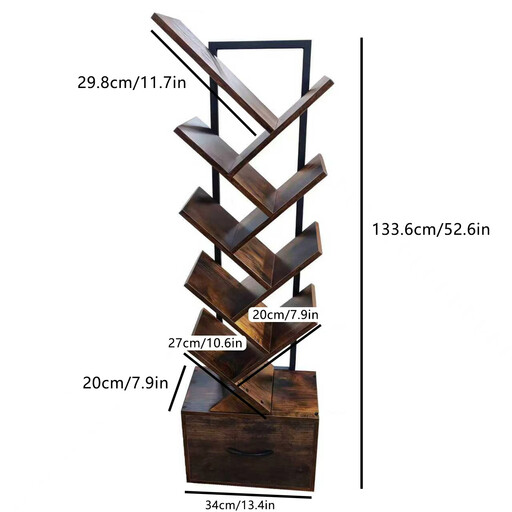
Why this choice suits this profile: Its geometric design appeals to those who want to combine storage with displaying objects in a living room or bedroom. However, check the dimensions and stated load on the product page before ordering.
The choice should be based on the available technical information, not just the styling shown. Proper fixing and correctly distributed weight remain essential.
A geometric shape inspired by modern farmhouse style, suited to décor and storing carefully chosen items.
We've put together a comprehensive, real-time updated selection of products that meet these exacting criteria as well as European safety standards.
Start by assembling the unit according to the instructions and place it on a stable floor. Then use the supplied anti-tip kit. The choice of wall plug depends on the wall type: plasterboard, brick and concrete each require different fixings. Only load the unit after checking the anchor is secure.
A narrow, tall bookshelf lets you make use of height without reducing floor space too much. Measure the available width, depth and height precisely. For storing bulky items, a lower cube model may prove more practical.
Its lifespan depends on the materials, the quality of assembly, humidity and the weight placed on each shelf. Tighten the joints after installation, avoid overloading and distribute books evenly. Cleaning with a slightly damp cloth, without excess water, will also help preserve particle board panels.