
Livraison le jour même ou le lendemain

Qualité garantie

Débloquez vos offres de bienvenue: Livraison GRATUITE | Jusqu'à -80 % | 30 jours d'essai gratuits à JoyPlus
Téléchargez l'application
Navigating the world of smart scales can quickly become a headache. Between the promises of dozens of metrics and sleek app designs, it's easy to get lost. As the Head of Product Recommendations at Joybuy, my mission is to help you make an informed decision. The goal isn't to fall for a gadget, but to invest in a true partner for your health journey. Let's break down the pitfalls to avoid and the criteria that truly matter for making the right choice.
Marketing has mastered the art of highlighting features that, in practice, often prove disappointing. Here are the three most common traps that lead straight to buyer's remorse.
The "20+ Metrics" Mirage: Metabolic age, protein rate, bone mass… Many scales unfurl an impressive list of measurements. However, most of this data consists of mere estimates, calculated from a handful of basic measurements (weight, impedance, age, sex). The true quality of a body analysis scale isn't measured by the number of metrics, but by the precision of its sensors. A scale with 10 reliable measurements is better than one displaying 25 fanciful data points.
Inconsistent Measurements: "I weigh myself twice in a row and get two different results!" It's a frustration many people know. This problem often stems from low-quality sensors or an unstable design. An overly thin tempered glass platform or poorly positioned electrodes can skew the results of the Bioelectrical Impedance Analysis (BIA), making any progress tracking useless.
The App: A Closed Ecosystem: A Bluetooth scale is inseparable from its app. The problem? Some are poorly designed, not user-friendly, or worse, require a paid subscription to access your history. Another major point of friction: the inability to sync data with broader health ecosystems like Google Fit or Apple Health, locking you into a single app.
To avoid these disappointments, it's best to focus on a few non-negotiable technical features. These are the true hallmarks of quality and utility in your future scale.
The core technology of a body fat scale is its BIA technology. Its principle: a very low-intensity electrical current (completely painless and harmless for most people) is sent through the body via electrodes on the platform. The speed at which this current travels through different tissues (fat, muscle, water) is then used to estimate their respective proportions. For a reliable measurement, ensure the scale has at least four electrodes well-distributed across its surface. This guarantees optimal contact with the soles of your feet and, therefore, a consistent body composition analysis from one weigh-in to the next.
Bluetooth connectivity is the standard today. It ensures simple pairing and low energy consumption. The key is to verify that in-app weight tracking is seamless. A good practice before buying: check the mobile app's reviews (on the App Store or Play Store). Is it updated regularly? Does it allow you to export your data or sync it with other services? A good app should also allow for multiple user profiles, a must-have for the whole family.
While weight remains the basic data point, a body composition scale provides much more relevant information for assessing your physical condition. The two key indicators to watch closely are:
Instead of an endless list, here are a few models that cater to specific user profiles, all selected based on the reliability criteria we've just discussed.
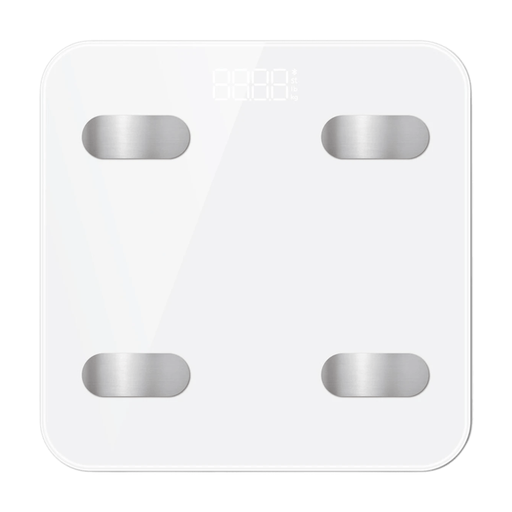
Why this model? Perfect for the whole family thanks to its large, stable 30x30 cm platform and multi-user management. It offers an in-depth analysis for those who want detailed tracking of their body composition.
It relies on four-electrode BIA technology to ensure the reliability of fundamental measurements, instead of overwhelming the user with a flood of derivative data.
A comprehensive analysis with 24 metrics and stable Bluetooth 4.2 connectivity for flawless data synchronisation.
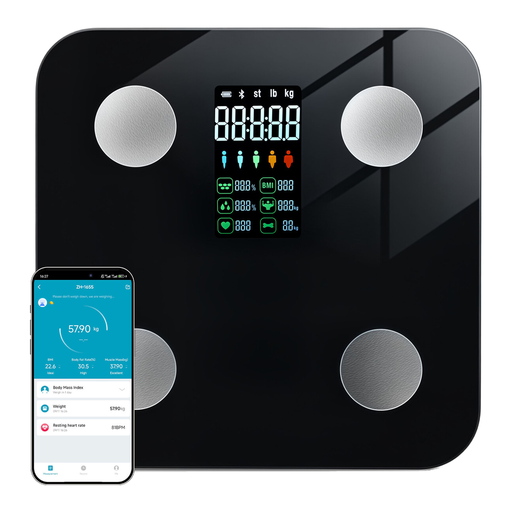
Why this model? Perfect for the user who loves instant visual feedback. Its colour screen displays key data (including heart rate) without you even having to pull out your smartphone for every weigh-in.
It doesn't make the user dependent on the app for a simple check-in. The colour LCD screen offers a much-appreciated level of autonomy for daily use.
Direct display of weight, body fat, and heart rate on its colour screen. It syncs with the Tuya app, a widespread smart home ecosystem.
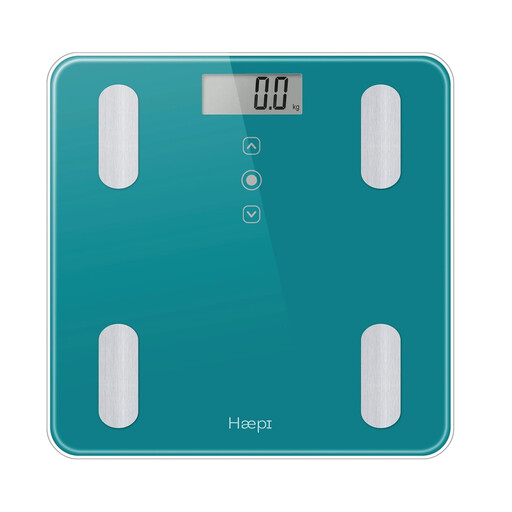
Why this model? For those new to body composition analysis who are looking for a reliable and straightforward device. It measures the essential metrics (fat, bone, and muscle mass, water, BMI) and that's it. No unnecessary frills.
It focuses on the accuracy of fundamental BIA measurements rather than offering an endless list of derivative data. This avoids the "the more metrics, the better" trap.
Ease of use and a clean design. It provides the essential data for meaningful health tracking, without overcomplicating things.
We have curated a complete, up-to-date selection of products that meet our strict selection criteria and current safety standards.
For reliable and consistent results, follow these three golden rules:
The vast majority of models operate via Bluetooth. The solution is simple: you open the app on your smartphone near the scale, and the data syncs. Wi-Fi, on the other hand, allows for automatic synchronisation without needing your smartphone nearby. In return, the initial setup can be more challenging, and the scale's battery life is often reduced. For most people, Bluetooth is more than sufficient and much more practical for daily use.
You should view the measurements from a body composition scale as estimates and trend indicators, not as a medical diagnosis. Their absolute accuracy can vary from one device to another. Their real value lies in tracking changes over time. If your body fat percentage steadily decreases over several weeks, that's a reliable indicator of progress, even if the absolute value isn't 100% accurate. Consistency is key.