
Livraison le jour même ou le lendemain

Qualité garantie

Débloquez vos offres de bienvenue: Livraison GRATUITE | Jusqu'à -80 % | 30 jours d'essai gratuits à JoyPlus
Téléchargez l'application
Customising your car is all about making a statement. In this arena, lighting plays a pivotal role. However, upgrading to LEDs can quickly become a headache. Between the dim, yellowish glow of stock bulbs and the risk of triggering a dashboard error message, it's easy to get overwhelmed.
This guide is here to light the way. As a product specialist at Joybuy, my mission is simple: to give you the keys to choosing the perfect blue T10 W5W LED bulb. A model that combines style, performance, and compatibility with your vehicle—with no unpleasant surprises. Together, we'll break down the essential criteria and present our top picks to simplify your choice.
Before you take the plunge, there are a few technical details you need to know. This is the secret to a seamless installation and a truly impressive look.
Modern cars are equipped with an on-board computer (OBC) that monitors all components, including the lighting. The catch? An LED bulb consumes far less power than a traditional halogen. The OBC, detecting this low power draw, may mistake it for a burnt-out bulb and trigger a warning.
To bypass this issue, the solution is simple: opt for a Canbus T10 bulb. These models include a built-in resistor that tricks the on-board computer by simulating the power draw of a stock bulb. This guarantees a "plug and play" installation with no pesky error lights to ruin the experience.
The T10 base, also known as W5W or 194, is a true Swiss Army knife of automotive lighting. It's found in:
Luminous intensity, measured in lumens (lm), is where performance truly counts. A 450 lm bulb will offer far superior visibility compared to a 280 lm model. For sidelights, aim for high brightness to ensure you are clearly seen. Conversely, for a car dome light, a softer intensity will be more comfortable.
Most cars operate on a 12V system. However, HGVs, motorhomes, and some commercial vehicles run on 24V. Choosing a model compatible with 12V-24V is the safest bet. It will effortlessly handle voltage fluctuations in the electrical circuit, which extends its lifespan. It's a true guarantee of robustness and versatility.
To help you move from theory to practice, here are three models that tick all the boxes: quality, performance, and compatibility.
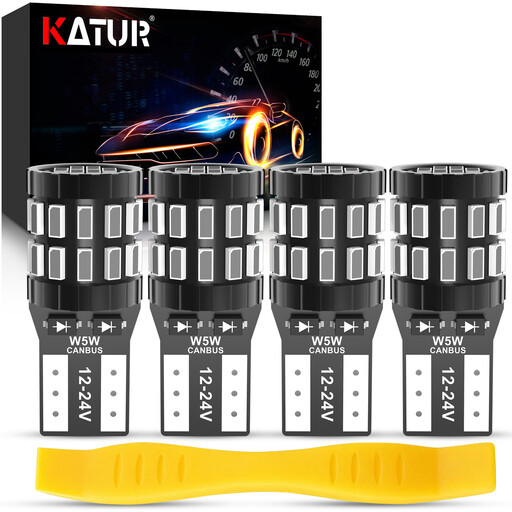
Key feature: Impressive light output. With 30 3014 LED chips per bulb, it delivers an intense 450 lumens of light with 360° coverage, leaving no dark spots. Its 12V-24V compatibility makes it universal, suitable for everything from city cars to HGVs.
Advantages:
Who is it for? For those seeking maximum brightness for their sidelights, whether on a car, motorbike, or truck.
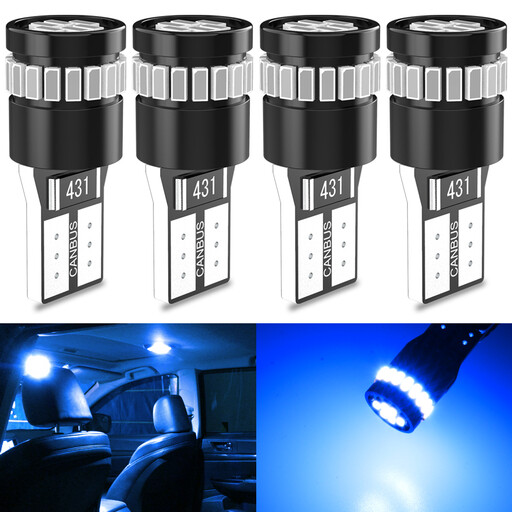
Key feature: An incredibly simple installation and a distinct "Ultra Blue" hue. Thanks to its compact (1:1 design) format, it fits into the original socket without any modifications. Its 24 3014 LED chips deliver a bright and uniform 280 lumens of light, perfect for the cabin.
Advantages:
Who is it for? Ideal for those who want a quick installation for their car's interior (dome light, glove box, etc.) and are looking for a very specific shade of blue.
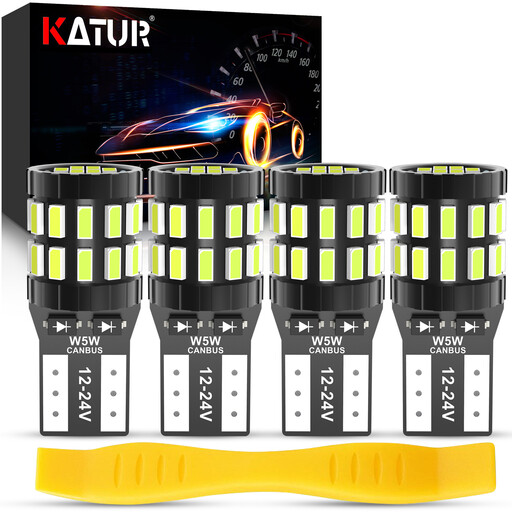
Key feature: The power of the first model, but with an exclusive colour: ice blue. Lighter and more modern, this hue stands out from classic deep blue. It boasts the same technical advantages: 450 lumens of brightness and 12V-24V compatibility.
Advantages:
Who is it for? For customisation enthusiasts who want to stand out with an original colour, without compromising on power and reliability.
This selection focuses on blue T10 W5W bulbs, but the world of automotive lighting is vast. Other colours, other bases, solutions for headlights or interiors... Feel free to explore our full catalogue to find the perfect fit.
? Discover our full range of blue LED lamps
1. Is a T10 W5W LED bulb difficult to install? No, the installation is child's play. It's a standard "plug-and-play" replacement: you simply remove the old halogen bulb and clip in the new LED. It takes just a few minutes, usually without any tools.
2. What is the Canbus system and why is it important for an LED bulb? The Canbus (for Controller Area Network bus) is your car's electronic brain: it constantly monitors all components. Since an LED consumes much less power than a halogen bulb, the system can interpret this low consumption as a fault and display a warning. A Canbus T10 LED bulb integrates a resistor that "tricks" the on-board computer to prevent any dashboard error messages. This is an essential feature for most vehicles manufactured after 2005.
3. Can I use a blue T10 W5W LED bulb for my number plate? Absolutely not. In many regions, number plate lighting is strictly regulated. For example, Article R313-12 of the French Highway Code states that the light must be white and non-glaring. Using blue bulbs for this purpose is therefore illegal on public roads. Reserve them for interior use (dome light, glove box), sidelights, or for off-road and private track use only.