
Livraison le jour même ou le lendemain

Qualité garantie

Débloquez vos offres de bienvenue: Livraison GRATUITE | Jusqu'à -80 % | 30 jours d'essai gratuits à JoyPlus
Téléchargez l'application
A blender lets you prepare a smoothie, sauce, soup, purée or frozen drink in just a few minutes. However, buying one can quickly lead to disappointment if you focus solely on the advertised power or an endless list of functions. An appliance that is too bulky may end up at the back of a cupboard, while a compact model may not be up to the job for a family.
To avoid unnecessary expense, the Joybuy Product Recommendation Officer offers a selection method based on how you actually use your blender, verifiable technical specifications and the everyday constraints of a French kitchen.
A high wattage alone does not guarantee a perfectly smooth texture. You also need to consider the shape of the jug, the type of blades, the maximum permitted capacity and the recommended continuous running time. A powerful blender designed to crush ice or blend frozen fruit needs a motor and blade assembly suited to the task. However, there is no need to exceed the limits stated in the instructions.
The stated capacity sometimes refers to the jug’s total volume rather than the recommended quantity for blending. To prepare several glasses, a family-sized capacity of 1.5 to 2 litres may be suitable. By contrast, a personal blender with a capacity of 475 to 710 ml is better suited to a single serving and is easier to store.
An appliance made up of numerous parts can quickly become inconvenient if the blades cannot be removed or if the components are not dishwasher-safe. Before buying, check which parts are removable, whether they are suitable for the dishwasher’s top rack and whether replacement parts are available. A blender that is easy to clean will naturally be used more often.
For simple smoothies, soft fruit and liquid preparations, moderate power may be sufficient. To crush ice or blend frozen fruit, seeds or thick mixtures, it is better to choose a more powerful motor and a pulse function. Wattage should be considered in relation to how you intend to use the blender, rather than in isolation.
A blender with multiple speeds lets you adapt the blending to each preparation: a gentle speed for incorporating ingredients, a high speed for achieving a smooth texture and a pulse function for brief bursts of extra power. Automatic programmes can make the appliance easier to use, but they do not remove the need to respect the maximum quantities.
A glass jug generally resists stains and odours well, but it makes the appliance heavier. Plastic or Tritan helps reduce the weight and is better suited to carrying, provided you follow the manufacturer’s recommendations.
A USB-C rechargeable blender is useful away from the kitchen, but its battery life and power are generally designed for small portions. Check the charging time, the stated number of cycles and the capacity you can actually use. A blender with a bottle should also have a leakproof lid that is genuinely suitable for transport.
For hot preparations, always follow the instructions. Some appliances must not be used with hot liquids, while a heated blender is specifically designed for this purpose. Never use an appliance that is not intended for this purpose with boiling-hot soup: pressure and heat can cause splashes. Always unplug the motor unit before cleaning and handle the blades with care.
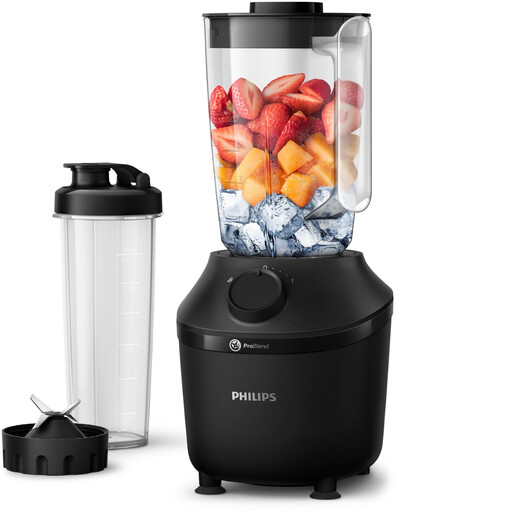
Why this choice suits this profile : Its 1.9 litre jug and simple controls cover everyday preparations, including drinks and recipes to share.
The stated capacity reduces the risk of choosing an appliance that is too small for several portions. The removable parts are listed as dishwasher-safe.
1.9 litre jug, pulse function, removable blades and bottle included.
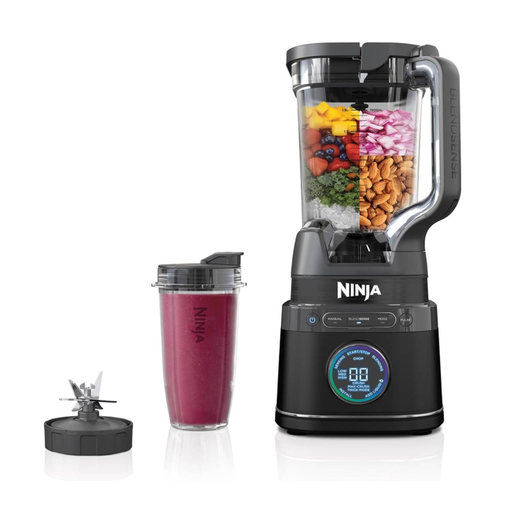
Why this choice suits this profile : It combines a large jug with two individual cups, plus manual and automatic settings for a wide range of preparations.
The combination of a 2 litre jug and a 680 ml cup means you do not need to buy a family-sized appliance and a personal blender separately.
1 200 W motor, 10 speeds, 15 stated functions and removable parts that are dishwasher-safe on the top rack.
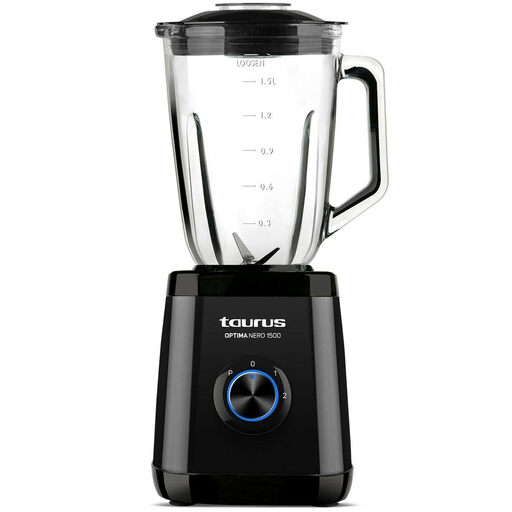
Why this choice suits this profile : Its glass jug and stated power are suitable for users who regularly prepare smoothies, purées or drinks with ice.
The pulse function and removable blades provide useful control over hard ingredients and simplify everyday cleaning.
Stated power of 1 500 W, 1.5 litre glass jug, five speeds and ice-crushing function.
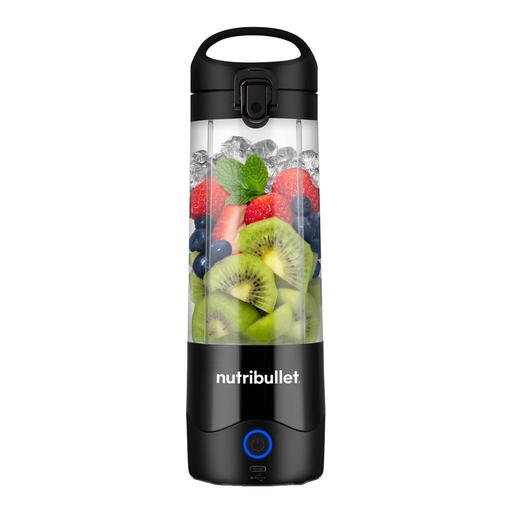
Why this choice suits this profile : Its 475 ml capacity and USB-C charging meet the needs of anyone who wants to prepare a drink away from home.
Its compact format means you do not pay for a large jug that would go unused. The stated short cycles also help define everyday use.
USB-C charging, 475 ml BPA-free Tritan cup and stated weight of 0.86 kg.
We have put together a complete, real-time-updated selection of products that meet these strict criteria and European safety requirements.
For one person, a 475 to 710 ml personal blender is particularly convenient. For several portions, choose a model with a capacity of 1.5 to 2 litres instead. If you use frozen fruit or ice, check for a pulse function and read the guidance on hard ingredients.
Not always. Some appliances prohibit it, while others specify a maximum temperature. Check the instructions before use. If the manufacturer does not approve hot liquids, allow the preparation to cool and never fill the jug beyond the recommended level.
Respect the usable capacity, alternate blending cycles with breaks and avoid running the appliance empty. Clean the removable parts immediately after use, dry them before storing and never immerse the motor unit in water. These simple habits reduce the strain placed on the motor and make everyday maintenance easier.