
Livraison le jour même ou le lendemain

Qualité garantie

Débloquez vos offres de bienvenue: Livraison GRATUITE | Jusqu'à -80 % | 30 jours d'essai gratuits à JoyPlus
Téléchargez l'application
Creamy smoothies, velvety soups, homemade sauces… there's no shortage of ideas for incorporating more fresh food into your diet. The blender has established itself as the ideal companion for this. The problem? Faced with an overwhelming number of options, it's easy to make a mistake. Too many users end up disappointed with a noisy, underperforming, or hard-to-clean appliance. To save you from this letdown, we've broken down the pitfalls to avoid and the essential criteria for finding the blender that truly meets your needs.
Before you even start comparing spec sheets, let's review the classic mistakes that lead directly to buyer's remorse.
To make the right choice, focus on the few features that truly make a difference in performance and durability.
As we've seen, the advertised wattage isn't enough. Look closely at the shape and number of blades. Robust, staggered stainless steel blades ensure a much more uniform blend. A "Pulse" (or Turbo) function is also a major asset for pulverising the toughest ingredients, like nuts or ice cubes. It's even a prerequisite for a blender capable of crushing ice effectively.
The choice of jar has a direct impact on use and maintenance:
The capacity should obviously match the size of your household: a 500 ml mini blender will suit a single person, while a family will opt for a 1.5 L model, or even larger.
Finally, each blender format is designed for a specific use:
To help you make your choice, here are a few models that stand out for their performance and practicality, each tailored to a specific user profile.
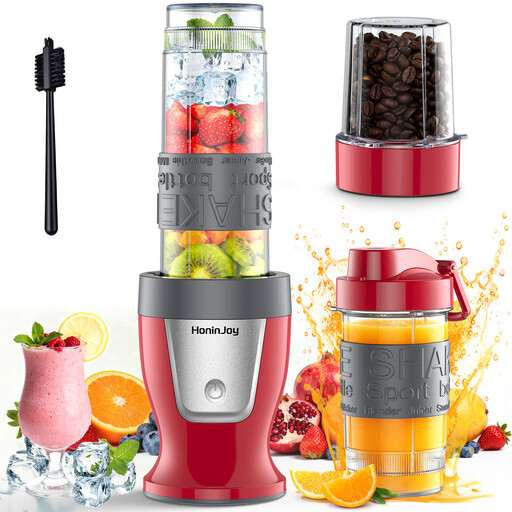
Why it stands out: Perfect for fans of the quick smoothie. Its two BPA-free travel bottles let you blend your drink and take it directly to the office or the gym. No more transferring!
It sidesteps the "cleaning nightmare": the bottles, lids, and blade assembly are all dishwasher-safe, which simplifies daily maintenance.
Compact versatility: It comes with a small grinder attachment for grinding coffee or spices. Enhanced safety: The appliance will only start if the jar is correctly locked onto the base.
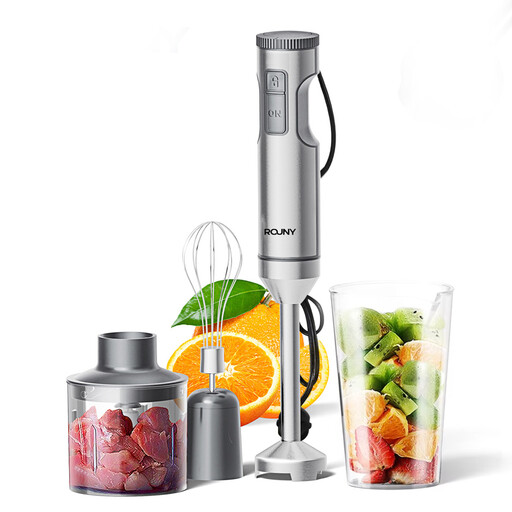
Why it stands out: The ally for those looking for more than just a blender. This immersion blender comes with a chopper, a whisk, and a measuring cup. It lets you prepare soups, sauces, purées, and even whip egg whites with a single motor unit.
It avoids the disappointing "all-in-one" trap. This isn't a machine that does everything halfway, but rather a powerful motor unit that connects to specialised accessories, each optimised for its function.
Precise control: Its variable speed dial allows for continuous power adjustment for perfect texture control. Stainless steel wand: Robust and hygienic, it allows you to blend directly in a hot pot without risk.
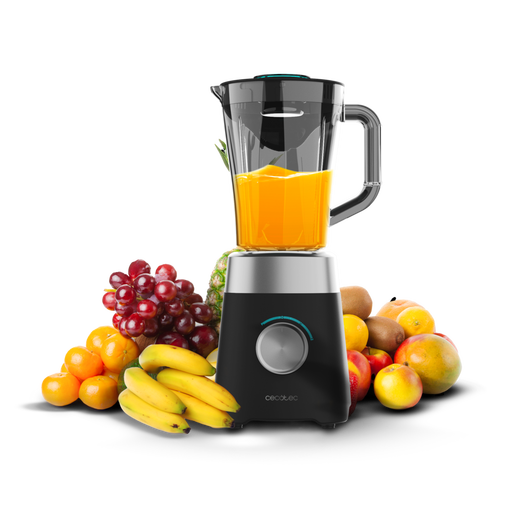
Why it stands out: With its large 1.5 L jar and heavy-duty motor, it's built for families. It prepares smoothies for everyone in a single batch, and its dedicated ice crush function makes it the perfect companion for summer drinks.
It debunks the "myth of raw power" by combining its 1300W with 4-edge, titanium-coated blades and a Pulse function. Proof that power is only effective when it's well-harnessed.
High performance: It can reach 20,000 rpm for incomparably fine textures. Ice crush function: A dedicated program to pulverise ice cubes without straining the motor.
We have curated a complete range of products that meet our selection criteria and current safety standards.
For everyday use (smoothies, cooked vegetable soups), a power of 500 to 800 watts is more than sufficient. However, for crushing ice, blending frozen fruit, or grinding nuts and seeds, aim for a model with 1000W or more, and make sure it has robust blades and a Pulse function.
Absolutely, and for several reasons. A blender with a glass jar is more resistant to scratches, doesn't retain odours or colours (goodbye to tomato sauce or turmeric stains!), and is considered healthier. It also handles thermal shock better, although it's still not recommended to pour boiling liquid into it. Its weight is its main drawback, but for an appliance that's meant to stay on the countertop, it's also a guarantee of stability.
The simplest trick is self-cleaning. Immediately after use, fill the jar halfway with warm water and a drop of washing-up liquid. Run the Pulse mode for 30 seconds, empty, and rinse. That's it! For a thorough clean, choose models with a removable blade assembly and where all components (except the motor base, of course) are dishwasher-safe.