
Livraison le jour même ou le lendemain

Qualité garantie

Débloquez vos offres de bienvenue: Livraison GRATUITE | Jusqu'à -80 % | 30 jours d'essai gratuits à JoyPlus
Téléchargez l'application
Far more than just a piece of fabric, a blackout curtain is a true ally for achieving restorative sleep, preserving your privacy, and even controlling your home's indoor temperature. Yet, in a market saturated with unkept promises, technical jargon, and marketing claims, it's easy to get lost and make the wrong choice.
As a Product Specialist at Joybuy, my mission is to help you see things more clearly. Let's forget the jargon. We'll focus on the criteria that truly matter to find THE curtain that will meet your expectations, with no unpleasant surprises upon unboxing.
Before you start shopping, let's review the most common mistakes to avoid any disappointment.
To avoid these pitfalls, here are three technical criteria to examine closely.
This is the key indicator. It depends on the weaving technology and, to a lesser extent, the colour.
Triple-weave technology is an excellent benchmark: it involves weaving a black thread between two layers of fabric, significantly improving opacity and thermal performance.
The "curtain header" (the hanging system) determines not only the installation but also the final aesthetic look.
A good blackout curtain is almost always an excellent thermal curtain. Thanks to its density, the fabric acts as an insulating barrier: it retains heat in the winter and keeps rooms cool in the summer. The result: real savings on your heating and air conditioning bills.
Similarly, this thick fabric acts as a noise-reducing curtain. Let's be clear: it won't turn your bedroom into a recording studio. However, it can significantly dampen street noise, conversations from passersby, or traffic, creating a much calmer and more serene atmosphere.
To help you move from theory to practice, here are a few models tailored to specific needs.
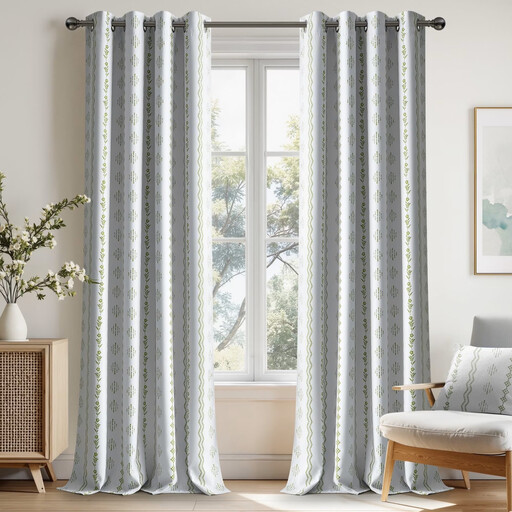
Why we love it: Perfect for bedrooms, whether for adults, children, or shift workers. It guarantees total darkness, even in broad daylight, for truly restorative sleep.
Its 100% blackout design eliminates any risk of confusion with a simple light-filtering curtain. Here, the darkness is absolute.
It combines perfect blackout capabilities, good thermal insulation, and a subtle bohemian decorative touch.
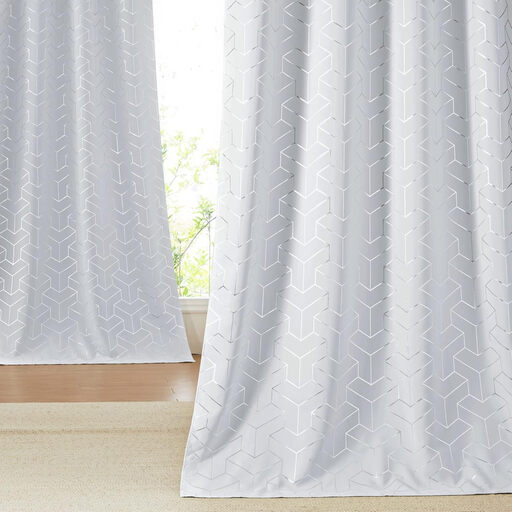
Why we love it: The perfect ally for living areas. It combines a contemporary design with effective blackout (85-95%) to control light and preserve privacy, without plunging the living room into darkness.
Its grommet system, compatible with most curtain rods, eliminates any installation headaches.
A quick installation for an immediate, flawless look, enhanced by a pattern that energises the decor.
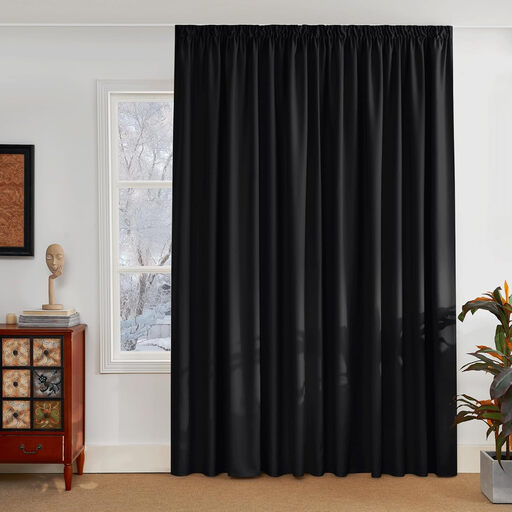
Why we love it: At 3 metres wide, it's tailored for picture windows, French doors, or even to be used as a room divider. It ensures perfect coverage and effective thermal insulation.
No more standard curtains that are too short! This extra-wide model covers non-standard dimensions, while its pencil pleat heading allows for precise, to-the-inch adjustments.
The solution for XXL openings, with the installation versatility of a pencil pleat header.
Discover our full selection of products that meet our demanding selection criteria.
For perfect blackout, the curtain must extend well beyond each side of the window.
Yes, a dense, heavy sound-insulating curtain genuinely helps to dampen external noise. Its mass, especially with triple-weave technology, helps absorb some of the sound waves. It's not a professional soundproofing solution, but the difference is noticeable in urban environments: it reduces echo and muffles background noise for a more subdued atmosphere.
The effectiveness of a thermal curtain depends primarily on its material and density (with triple-weave being a bonus), far more than its colour. A thick fabric, regardless of its shade, will create an insulating barrier. However, for blocking light, dark colours (black, charcoal grey, navy) remain more effective than light shades, assuming the weaving technology is the same.